
by Freddie Walters
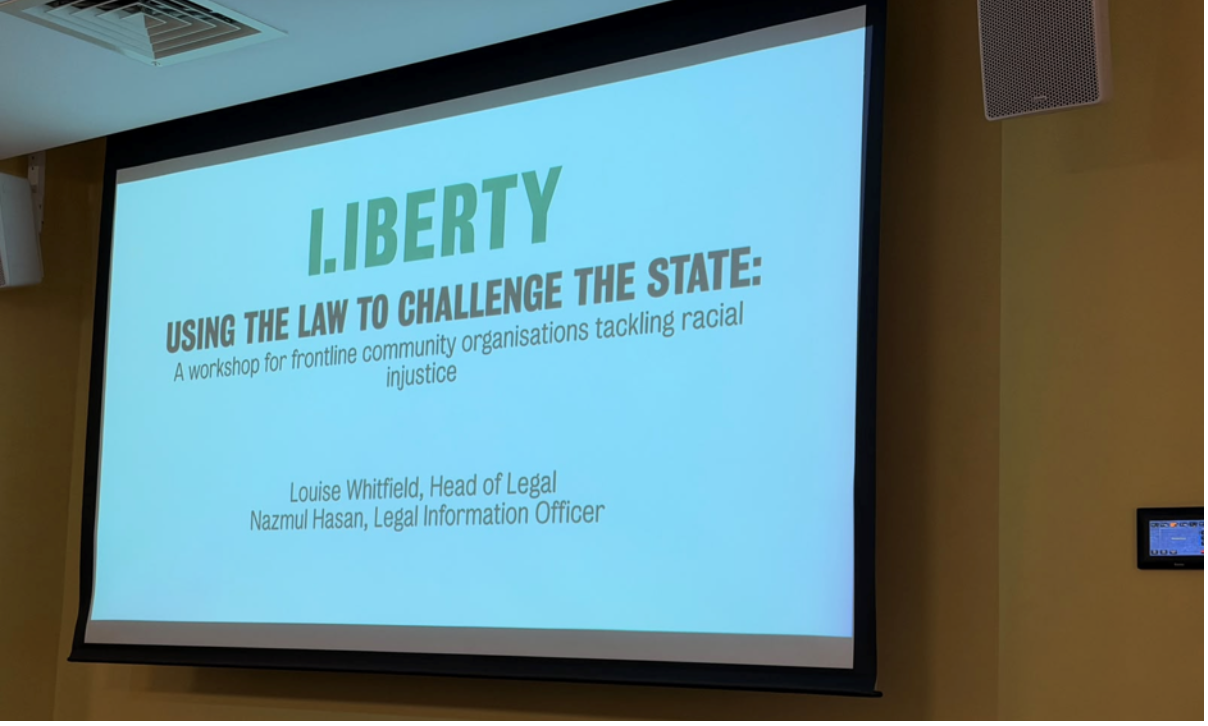
On 30 June 2026, we attended a community workshop, ‘Using the Law to Challenge the State’ delivered by human rights organisation, Liberty. The workshop was organised by Racial Equality Network and Bradford City of Sanctuary as part of their Paths to Power programme of events which Right to Remain was also part of, when we delivered our own session Building Collective Safety Against Racist Immigration Enforcement. The aim of the workshop was to show how strategic litigation and community lawyering can be powerful tools for community organisations tackling racial injustice.
What is strategic litigation?
Litigation is the process of bringing legal cases to the courts. Therefore strategic litigation means bringing carefully selected court cases that are designed not only to help the people involved, but also to change the law, influence policy, or draw attention to important social issues. For example, a legal challenge to an unfair immigration policy may not only help the individual bringing the case but also lead to changes that benefit many others in the same situation.
What is Community-Driven Lawyering?
Community-Driven Lawyering is an advocacy model originating from the US centering the needs, knowledge, experiences and expertise of communities/representative community organisations in any legal work. For example, lawyers might work alongside a group of migrants to challenge unsafe housing conditions. To do this they would consult the wider community, allowing their input to shape the legal strategy and overall goals for the campaign.
Lessons from Liberty
Liberty shared examples of their own work (as well as the work of the other organisations who attended) to demonstrate the real-world positive impact legal action can have when done properly. A strong example discussed in the workshop was Liberty and Kids of Colour’s challenge to the Manchester Caribbean Carnival banning letters. Since 2006, Greater Manchester Police had sent letters banning people from attending the Carnival, based on vague and unclear criteria, including perceived links to gangs or serious youth violence. Kids of Colour, supported by Liberty, challenged the practice and raised concerns that it was discriminatory, opaque and unfair. Following the threat of judicial review, Greater Manchester Police confirmed that it would not send the banning letters that year. Despite Kids of Colour knowing the policy was unfair they didn’t have the necessary resources to progress this knowledge into legal action. However, through their connection with Liberty they were able to work together and challenge the council. This highlighted the importance of legal education and building connections between legal professionals and community groups.
The workshop then went into detail on the actual practicalities of challenging the state using the law. We learned about other different potential avenues of legal action such as:
- Judicial Review (JR) – A legal challenge to the way a decision has been made. A judicial review is not about whether a decision was correct, but whether the law or procedure has been correctly applied. For example, someone might ask a court to review a Home Office decision refusing them leave to remain to see if the decision was made fairly following the proper procedure.
- Test Cases – Legal cases that are brought to clarify or change the law, creating a precedent (legal rule) that can help others in similar situations. For example, a case challenging a new immigration rule could help clarify how that rule should apply to other similar cases.
- Civil Claims – Cases brought by individuals or organisations to seek a legal remedy (solution), such as financial compensation or a recognition of wrongdoing, rather than to prosecute a crime. For example, a person unlawfully detained by the Home Office might bring a claim for compensation.
- Death Inquests – Independent investigations into a person’s death to clarify facts such as the cause or timing of death. For example, if someone died while in police custody, a death inquest could be used to see if the police in any way caused that person’s death.
We also heard about the different potential grounds for legal action. Before taking a case to court lawyers must identify the legal basis / reason (grounds) for the claim. Some examples of potential grounds for a claim given in the workshop were:
- Illegality in public body decision making – A common ground for judicial review, this is when a public body (i.e. the Home Office) acts outside of the powers given to it by law or fails to follow proper procedure. For example, the Home Office may ignore relevant evidence when deciding an asylum claim.
- Breach of the Equality Act 2010 – When someone is treated unfairly because of a protected characteristic , such as race, disability, sex, or religion. For example if a disabled asylum seeker is not provided with appropriate adjustments during the asylum process.
- Breach of the Human Rights Act 1998 – When a public authority interferes with a person’s rights protected by the European Convention of Human Rights. For example, removing someone to a country where they face a real risk of torture or inhumane treatment could be a breach of human rights.
As important as the practical understanding of the law is, we were reminded throughout the day of the significant implications legal action can have. Taking legal action is a massive commitment of time, finances and stress which can be incredibly challenging for the individuals going through it. Therefore, despite the excitement of wider social change, it should always be recognised that there are real people at the centre of it all and their wellbeing and livelihoods are at stake so the decision to take legal action should not be taken lightly.
It was emphasised that to achieve the best outcomes, these two concepts must be used in harmony. Strategic litigation is a powerful tool with often the threat of legal action being enough to create serious change and shine a light on injustice. However, historically the law has been inaccessible, with lawyers being out of touch with the lived experiences of their clients. Therefore, the importance of viewing any strategic litigation through a Community-Driven Lawyering approach cannot be understated. The communities affected should be consulted directly to ensure they can make informed decisions and are not patronised. Lawyers aren’t saviours, they are equals working with individuals and organisations to have the most positive impact possible.
Conclusion
The value of the workshop came in recognising that on its own, the law isn’t a silver bullet to tackle all injustice and that any legal action should be carried out in a way that is sensitive to and inclusive of the communities it aims to fight for. Therefore, a key theme throughout the workshop was bridging the gap between lawyers and community workers bringing together legal experience with a true and accurate understanding of the lived experiences of the communities most affected by injustice.
It is often painfully obvious that there is a grave misalignment between the legal support the community needs and the legal support actually available. Therefore another key aim of the workshop was equipping community organisations with the skills and resources to best help their service users access legal advice as efficiently and effectively as possible.
Key Takeaways
- Legal action can be a powerful tool in inciting social change.
- It is important to not lose sight of the real lived experiences of the communities’ legal action is attempting to help. All action should be community-driven.
- Community organisations play a vital role in bridging the gap between legal professionals and the communities who would benefit from legal action.
- There are many potential avenues of legal action so it is important that even if you only think there is a small chance of your case being successful, you should still reach out for legal advice at the earliest opportunity.
- The legal process can be incredibly strenuous on individuals and organisations and this should always be recognised when going down the legal action route. Therefore, legal education and supporting organisations play a vital role in making the process more manageable and allowing individuals to achieve the best possible outcomes for themselves and their communities.









Discussion: