

The UK immigration system is a maze. With constant changes to the law, and more and more complicated requirements, it can be hard to figure out which routes to take to make an application and to understand how to present your case. If you are a migrant who is experiencing domestic abuse, this can make it overwhelming to think about a safer future away from abuse, particularly when you have little or no access to your personal documents to understand your own immigration status and rights.
If you are experiencing domestic abuse, or are supporting someone in this situation, our new guide, which forms part of our toolkit, can be used as a resource to find and share information on the different types of applications that could be made, as well as useful steps to help you prepare your case.
There are some immigration routes that exist specifically for migrants who have experienced domestic abuse, but not everybody can apply for all of them so it is important to think ahead and consider longer-term immigration options when it is safe to do so.
If you are in immediate danger, call 999. If you need support you can contact the National Domestic Violence helpline on 0808 200 0247. The helpline is free and is open 24 hours a day.
What can I apply for?
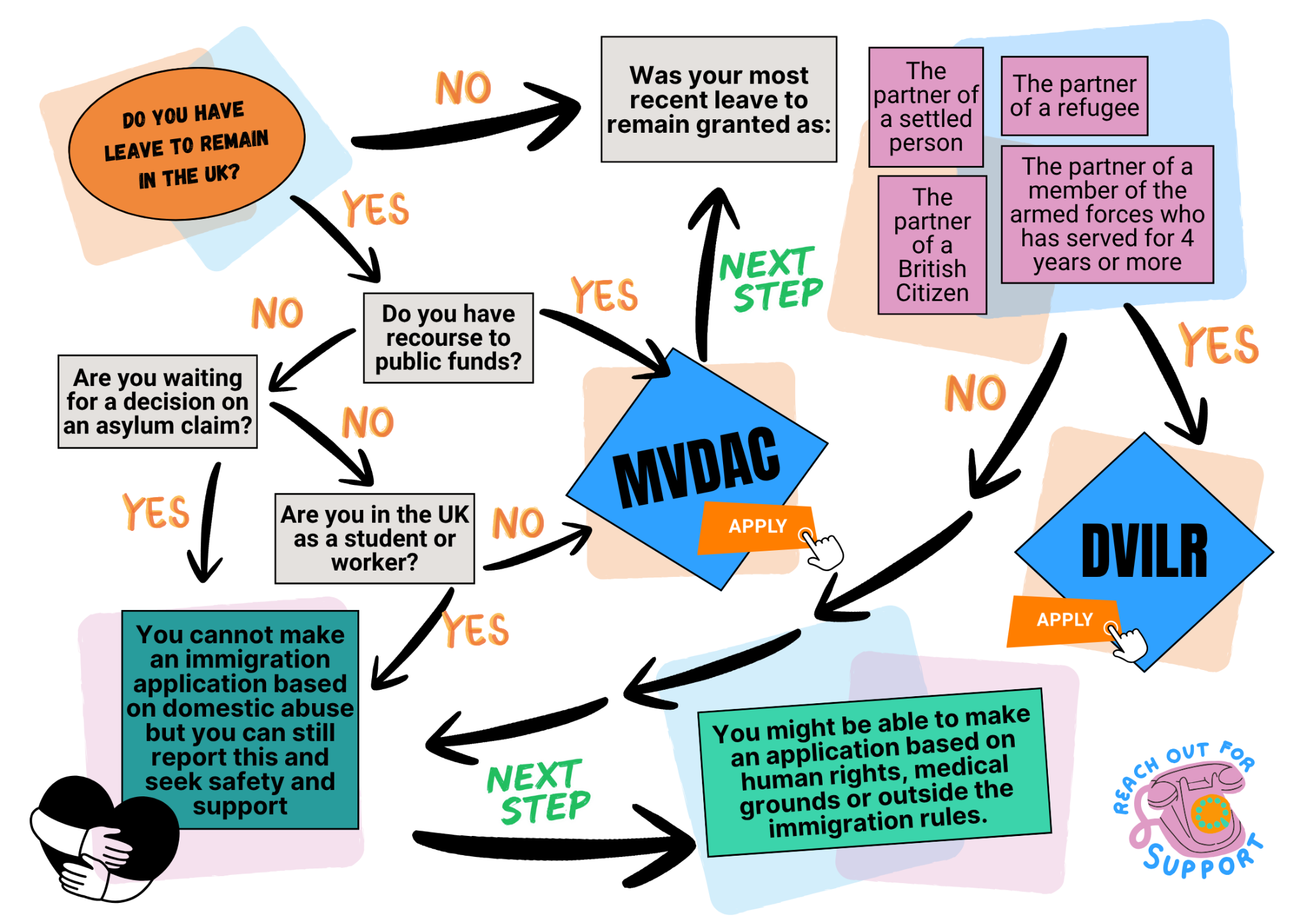
We explain the two main applications for people who have experienced domestic abuse in detail in the new guide. We have also created a flowchart to try and help you understand whether you will be able to apply for either route. If you can’t apply for these routes, there might be other immigration applications that you can make – there is information on different routes in our toolkit that is being updated regularly, and we outline some options in the new guide.
Some Abbreviations
‘DVILR’ is used to refer in short to an application for indefinite leave to remain in the UK for people whose relationship with a partner has broken down due to domestic abuse.
‘MVDAC’ refers to an application for temporary leave to remain in the UK that you can make if you have experienced domestic abuse, which gives you 3 months to apply for public funds to access housing and financial support, and to make a further application to remain in the UK.
For DVILR applications, there is no specific list of evidence that you must submit, but there are some documents that are more likely to be useful than others. Your case might be accepted with just one document, or you might have lots of pieces of evidence to submit. The Home Office has to consider all the evidence you send when they make a decision on your case and decide whether it is more likely than not that your relationship broke down because of domestic abuse.
We go through the different types of evidence that you could submit in the guide, as well as explaining how to find out your immigration status, and what you can do if you don’t have much evidence or any of your personal documents.









Discussion: