
Last updated: 14th July 2026
This guide is for people who have experienced domestic abuse and are worried about their immigration status, money, housing, safety or support in the UK.
You do not have to read everything at once. Some of this information may feel difficult or upsetting. You can take your time, stop and come back to it later, or read it with someone you trust.
If you are in immediate danger, call 999. If you need support you can contact the National Domestic Violence helpline on 0808 200 0247. The helpline is free and is open 24 hours a day.
Domestic abuse is not only physical violence. It can include emotional abuse, threats, humiliation, sexual abuse, financial control, being isolated from other people, being monitored, or being stopped from making your own choices.
It can also include someone using your immigration status against you. For example, they might threaten to report you to the Home Office, refuse to give you your documents, stop you accessing your UKVI account, control your money, or tell you that you cannot get help because of your immigration status.
This guide explains some immigration routes and support options that may be available to people who have experienced domestic abuse. There is a lot of information on this page – take your time and remember that what you’re feeling is valid and you deserve safety and support.
In this guide, we use the words domestic abuse rather than domestic violence, because abuse is not only physical violence. Some Home Office guidance uses the words “victim” or “survivor”. In this guide, we usually say people who have experienced domestic abuse. You may use different words for yourself, and that is okay.
On this page you will find the following information:
- What is domestic abuse?
- Domestic Violence Indefinite Leave to Remain (DVILR)
- How to make an application under DVILR
- Dependent children
- Fee Waivers
- Action Section: Evidence for fee waivers
- If you don’t have access to your UKVI account, or if someone else can access this
- What evidence do I need to make an application under DVILR?
- How will the Home Office assess my evidence?
- Other reasons you may need to stay in the UK
- Action Section: How can I check what visa or immigration permission I have?
- What happens after you apply?
- Getting temporary support through Migrant Victims of Domestic Abuse Concession (MVDAC)
- What can I apply for?
- If you are outside the UK
- Legal Aid
- If you are seeking asylum and experiencing domestic abuse
- Organisations that can help
What is domestic abuse?
Domestic abuse is when someone close to you behaves in a way that harms, controls, frightens or traps you.
It does not have to be physical violence. Some people experience physical abuse, but others may experience abuse that is emotional, sexual, financial, psychological or controlling. Domestic abuse is defined in the Domestic Abuse Act 2021 which you can learn more about here.
Domestic abuse can include:
- being threatened, shouted at, humiliated or made to feel afraid
- being stopped from seeing friends, family or support workers
- being controlled through money, housing, food, phones, documents or transport
- being forced or pressured into sex or sexual contact
- being monitored, followed or checked up on
- being told what to wear, who to speak to, or where you can go
- having your passport, BRP, eVisa details or other documents taken away
- being threatened with the Home Office, police, social services or deportation
- being made to feel that you cannot leave because of your immigration status
If you feel like you are being controlled, isolated and made to depend on someone else then you might be experiencing coercive control which is a form of domestic abuse. You can read more about recognising the signs of coercive control here.
Domestic abuse can happen in a relationship, after a relationship has ended, or within a family. It is not always carried out by a partner. It can also be carried out by a former partner, spouse, parent, adult child, in-law or another family member.
For migrants, immigration status can be used as part of the abuse. Research shows that having insecure immigration status is used as a tool of domestic abuse. Some migrant women will be dependent on the abuser for their immigration status – for example if they are on a spousal or partner visa. Sometimes an abuser can also stop someone from proving their immigration status by taking their documents or access to online status.
Because of the No Recourse to Public Funds (NRPF) condition on most visas in the UK, people experiencing domestic abuse have limited options in accessing support. If you have leave to remain in the UK with NRPF it means that you cannot access public funds which include a large number of welfare benefits and housing assistance. You can find out what public funds are here.
The NRPF condition is part of the hostile environment, which makes people more vulnerable to domestic abuse by linking their rights to their immigration status. This can make it harder to ask for help, leave safely, access money or housing, or understand your options.
Abuse most often happens inside a home, without other people knowing about it. You do not need to have reported the abuse to the police for it to be real. You do not need to have physical injuries. You do not need to have left the relationship already. You may still be unsure about what has happened, or worried about what will happen next. You can take things one step at a time.
Domestic Violence Indefinite Leave to Remain (DVILR)
If you have experienced domestic abuse, and your relationship breaks down permanently as a result, you may be able to make an application to settle in the UK in your own right, without any dependency on your partner. This type of application is called ‘Domestic Violence Indefinite Leave to Remain’ which is shortened to DVILR.
The rules for DVILR applications are found in Appendix Victim of Domestic Abuse (VDA) of the Immigration Rules. These Rules can be confusing but it is important to understand them before making an application to make sure that you qualify for any particular route by meeting the requirements. The rules explain who can apply for indefinite leave to remain (ILR) due to a relationship breakdown that happened because of domestic abuse. Not everyone will be able to apply for DVILR – this depends on their current or most recent immigration status.
You can apply for permission to stay in the UK due to domestic abuse if your most recent grant of leave to remain was as:
- The partner of a British citizen,
- The partner of a member of the armed forces who has served at least 4 years
- The partner of a settled person (such as indefinite leave to remain, or settled status under the EUSS)
- The partner of a person with refugee status
From 8th October 2026, you will also be able to apply for permission to stay in the UK due to domestic abuse if:
- you are over 18 and;
- your most recent grant of leave to remain was as the dependent child of the same categories listed above and;
- Your relationship with your parent has broken down because of domestic abuse from your parent or their partner.
You cannot apply for permission to stay due to domestic abuse if you are:
- In the UK to get married
- In the UK as a dependant of your partner, who is on a student or graduate visa
- In the UK as the partner of someone with humanitarian protection leave
The relationship breakdown does not need to happen during the last grant of leave. This means that you do not have to have valid leave at the time of the application. It is possible to apply if your leave has expired, as long as your last grant of leave was one of those that permits access to the domestic abuse route.
How to make an application under DVILR
To make an application for indefinite leave to remain under the DVILR, you need to use the SET (DV) form which is an online form. After your submit the form, you will be asked to give your biometrics – have your fingerprints and photo taken – and give proof of your identity to the Home Office.
Many people cannot prove their identity, but if you are making a DVILR application, this should not mean that your application is refused. Controlling someone’s documents can be a form of abuse, and many people leaving situations of abuse do not have access to their own identity documents. If you can’t prove your identity, then an explanation can be provided and the Home Office should consider this.
Immigration applications usually have suitability requirements, which are reasons an application can be refused, mostly relating to criminality, character, debt and immigration history. In DVILR applications, there is an exception relating to immigration history which means that if you have been in the UK without leave to remain or don’t currently have leave to remain, it will not be a reason to refuse your application. This means that you can make an application even if your leave to remain has expired.
Most types of applications for settlement (indefinite leave to remain) require you to prove that you speak English at a certain level and pass a Life in the UK test. If you are the main applicant under the domestic abuse route, you do not need to prove your knowledge of English or Life in the UK.
Dependent children
A dependent child is a child who is applying for leave to remain based on a parent’s application. In some cases, a child may need to apply separately from their parent under the domestic abuse route. For example, the parent may already have applied earlier, the child may not have been included in that application, or the child may need to make their own application later.
A child of a Victim of Domestic Abuse who is not applying at the same time as their parent should use the SET (DV) form and explain their circumstances.
Dependent children applying under DVILR do not need to pass an English language test, the life in the UK test or meet any accommodation or income requirements.
A child can’t be granted DVILR by themselves unless a parent has already been granted settlement on this route. If a child is applying for DVILR without a parent, the Home Office will consider whether they should be granted leave to remain outside the rules or on another route. We explain what might be considered below.
Fee Waivers
There is normally a fee for a settlement application (the current fee should be listed here), but it is possible to apply for a fee waiver, so that the application is free, if you cannot pay for a DVILR application.
In order to qualify for a fee waiver, you must provide evidence that shows one of the following:
- You do not have adequate accommodation or a way to get this
- You cannot cover your basic living costs
- Paying the fee would harm your child’s wellbeing
You are not expected to borrow money or rely on someone else to pay the fee for you. If the Home Office thinks there is not enough information in the fee waiver request, they should ask for more information before making a decision. If the fee waiver is refused, you should normally be given 10 working days to pay the fee, and if you pay in time the application keeps its original date (this is important for 3c leave which we explain below).
ACTION SECTION
Here are suggestions of types of financial evidence you might need to show that you cannot afford the fee:
- Bank statements
- Utility bills
- Payslips
- Tenancy agreements
- Supporting letters from council or a refuge where you been staying
- Read our Toolkit section on what a letter of support should contain
- Evidence of any other support you have received
If you are supporting someone with an application, you can help them to request copies of their bank statements or other documents. You can also help them to write out a summary of their income and spending so that this is clear and accurate for their application. This is normally listed as monthly or weekly income and spending and should include things like rent, food, transport, clothing, childcare, utility bills or phone bills, and any credit or debt repayments.
Read more about evidence needed for fee waiver applications here.
If someone is receiving support from friends or from an organisation, you can help them to request a clear and detailed letter confirming what support is being provided, for how long and since when, and why. The letter should confirm who is writing it, and how they know the person. If possible, they should provide a copy of their ID and if they are a professional, they should write this on letter-headed paper.
If you don’t have access to your UKVI account, or if someone else can access this
Domestic abuse often involves control, which can include restricting or controlling access to immigration status documents, like your UKVI account, your email account or letters. You can take back control of your accounts and tell the Home Office to send information to somewhere else.
If someone else may have created, accessed, or managed your UKVI account, or if you are not sure who has access, you should contact UKVI straight away so you can secure your account and receive updates directly.
It is important that if you make an immigration application, you use contact details that are secure. This might mean creating a new email address that only you have access to, and which you can use to set up a UKVI account and receive updates on your application. If you are unsure how to do this you can ask a friend or support worker to help you with this.
What evidence do I need to make an application under DVILR?
You will need to be able to evidence what has happened when you submit your case. A lot of people think that evidence means important documents which can make it feel scary, but there are a lot of things you can do to explain your case. Understanding what could be useful and how to get this can help you think about practical steps you can take to prepare for an application.
It can be more difficult to think about evidence if you feel unsafe and overwhelmed. If you are trying to gather evidence while you are still experiencing abuse, or you have left documents behind when you fled, remember that your safety is the most important thing. Your own explanation of what has happened can be enough by itself, and you can request copies of important documents.
You might also find it difficult to speak about what happened, or be scared to explain your situation or ask for help. Take it step-by-step, and think about what could help you explain what has happened. If you are supported by friends or professionals, then you can ask them to help you organise things, write your story down or ask for copies of any documents.
There is no fixed list of evidence for a domestic abuse application but there are some documents that are likely to be more useful than others. The Home Office should look at all the evidence together and should not focus on just one piece of evidence when making a decision.
Summary of evidence you might use
You may have several types of evidence, only one type, or very little documentary evidence. The Home Office should look at everything together, including your own account.
| Type of evidence | Examples | How it may help | What to remember |
| Your own account | A personal or witness statement explaining what happened | Helps the Home Office understand the abuse, how it affected you and why the relationship broke down | Your statement may be enough by itself. It is okay if you cannot remember every date or detail |
| Police evidence | Incident reports, crime reports, cautions, arrests, charging decisions or a Clare’s Law disclosure | May show that abuse was reported, investigated or identified by the police | You do not need to have reported the abuse to the police. No arrest or prosecution does not mean the abuse did not happen |
| Court evidence | Criminal convictions, court findings, non-molestation orders, occupation orders or protection orders | May provide official confirmation of abuse, risk or protective action | An order can still be useful even if the court did not make a final finding that abuse happened |
| Domestic abuse service evidence | Letters from a refuge, domestic abuse worker or Independent Domestic Violence Adviser | May explain the abuse, risks identified and support you have received | A detailed letter should explain who wrote it, their experience and how they know about your situation |
| Risk and safeguarding assessments | MARAC referrals, DASH or DARA assessments, MASH records or child protection plans | May show that professionals identified domestic abuse or concerns about safety | These records may be helpful even if you do not have a copy of the full assessment or meeting notes |
| Social care evidence | Letters or assessments from a social worker, children’s services or CAFCASS | May explain what professionals observed, assessed or did to support you or your children | Professional involvement does not mean that you have done anything wrong |
| Medical evidence | GP records, hospital records, mental health records, medical letters or evidence of treatment | May show injuries, health problems or the physical and emotional effects of abuse | You do not need to have physical injuries. Not having medical evidence should not count against you |
| Other professional evidence | Letters from a housing worker, teacher, caseworker, counsellor or support worker | May confirm what you disclosed, what they observed and what support they provided | These letters can be particularly useful when considered alongside your statement and other evidence |
| Evidence from friends or relatives | Statements from people who saw or heard abuse, supported you or noticed its effects | May show what happened or how the abuse affected you | A person can still provide useful evidence even if they did not directly witness the abuse |
| Messages and other personal records | Texts, emails, social media messages, photographs, call records or transcripts | May show threats, control, harassment or a pattern of behaviour | Keep dates and context where possible. Only gather or store evidence where it is safe to do so |
You do not need every type of evidence in this table. Your safety comes first, and you should not put yourself at risk to obtain documents. You can explain why evidence is missing or difficult to get.
How will the Home Office assess different types of evidence?
The Home Office Caseworker Guidance explains which types of evidence someone might submit and how the evidence should be assessed when making a decision. In its guidance, the Home Office groups evidence into different categories. These categories only explain how the Home Office may look at each piece of evidence. They are not a judgment about what happened to you, how serious the abuse was, or whether you should be believed.
- Conclusive evidence means the Home Office will usually accept this evidence as enough to show that domestic abuse happened.
- Compelling evidence means the Home Office may give this evidence a lot of importance, especially if it is clear and detailed.
- Less compelling evidence may not be enough on its own. However, it can still be useful when the Home Office looks at it together with your statement and other evidence.
Some official documents may be treated as conclusive evidence. For example, this may include a criminal conviction or a clear decision from a court. This is because the police or court have already looked into what happened and made an official decision.
Other evidence may be called compelling or less compelling. The Home Office may look at:
- who wrote or created the evidence (if they are a professional, then their experience and qualifications)
- how that person knows about the abuse
- how much detail the evidence gives
This does not mean that the evidence is not important. It also does not mean that the Home Office does not believe the person who provided it.
The Home Office should look at all the evidence together. Different pieces of evidence can support each other and help explain what happened.
Your own statement is also evidence. A clear and detailed statement may be enough on its own, especially if you explain why you cannot provide other evidence.
What does “balance of probabilities” mean?
The Home Office must decide whether it is more likely than not that your relationship broke down because of domestic abuse. This is called the standard of proof.
You do not have to prove the abuse in the same way as a criminal court case. You do not need a police report, prosecution or criminal conviction. Police evidence is only one kind of evidence.
The Home Office should look at all the information together. This can include:
- your own statement
- letters from support workers or professionals
- medical records
- court or police documents
- messages, photographs or statements from other people
For some people, their own statement may be the only evidence they can provide. A clear and detailed statement may be enough, especially if you explain why other evidence is not available.
We explain more about preparing a witness statement in our here.
What if I do not have much evidence?
Experiencing abuse can make it difficult to collect evidence or talk about what happened. You may feel afraid, ashamed or embarrassed. You may not trust the police or other authorities. You may also find it difficult to remember events clearly or explain them in date order.
The Home Office should consider how abuse and trauma may have affected:
- what you can remember
- how you explain what happened
- when you first told someone
- whether you were able to ask for help
- whether you were able to keep or collect documents
If some information is missing or unclear, explain why as well as you can. The Home Office should consider your explanation and should not expect every person to have the same kind or amount of evidence.
What if I stayed or returned to the relationship?
Many people cannot leave an abusive relationship quickly or safely. Some people leave and later return. Others may still live with the person who abused them.
There may be many reasons for this. You may be scared, threatened, worried about how leaving could affect your immigration status, concerns about children, being financially dependent, problems with housing, isolated from family or friends and hoping that the abuse will stop. Whether or not you stay or return does not determine whether abuse has happened or whether the relationship has broken down.
It is not your fault that you experienced abuse. It is also not your fault if leaving was difficult or took time.
Other reasons you may need to stay in the UK
You may have reasons to stay in the UK that are separate from your domestic abuse application. These may relate to your family, your children, your health, your life in the UK or what could happen if you returned to your country. These reasons may involve your human rights. We explain what human rights are, including family and private life here.
To help you think about what might be relevant in your DVILR application, you could ask yourself:
- How long have you been in the UK? Do you have strong networks in the UK such as friends, family, community groups?
- Do you have children? If so, are they in the UK and do they live with you? How old are they? Were they born in the UK? Do they have any additional needs?
- Do you have other family members in the UK (mother, father, siblings)? Do you have a good relationship with them? Are they involved in your children’s lives? Do they require your support?
- Do you have family in your home country? If so, are you in contact with them? Have you children been there and do they speak your language? Would they be able to support you if you returned?
- Do you have any medical conditions or care needs? Do your family members have any medical conditions or care needs? If so, do you require ongoing treatment or support?
- Is there anything that would make it difficult for you to live in your home country?
An application under Appendix Victim of Domestic Abuse is mainly about whether your relationship broke down because of domestic abuse and whether you meet the other requirements of the route. The Home Office guidance says that, if the application is refused, the caseworker should consider whether it may be appropriate to give you permission to stay outside the Immigration Rules. Information about your family, children, health and life in the UK may be relevant to this decision, so it is a good idea to include this in your application.
Including this information does not automatically mean that the Home Office will consider every other immigration route, but it does mean that you might be given a right to appeal. It also does not automatically make a separate human rights or protection claim.
ACTION SECTION
If you are not sure what your immigration status is, you can check this by making a subject access request to the Home Office for any records relating to you.
To make a subject access request, you can use the online form.
You will need to give your personal details, and contact details, including an email address and postal address in the application.
You can also request your records by email or post using the details found here.
The3million have produced a helpful guide on how to make a subject access request which you can find here.
What happens after you apply?
The Home Office will send you a letter or email explaining its decision. Read this carefully to make sure you understand – ask someone you trust to help you read it if you are unsure.
If your application is successful
If your application under Appendix Victim of Domestic Abuse is successful, you will be granted indefinite leave to remain, also called settlement. This means you can stay in the UK without a time limit. You can work and study without immigration restrictions. You can also apply for benefits if you meet the usual rules.
Your immigration status will normally be shown on your eVisa. It’s important to keep a copy of your decision letter or email too as you may need it later to prove your status or if you apply for British citizenship.
If your application is refused
A refusal under Appendix Victim of Domestic Abuse does not have a right of appeal.
You can usually apply for an administrative review. Your decision letter should tell you whether you can do this and explain the deadline.
An administrative review asks the Home Office to check whether it made an error when deciding your application. For example, you could explain that the Home Office:
- did not consider some of the evidence you submitted
- misunderstood important information
- used the wrong Immigration Rule
- did not follow its own guidance
The review will mainly look at the application and evidence that the Home Office had when it made the decision. You can explain what you think the Home Office got wrong. However, you cannot usually use an administrative review to submit a completely new case or new evidence.
If you are in the UK, you will normally have 14 days from receiving the decision to apply for an administrative review. If you are detained, the deadline is normally 7 days. Check your decision letter carefully because the deadline may be different in some situations.
An administrative review usually costs £80. You will not have to pay this fee if the fee for your original application was waived or you were exempt from paying it. In limited circumstances, you can also ask not to pay because you cannot afford the fee.
If the administrative review is successful, the Home Office will withdraw the refusal and make a new decision. This does not always mean that your application will be granted.
Human rights and appeal rights
Including information about your family, children, health or life in the UK does not automatically make a separate human rights claim. It also does not automatically give you a right of appeal.
If the Home Office has made a separate decision to refuse a human rights or protection claim, you will normally have a right of appeal. Your decision letter should clearly tell you whether you have a right of appeal and the deadline.
Where there is a right of appeal, the deadline is normally 14 days if you are in the UK and 28 days if you are outside the UK. There are some exceptions, so always follow the information in your decision letter.
What if the administrative review is unsuccessful?
In some circumstances, it may be possible to challenge the decision through a judicial review.
A judicial review asks a court or tribunal to decide whether the Home Office acted lawfully. It is not a full appeal and it is not simply another chance to ask the Home Office to make a different decision.
Judicial review is complicated and has strict deadlines. Legal aid may be available. Try to contact an immigration solicitor, law centre or specialist organisation as soon as possible after receiving the administrative review decision.
We explain more about judicial reviews on our toolkit page. The British Institute of Human Rights have also explained this really well here.
Getting temporary support through the Migrant Victims of Domestic Abuse Concession (MVDAC)
If you have experienced domestic abuse, you may be worried about having no money or nowhere safe to live. This may be a problem now, or it may happen if you leave the person who is abusing you.
The Migrant Victims of Domestic Abuse Concession, called MVDAC, may be able to help some people whose immigration status depends, or previously depended, on their partner. MVDAC is designed to help migrants who have experienced domestic abuse, and their children, by:
- giving you three months’ permission to stay in the UK independently from your partner, so you have time to move away from the abusive situation
- allowing you to apply for benefits and financial support, which may help you avoid having no money or nowhere to live
- giving you time to apply for settlement under Appendix Victim of Domestic Abuse, make another immigration application, or arrange to leave the UK if you choose to do so
If your application is successful, you will usually receive:
- permission to stay in the UK for three months, independently from your partner
- permission to apply for benefits, including support that may help you find safe accommodation
MVDAC is a temporary form of support. It does not give you settlement or permanent permission to stay in the UK.
Most people must make another immigration application within the three-month period. This could include an application for settlement under Appendix Victim of Domestic Abuse if they qualify, or an application under another immigration route.
Not everyone who has experienced domestic abuse can apply for MVDAC. We explain who may qualify below.
This application is a concession in the form of a policy outside of the immigration rules. This means that there is no law saying that you must be granted the concession, but it can be processed by the Home Office more quickly and easily than other types of applications.
Who can apply for MVDAC?
MVDAC is only available to some people whose immigration status depends, or recently depended, on their partner. You must be in the UK when you apply.
You may be able to apply if your current or most recent immigration permission was as:
- a partner of a British citizen or someone who is settled in the UK
- a partner of some people with pre-settled status
- a spouse, civil partner or long-term partner with pre-settled status under the EU Settlement Scheme, where your status was based on your relationship
- a partner of someone with refugee status
- a partner of someone who is serving, or previously served, in the UK armed forces
- a dependent partner of someone with a work or student visa
- a partner, fiancé, fiancée or proposed civil partner under the Ukraine Scheme, where your permission was based on your relationship with a Ukrainian national
Some older types of partner permission are also included. However, this does not usually include someone with permission as a fiancé, fiancée or proposed civil partner under Appendix FM. It also does not include dependent partners under the Hong Kong British National (Overseas) route.
You can check your current or most recent immigration status by looking at your Home Office decision letter or email, or by checking your eVisa.
If you have had more than one type of immigration permission, your eVisa will usually show the permission you received most recently. This can be important if you have pre-settled status. Pre-settled status is temporary permission to stay in the UK under the EU Settlement Scheme. It was usually given to people from the EU, EEA or Switzerland, and some of their family members.
You may still have pre-settled status even if you later received another type of immigration permission. If you think you have pre-settled status but it is not shown on your eVisa, you can contact UKVI. If you cannot access your eVisa or find your decision letter, you can make a subject access request to the Home Office for copies of information about your immigration history.
You must also tell the Home Office that:
- your relationship ended because of domestic abuse
- you need a short period of immigration permission that does not depend on your partner
- you want the option to apply for public funds which includes some benefits and housing support.
You do not need to be homeless or have no money before you apply. MVDAC may help if you are worried that you will have no money or nowhere safe to live after leaving the relationship. You may be able to include dependent children who also need temporary immigration permission.
You can use the Home Office MVDAC form to apply. You can read the Home Office guidance for caseworkers to understand how applications should be decided.
Who cannot apply for MVDAC?
MVDAC does not cover everyone who has experienced domestic abuse. You cannot normally apply if your immigration permission is in your own name and does not depend on your partner.
For example, you cannot normally apply if you have permission as:
- a student in your own right
- a worker in your own right
- a visitor
This is different from being the dependent partner of a student or worker because your permission is based on your own individual circumstances and is not connected to another person. A dependent partner may be able to apply as their permission is based on their relationship.
What happens to my current immigration permission?
Sending an MVDAC application does not immediately cancel your current immigration permission.
However, if MVDAC is granted, it will usually replace your current immigration permission with three months of temporary permission. It is very important to understand that you cannot go back to your previous permission later unless you make a new application.
The main exception is for eligible people with pre-settled status under the EU Settlement Scheme. They keep their pre-settled status when MVDAC is granted.
If your MVDAC application is refused while your existing immigration permission is still valid, applying does not by itself cancel that permission. Make sure you check the refusal letter carefully.
What happens if MVDAC is granted?
If your application is successful, you will receive:
- three months of permission to stay in the UK independently from your partner
- permission to work
- permission to apply for public funds
Benefits and housing support are not given automatically. You will need to make separate applications, and the organisation deciding the application will check whether you meet those rules.
The Home Office decision letter should also tell you whether you are eligible to apply for settlement under Appendix Victim of Domestic Abuse. This does not mean that a settlement application will automatically be successful and you will still need to make a separate application and meet the requirements.
Not everyone who receives MVDAC can apply for settlement under Appendix Victim of Domestic Abuse. For example, dependent partners of some workers and students may receive MVDAC but may not qualify for settlement under that route.
If you are supporting someone to make an MVDAC application, or considering applying for this yourself, it is important to think about what you will apply for next before you make this application.
I have been granted MVDAC, what must I do during the three months?
If you do NOT have pre-settled status, you must do one of the following before your three months of MVDAC permission ends:
- apply for settlement under Appendix Victim of Domestic Abuse, if you are eligible
- apply for another type of immigration permission
- make arrangements to leave the UK
If you make a valid immigration application before the three months end, your MVDAC permission will normally continue while the Home Office decides the new application.
If you do not make another application before your MVDAC permission ends, and you do not have another immigration status, you may become an overstayer. You may also lose access to public funds.
If you have pre-settled status, you keep that status after the three months. However, the temporary access to public funds given through MVDAC may end. If you are eligible for settlement under Appendix Victim of Domestic Abuse and need to keep access to public funds, you should apply within the three-month period.
You may also choose to leave the UK during the three months. You will need to apply for permission to enter if you wish to return to the UK.
Section 3C leave
If you have made an application for indefinite leave to remain on the domestic abuse route, and you are waiting for the outcome of that application, your rights will be protected under what is called ‘Section 3C leave’. This means that the rights and entitlements you had when you made the application will continue until you get a decision – even if there is a delay.
If you have applied directly for DVILR then the rights you held at the time you applied will continue. If you applied for DVILR before the end of the 3 month period of leave to remain granted under MVDAC then you will still have access to public funds and other rights.
If your application for DVILR is successful then you will be considered ‘settled’ in the UK which means you have access to public funds and services. If your application is refused, then you will keep your rights if an application for an administrative review is submitted within 14 days or if you lodge an appeal within 14 days whilst the review or appeal is ongoing.
What can I apply for?
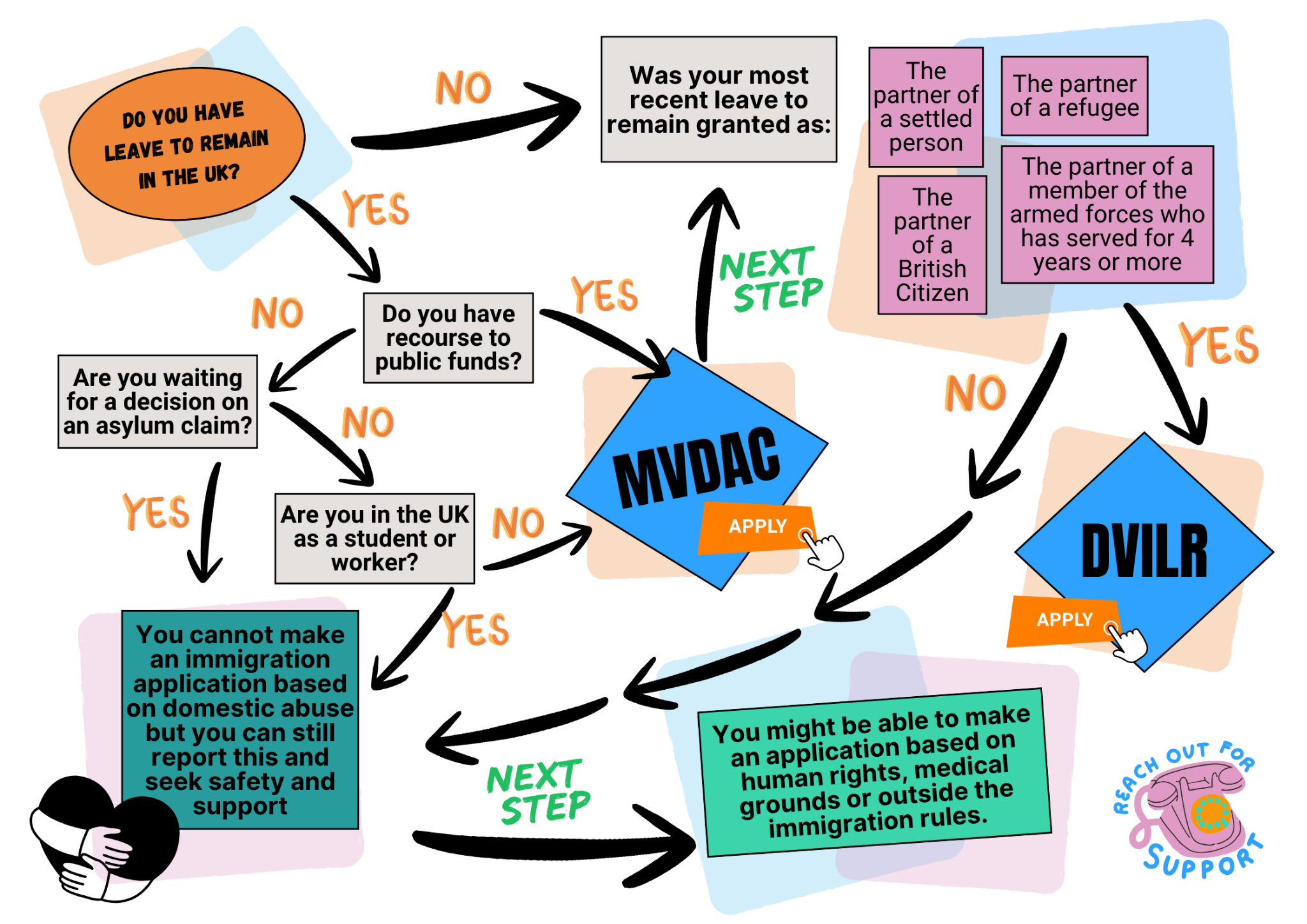
We have explained a lot of information so far, and this can be difficult to process all at once. To help you understand the different applications, and whether you can apply for them, we have created a flow chart to follow.
MVDAC = Migrant victim of domestic abuse concession – temporary leave to remain to allow you to access support and services while you make a further application
DVILR = Domestic violence indefinite leave to remain – settlement in the UK as a person who has experienced domestic abuse
If you are outside of the UK
Transnational marriage abandonment
Transnational marriage abandonment is a form of domestic abuse. It happens when a husband, wife or partner deliberately leaves someone in another country and prevents them from returning to the UK. We use the word “stranded” because the person may be unable to return safely or independently.
For example, the person may:
- take away or keep their passport or immigration documents
- cancel or affect their immigration permission
- refuse to help them return to the UK
- leave them without money, housing or support
This abuse uses a person’s immigration status to control them and keep them separated from their home, family or support in the UK.
If you have been stranded overseas and your relationship has broken down permanently because of domestic abuse, you can apply for indefinite leave to return to the UK.
The relationship breakdown might have happened when you had leave to remain and were in the UK, after you left the UK or after your leave to remain expired. This means that even if you have no leave to remain or visa to enter the UK, you can apply to return to the UK on this route if you have become stranded abroad due to domestic abuse.
Legal aid
Because applications involving domestic abuse are complicated, it is a good idea to get legal advice if you can. Legal Aid is usually available for people making applications under the domestic abuse rules. This means you might be able to get legal advice and representation for free.
We know it can be hard to find legal advice. A domestic abuse service, law centre or local support organisation may be able to help you look for advice and to support you to gather information or documents for your application.
You can use this page to help you find a legal advisor.
Learn more about Legal Aid and how to work with your lawyer in the Toolkit.
Learn more about Lawyers and Legal Aid here
If you are seeking asylum and experiencing domestic abuse
If you are seeking asylum and have experienced domestic abuse, you can ask the Home Office for help.
If you are living with the person who is abusing you in Home Office asylum accommodation, you can ask to be moved to safe accommodation. You can also ask for any children who live with you to be moved with you.
The Home Office should keep your new address confidential and should not tell the person who abused you where you have been moved.
The Home Office has specific guidance on how to respond to reports of domestic abuse from asylum seekers and they have certain responsibilities if they are made aware of domestic abuse, as do Home Office accommodation providers.
ASAP have also made a helpful factsheet on this which explains what should happen in this situation.
Organisations that can help
- National Domestic Violence helpline is a 24 hour phone line offering emergency support and referrals. The number is 0808 200 0247, and there are translation options.
- See general information on the NHS website.
- The Organisation Rights of Women provides advice on immigration law relating to domestic abuse. If you have questions, you can access free legal advice by calling 020 7490 7689 on Mondays and Thursdays, 10am-12pm and 2-4pm. If you are a professional you can access free second tier legal advice on 020 8138 8028 open fortnightly on Fridays, 10am – 12pm.
- Women’s Aid is a national charity working to end domestic abuse. See their website for how to access help.
- Men experiencing domestic abuse can call the Men’s Advice line on 0808 8018 327 Monday to Friday 10am to 8pm for non-judgemental information and support.
- Southall Black Sisters offer free advice, support and advocacy to women and girls who have experienced domestic abuse. You can contact them on 020 8571 0800 or email at info@southallblacksisters.co.uk.
- Karma Nirvana work with people who have experienced forced marriage and honour crimes. You can contact them on 0800 5999 247.
- Latin American Women’s Rights Service (LAWRS) offers free and confidential services for Latin American women, including legal immigration advice.
- Ubuntu Women’s Shelter is a Glasgow based charity which provides unconditional practical support for destitute women and people of other marginalised genders who are NRPF and have insecure immigration status. For short-term accommodation, you can call +447570877817.
- Safety4Sisters are a Manchester based organisation offering support to women experiencing abuse. You can call on 0161 464 9505.
- IDAS are a charity in North Yorkshire, including Sheffield and Barnsley. They have a free confidential advice line and offer specialist support.