
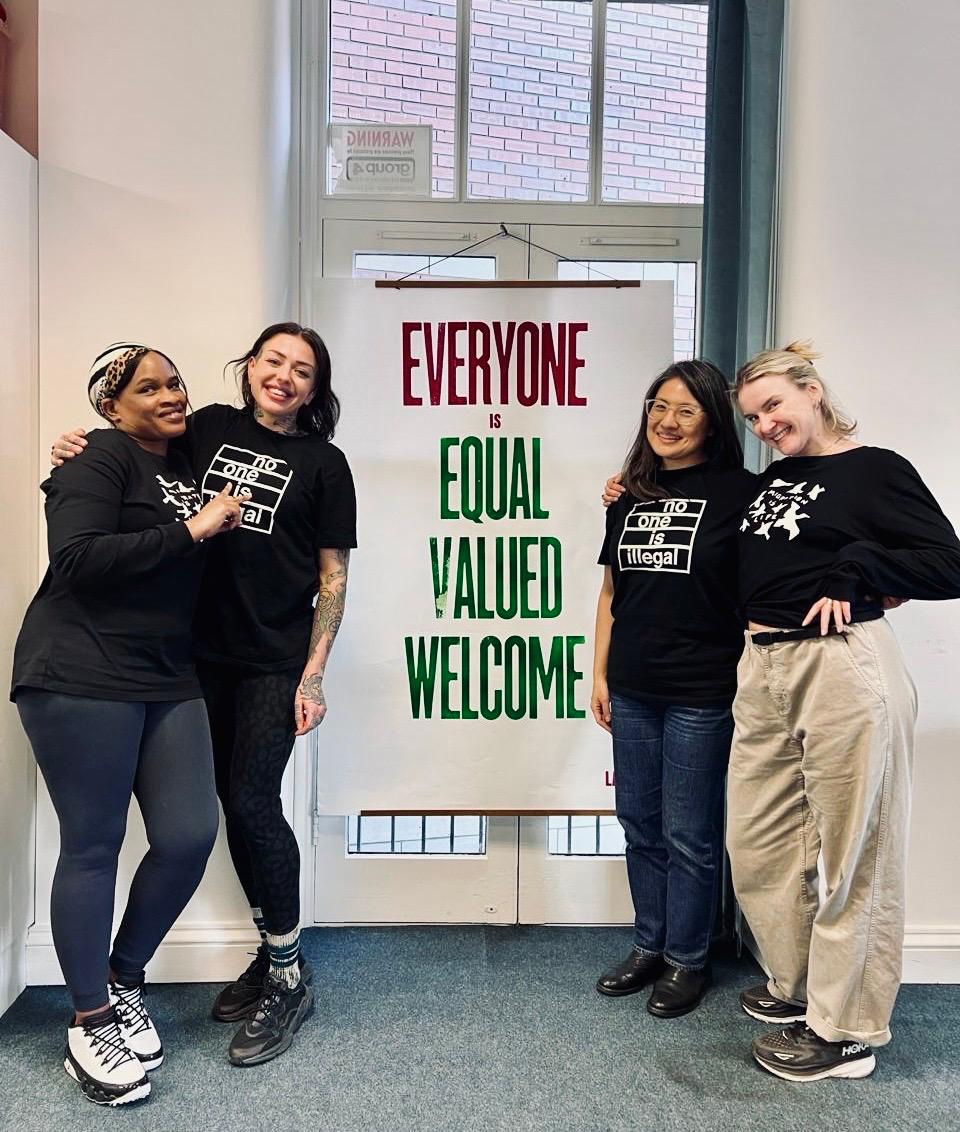
Here’s Right to Remain’s reflections on 2025. Thank you for all your support this year! We are looking forward to continuing our fight for migration justice with all of you.
In solidarity always, Right to Remain team
Ally’s reflections:
I joined Right to Remain in July 2025, so I’m reflecting as someone who came in mid-year and without the context of previous years of “how we do things” internally at Right to Remain, however not as someone new to the Toolkit or the work. I’ve used Right to Remain resources regularly while delivering casework for years, and I’ve seen first-hand how these materials land in real lives: what people hold onto, what’s hardest to navigate, and the importance of making sure knowledge belongs in the community – not just with caseworkers, lawyers and judges. I understood the value of legal education before, having delivered workshops for years, but through Right to Remain I’ve learned something deeper about what “knowledge is power” can really mean. The accessible, interactive, participatory style isn’t just effective but it’s also calm and grounding. Our approach at Right to Remain cuts through the noise that’s designed to exhaust us, and helps our communities to feel more grounded, clearer, and more able to act for themselves and each other.
There was guilt in stepping away from frontline practice. I was good at it, well-rehearsed, thorough, and trusted, and I worried that moving away from that day-to-day rhythm would mean losing touch with the reality of the work. But what I’ve found at Right to Remain is that lived experience isn’t something tokenistic. It’s integrated in a way that I haven’t seen before, shaping both the direction of the work and how we do it together. “Radical solidarity” isn’t just a slogan but shows up in our boldness, values, and the permission to bring full humanity to the work – full personhood, real relationships, warmth, anger, grief, joy, and the kind of collective care that makes Right to Remain feel genuinely unique.
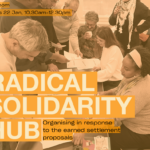
For me, this has especially shown up at in-person moments: the Radical Solidarity Hubs, sharing food, warmth and connection with so many different people fighting for migrant justice, singing on the coach from Manchester to Durham for the National Day of Solidarity, and campaigners dancing together outside Derwentside IRC, vibrant and unapologetically visible and defiant against the grey sky and the grey walls of the detention centre. These are the moments I hold onto in an increasingly difficult context to organise and work within. They are reminders that solidarity isn’t abstract. It’s something we can feel, hear, and build together, even in the shadow of systems designed to isolate and disappear people.
So I will call 2025 the year of connection, because it’s what turns our values into something real and it’s how we keep walking the walk, not just talking the talk.
Eiri’s reflections:
I spent 2025 plagued with maddeningly intriguing questions.
What is solidarity? Lately, solidarity has become fashionable as a concept. It adorns everyone’s social media output. But how it materialises itself was a mystery to me. Everyone was suddenly talking about solidarity, yet I couldn’t quite see any changes in people’s behaviours, attitudes or actions. I was still trapped in the same NGO-industrial complex governed by the same structure of power. It was so jarring that sometimes I questioned my own sanity. Right to Remain kept me sane by showing me what it is. We call it ‘radical solidarity’, to stress the importance of shared humanity with others who might not be like us. It shows in our day to day work by my amazing colleagues (though they do regularly drive me mad, and they know it). Solidarity is beautiful but also often complicated and messy. I like the rawness of it though, which does shape your soul.
Another question. What does ‘holding space’ mean? I know that Right to Remain does this but I struggle to explain exactly what it is. My provisional definition is: ‘holding space is an act of transformation, of turning pain, anger and grief into energy, power and hope’. I have witnessed many moments of ‘holding space’ at Right to Remain: when cruel policy changes are thrown at us; when frightening news headlines demonising migrants overwhelm us; when one of us is detained, harmed and damaged by the hostile environment. How exactly that transformation happens remains unclear, but these moments at Right to Remain have kept me sane.
As we end 2025, I am grateful to my colleagues and These Walls Must Fall campaigners who show up authentically for our community and for each other and keep me sane. Our name, Right to Remain, is going to be even more relevant in the near future. It is a great honour to be on a journey, together with everyone at Right to Remain, to live up to that name.
Esther’s reflections:
Working in the migration justice sector is not without its challenges. This year felt particularly hard; we saw the rise of the far-right in a more organised and wide-spread way than in previous years, Reform UK took pockets of power across the country, and the Labour Government ramped up their anti-migration rhetoric and policy in an unprecedented manner. Crazy to think last July we were welcoming the change of Government, and now they are behaving just as sinister, if not more so, than their predecessors.
However, when I reflect on the year, these “hurdles” shall we say, don’t come to mind at all. Instead, what I remember is a year of increased solidarity, reinforced relationships, care, and community.
I think of our #FreeFatou campaign, which saw ourselves and a network of community members rally around Fatou to block three attempts at her removal, and secure her release back in Liverpool where she belongs.
I think of Fatou again, returning to the site of her detention at Derwentside IRC to stand with hundreds of others to campaign for the freedom of all people detained.
I think of the campaigners dancing in a field, holding colourful banners and signs, showing that collective resistance is about love, joy and community.
I think of my Right to Remain team members, who live so authentically and by their values, that coming to work doesn’t feel like work; it feels like humans doing the thing that needs to be done for other humans.
I believe in the work we do at Right to Remain – public legal education, building solidarity across communities, and lived experience led campaigning and organising, but more so, I believe in the way we do that work; nurturing the power of humans, authentically.
Maggy’s reflections:
As I reflect on 2025, I do so as an organiser holding both personal responsibility and collective pride. This year has required resilience, patience, and an unwavering belief in the power of people coming together, even when conditions made organising harder, heavier, and more emotionally demanding than ever.
One of the most meaningful moments of this year has been seeing some of our campaigners finally granted refugee status. After years of Home Office reporting, detention threats, surveillance, and uncertainty, these outcomes were reminders that sustained organising works. Each grant was not just an immigration decision, but a moment of safety, dignity, and restored hope,and we celebrated them together, as a movement.
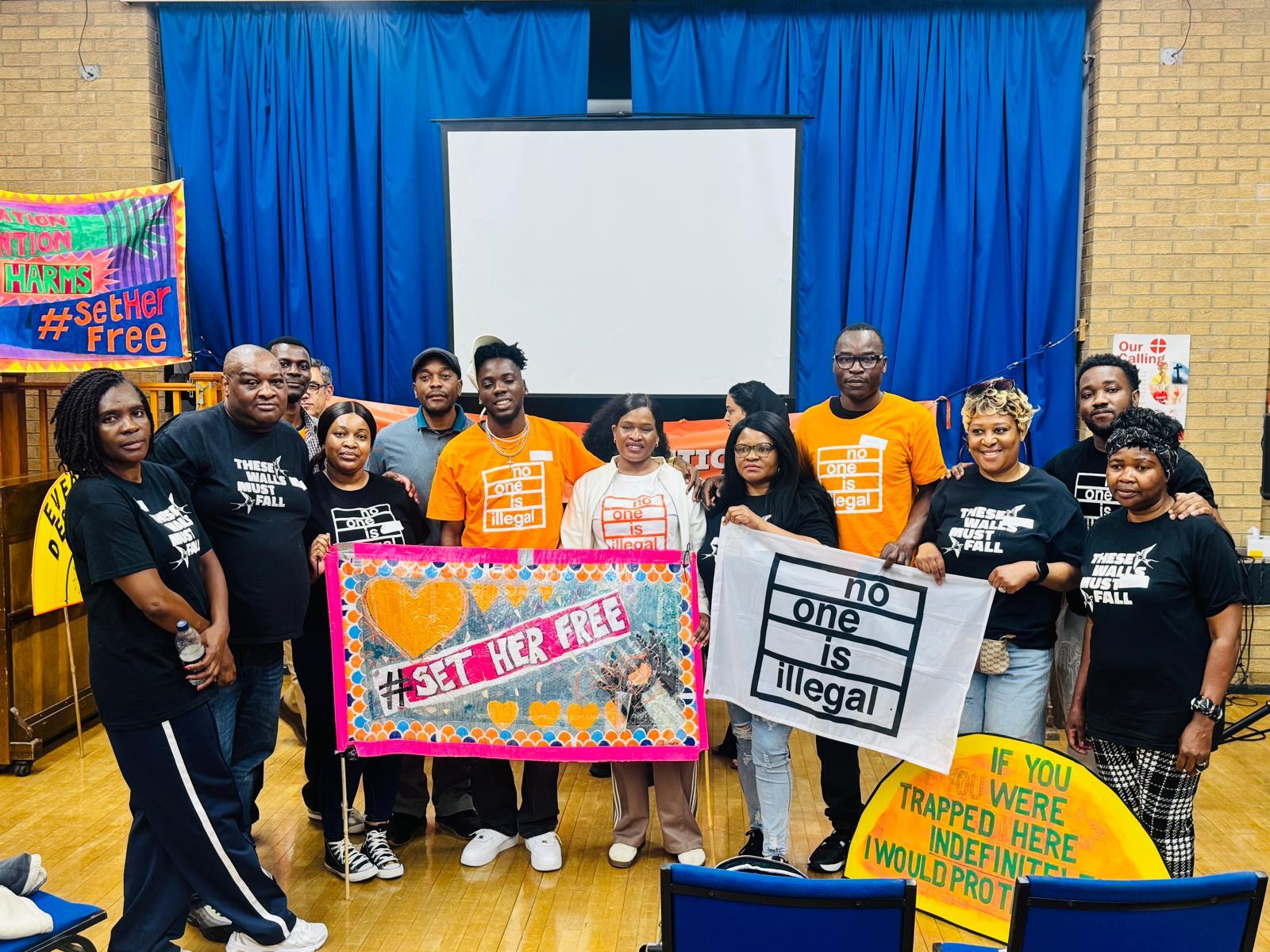
Alongside these wins, we also mourned. We lost lives that should still be with us. We carried grief while continuing to organise, knowing that remembrance and resistance often sit side by side in this work. At the same time, we faced increased far-right hostility, intimidation, and public hate. Instead of being broken by it, we grew closer as migrant families and communities. We made a deliberate choice to respond not with fear, but with visibility and solidarity,creating our own flags of resistance and care, refusing to be intimidated by symbols of hate.
This year was also marked by national organising. Our campaigners travelled long distances, often at great personal cost, to educate communities, share lived experience, and build collective understanding across the country. Their commitment never wavered. Despite exhaustion, surveillance, and uncertainty, they continued to show up, not just for themselves, but for others still trapped in the system. This work has been made possible by the courage, consistency, and generosity of our campaigners.
We worked in deep solidarity with many organisations, building relationships and strengthening a shared movement in line with the ethos of Right to Remain to build a bigger tent, one rooted in unity, shared leadership, and lived experience. Through this, we saw successful national actions, solidarity hubs, and the release of people from detention, reaffirming that collective pressure can still create freedom.
At the same time, challenges remain. As much as we celebrate those granted their refugee status, Family reunion barriers continue to separate them with their loved ones. New proposals threaten livelihoods and deliberately create division within our migrant communities, intensifying feelings of precarity and unequal privilege.
Yet, 2025 has shown me and all of us that resilience is not passive endurance. It is active, organised, and collective. These Walls Must Fall is sustained by the strength of its campaigners, and I remain deeply committed to leading work that turns pain into power, and solidarity into lasting change.








We have had a year of racism and oppression in Scotland, unfortunately, and we fear even more in the new year that this injustice and cruelty will continue for us refugees.