
by Eiri Ohtani, Director
A place only becomes a place of solidarity and protection because of the people who are there, what they know, what they do, how they do it with humanity and grace, and what they believe in. And people need to survive in a place; you cannot live in an ether of social media.
Earlier this month, we welcomed Liz Peretz of the Coalition to Close Campsfield (Oxfordshire) and Debbie Beeks of the No To Hassockfield Campaign (County Durham) to our first place-based detention campaign event on Zoom. Emma Jones of Asylum Welcome (Oxford) also joined us, sharing insights from her colleagues’ humanitarian visiting support into the lived realities of those in detention.
These two anti-detention groups are spearheading campaigns to shut down their local detention centres: Campsfield House IRC (Immigration Removal Centre), a male-only facility with 160 beds, and Derwentside IRC, a female-only facility with 84 beds. These IRCs are part of the UK’s broader immigration detention estate, which comprises eight IRCs, four residential short-term holding facilities (STHFs), and one pre-departure accommodation (PDA) for families.
Immigration detention, often concealed behind barbed wire, is the most invisible aspect of the Hostile Environment. Despite its hidden nature, its harm to people seeking asylum, refugees, migrants, their families and friends is severe. And its use is escalating: according to the Home Office, 22,586 people entered immigration detention in the year ending March 2026, a 7% increase from the previous year. The number of people detained has, in fact, been rising since 2023, following a significant reduction in the period up to 2019.
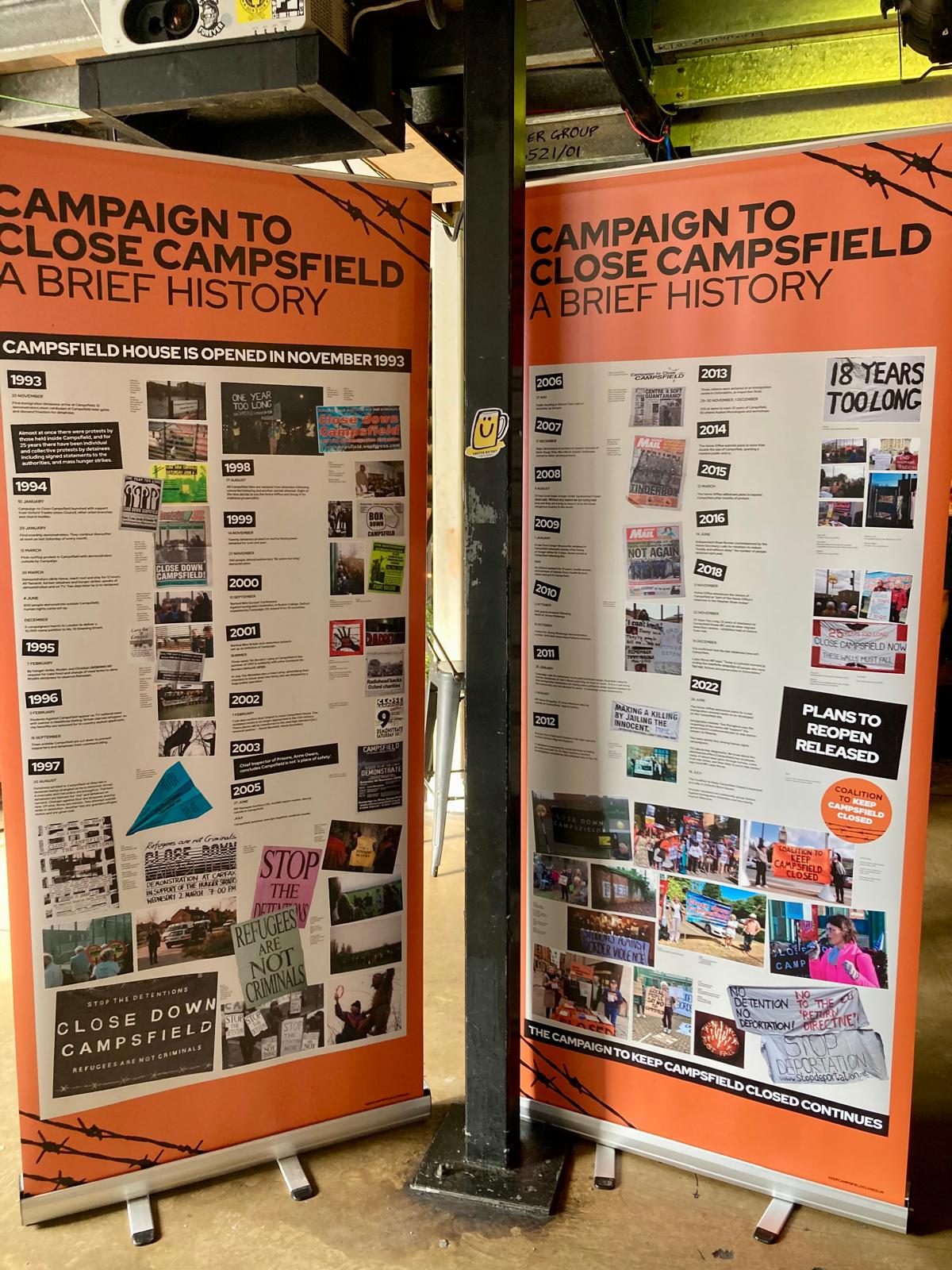
Immigration detention centres are places where the state deprives people of their liberty, with no time limit, for administrative purposes. As Liz and Debbie highlighted, one of their groups’ primary functions is to bear witness to and publicise this harm, preventing its normalisation. Both groups regularly organise visible, in-person demonstrations, steadfastly refusing to allow the UK to normalise this inhumane system and its prison-like infrastructure.
Place-based resistance against detention
Liz Peretz, a veteran of the anti-detention and social justice campaigns in Oxford, voiced her opposition the very moment Campsfield detention centre opened decades ago. She spoke about the enduring and total local opposition to Campsfield, including the unanimous opposition of local and parish councils. She also expressed deep regret at having to resume this campaign when Campsfield reopened in 2025, after the local community secured its victory in 2018 to shut down Campsfield. Now, joined by a younger generation of activists in a much harsher political environment, more organisations and groups are joining the Coalition to Close Campsfield. The most pressing challenge is to stop the government’s plan to more than double the size of Campsfield, from 160 to 400 bed places. Liz urged everyone to join forces and take part in the consultation process.
Debbie Beeks spoke about the deep involvement of local people from diverse backgrounds, who have united to campaign for the closure of Derwentside detention centre. The No To Hassockfield campaign began in 2021, initially to stop the government’s plan to open the Hassockfield detention centre (later renamed Derwentside detention centre). When the plan proceeded, the group decided to continue campaigning for its closure and became increasingly active in its fifth year. Like many other detention centres, Derwentside is located in a remote area of County Durham, truly ‘out of sight, out of mind’. However, the group’s voice does reach detained women and the refugee and migrant community: last year’s annual demonstration was co-led by lived-experience leaders from Right to Remain’s These Walls Must Fall. Touching upon the changing public responses campaigners receive from passing vehicles at their monthly direct action demonstrations, Debbie shared how campaigners find strength in solidarity, including from their trademark colourful, collectively produced placards.
Emma Jones from Asylum Welcome shared what her colleagues and volunteers witness when they provide social visits to people held in Campsfield. As in other detention centres, access to healthcare and legal advice is a significant problem, in addition to the sense of isolation, fear and anxiety caused by imprisonment. Emma explained that many people are also confused and distressed, unable to fully understand why they are being detained and, of course, not knowing what might happen to them next.
The thoughtful insights and observations shared were so profound and enriching that, for once, I regretted not recording the event.
Centrality of place in solidarity work
In our hyper-digitalised present, an intentional focus on place might sound anachronistic. Over the past few years, as we have worked with over 1,000 groups across the UK through public legal education, strategic convening and campaigning, and organising. As we reviewed what’s working and what we need to do more, the concept of place has increasingly framed Right to Remain’s thinking about our shared struggle – and that focus on place characterises our strategic objectives for 2026/27.
The need to build solidarity that protects our migrant and refugee communities is more urgent than ever, as eruptions of racial violence and immigration enforcement activities threaten communities across the UK. Fortunately, more people are now talking about solidarity and the need to build more solidarity, but many questions remain: how, where, and what?
Our digitalised world of social media conveys information to the masses at dazzling speed. It is brimming with fantasies of possibilities and connections – both for good and bad. We can instantly see what is happening in multiple locations – events, activism, and demonstrations – so much so that sometimes these places blur into one big mass, a digital non-place. This can make solidarity abstract. We repeatedly hear from the groups we work with about their frustration that social media visibility and ‘likes’ are not translating into action on the ground.
A fast-thickening web of immigration enforcement – reporting, raids, detention, and deportation – brings the role of place back into the limelight. So too do the recurring eruptions of violence, triggered and orchestrated by the far right and well-funded influences.
Practical resistance and protection from the harm of immigration enforcement and racist violence rely on people who occupy the same place. This includes people holding welcome desks outside reporting centres, people gathering to stop immigration raids, those demonstrating against detention, people supporting others incarcerated in detention centres, those creating a circle of protection and support for people facing detention, and those evacuating families targeted by racist violence and bringing them to safety – often away from public gaze. A place only becomes a place of solidarity and protection because of the people who are there, what they know, what they do, how they do it with humanity and grace, and what they believe in. And people need to survive in a place; you cannot live in an ether of social media.
A place is also where people can take collective political actions using existing mechanisms. Playing along with the existing political systems is not a silver bullet that transforms society. But while a new, better system struggles to be born, what can be achieved or denied by the existing political systems can have a massive influence over how our day-to-day lives are ordered – through laws, policies, and practices. The recent local elections and the prospect of the next General Election have alerted many of us that where people exercise their political agency needs more attention than ever.
As part of Right to Remain’s efforts to build places of solidarity and protection – by building the knowledge, solidarity, and power of people and communities – we will continue to work with the Coalition to Close Campsfield and No to Hassockfield Campaign and other local groups, to build a society that protects us all. When asked to name one ‘win’, Debbie from No To Hassockfield described how the group members’ shared belief in justice and compassion sustained their campaign. She said, ‘our win was solidarity,’ and that is what we all want to see everywhere in the UK – because that’s what we need to protect our community from immigration enforcement.









Discussion: