
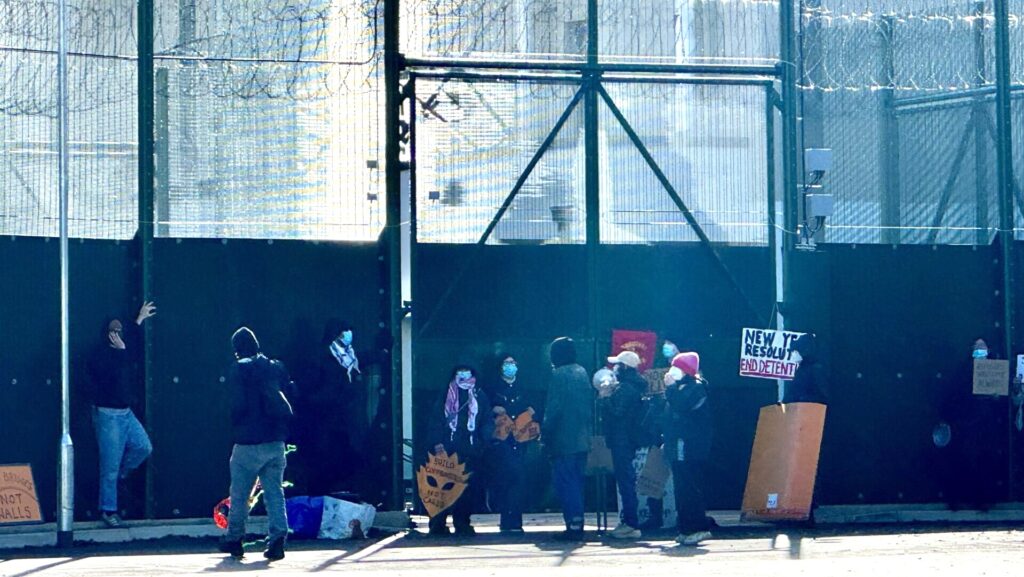
Group of protesters just outside Campsfield IRC gates. Image credit: Mercedes Haas for Cherwell
In December 2025, Campsfield detention centre reopened despite strong local opposition, with 160 bed spaces in this first phase. The centre had been closed in 2018, after decades of consistent opposition by local campaigners and as part of a wider commitment to reduce immigration detention at the time, after an official review of welfare in detention found that detention itself causes harm, instigated by coordinated civil society advocacy.
Now the Home Office has applied to add a further 240 places, taking Campsfield capacity to 400 bedspaces, more than doubling its current size. A public consultation is now open until 11:59pm on Friday 24 July 2026.
In this blog we explain what’s being proposed, how it’s being pushed through, how it fits a wider drive towards more detention and removals. This is not just about the expansion itself. We are alarmed by the way in which a locally opposed detention centre is being pushed through an exceptional planning route with key parts of the evidence being obscured from the public. We will also look at how you can oppose the plans before the consultation closes.
What is Campsfield IRC?
Campsfield Immigration Removal Centre is located in Kidlington less than 30 minutes drive from Oxford City Centre. The site was originally used by the military as an airfield, then turned into a young offenders’ facility before being converted into an immigration removal centre in 1993. When Campsfield closed in 2018, it had 282 bedspaces. Its closure formed part of the previous Conservative government’s commitment made in 2016 to cut the detention estate by 40% which was made in response to Stephen Shaw’s review into the welfare of vulnerable people in detention. Shaw’s review criticised the conditions of detention, highlighted the deep harm caused by detention and questioned the use of detention itself. At the time, the government said that the closures were meant to lower both the number of people held and the length of time they spent in detention before removal, and to improve detainees’ welfare. This was a result of years of coordinated civil society advocacy that centered around a demand to end the UK’s practice of indefinite detention.
What does the government want to do?
The reopening is happening in two phases. The first, completed in 2025, refurbished the existing buildings to hold 160 adult men. The second part (the part of open to consultation) is to add new accommodation blocks to add 240 more bedspace – more than doubling its current capacity. This forms part of a wider government programme to expand the detention estate to around 3,500 places by 2030, with roughly 1,000 new beds planned across Campsfield and another centre, Haslar IRC near Portsmouth. Haslar was previously closed in 2015 and was also heavily criticised for the inhumane conditions.
You can read the full Planning Statement (April 2026) for the expansion of Campsfield IRC here.
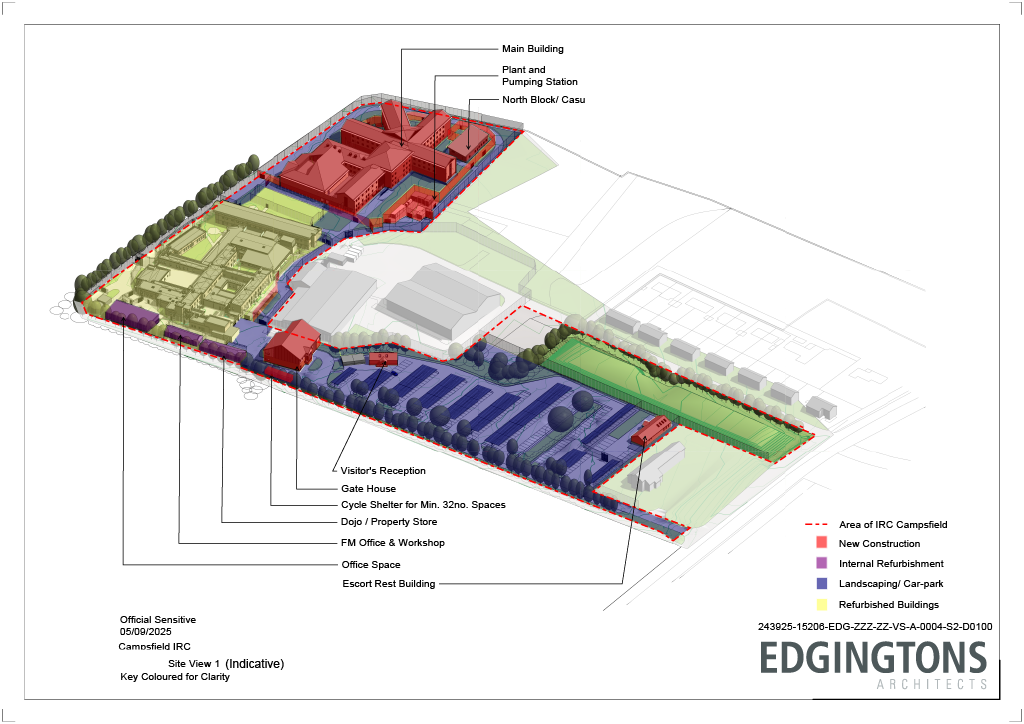
Image from publicly available documents as part of Crown Development Planning Application
How is the government trying to push their plans through?
Normally, expanding Campsfield would be a decision for the local council, which for Campsfield is Cherwell District Council. The council is locally elected and answerable to the people who live in the area. An application like this would usually be handled through the normal local planning route, which means residents and the wider public can have their say. And importantly, if councillors didn’t want the scheme, they could refuse it, and the Home Office would then have to appeal if it wanted to carry on.
However, this is not what is happening. The Home Office has instead used the Crown Development Route – a fast-track planning system the government can use for its own building projects when it decides they are “nationally important”. Cherwell Local Authority and residents can still comment, but they no longer have the power to refuse the proposal in the first place.
Taking the decision away from the local council
This is important to understand because Campsfield has been opposed locally for years, and removing the council’s power to say no also removes the most direct way for the local community to stop the expansion. Using the Crown Development Route also means that the plans face less scrutiny than they would using the normal local planning process.
In order to use the faster Crown Development Route, the Home Office also has to evidence why they believe their plan to expand Campsfield is “nationally important”. As part of the publicly available planning documents, you can read the Statement of National Importance here. Unsurprisingly, the reasons given are incoherent, incomplete and short-sighted. The Statement of National Importance presents almost every current “hot topic” in the asylum and immigration system, (foreign national ex-offenders, small boats, asylum hotels, public safety, enforced returns, border infrastructure and value for money) and claims detention expansion is the answer. All these issues have their own different and more complicated causes, many of them caused or worsened by Home Office failures: years of delay, poor decision-making, lack of access to legal advice, poor accommodation planning, outsourcing failures, and an asylum system repeatedly run through crisis management rather than care or competence. None of this is resolved by removing people from their families and communities and locking them up in prison-like conditions with no legal time limit, only for the majority to be released back into the community harmed and destabilised.
Keeping key information out of public view
As part of the application documents, the government has also filed a National Security Statement which details what documents should not be publicly available as part of the planning application. Some redactions are expected, such as specific building layouts, security systems and CCTV positions, but other information that has been withheld is important for the public to understand and challenge the case being made.
For example, the government argues that detention expansion is “value for money”, while redacting detailed cost models and contractor pricing that would allow the public to test that claim. Campsfield is run for the Home Office by private company Mitie, the private contractor that operated it before it closed in 2018, on a fresh six-year contract awarded in 2025. Mitie has previously faced serious allegations of racism among its staff. Mitie also runs Harmondsworth, where inspectors in 2024 found the worst conditions they had seen in immigration detention (a progress report shows some improvements made in 2025). A bigger Campsfield means more publicly funded detention places in a privately run centre, creating more revenue for a company but the detailed numbers showing how that money is spent, and who profits from it, has been obscured from public view. It also entirely ignores the “costs” shouldered by friends, families and supporters after people are severely damaged, mentally and physically, by their torturous experience of detention, only to be released back into their community with no dedicated support for their recovery.
How can you oppose the plans?
The plans are not yet decided, and there is a way to be heard. A public consultation is open until 11:59pm on Friday 24 July 2026, through the Planning Inspectorate’s Crown Development portal, and anyone can submit a written representation. You can find the consultation here.
Because this is a planning process, representations made are most likely to carry formal weight if they respond to recognised planning issues. For example, the proposed expansion is also on Green Belt land, which is land given special planning protection to keep it open and stop towns and cities spreading out unchecked. People can ask whether the Home Office has properly justified the harm caused by expanding the site, including new buildings, fencing, lighting, parking, traffic and other security infrastructure. Other planning issues people may want to raise include environmental impact, ecology and protected species, light pollution, noise, traffic, pressure on local infrastructure, the scale of the development, and whether the Home Office has really shown why the centre needs to increase to 400 places. People can also question whether enough information has been made public to properly assess these issues, especially where documents about ecology, lighting, transport, costs or security have been redacted or withheld. You can find all the documents and assessments here.
The consultation is also a public record, so it is important to say plainly that detention harms people, especially as the deep harm on both individuals and communities is not properly reflected in any of the planning documents.
We will be sharing an example response in the near future and will be hosting an online workshop on how to respond, together with the Coalition to Close Campsfield. Please watch out for our further announcement.
In the meantime, you can learn more about the work of the Coalition to Close Campsfield here.
– Ally Swadling, Lead Legal Education Officer











Discussion: