

Artwork by Jessica Thornton
This summer’s scorching heatwave served as a stark awakening for many: we have moved beyond the preparation stage and are now squarely in the phase of climate change adaptation. The same can be said for fascism and authoritarianism. Many roundtables, ‘thought pieces’, and reports still conclude with the non-committal statement: ‘we need to prepare for the rise of the far right’. But it is already here, muscling its way into our streets and neighbourhoods, and screaming from social media posts.
Unreported by the mainstream media, many grassroots groups and lived-experience leaders in the migration justice movement are already adapting to this. And adaptation is not the same as capitulation.
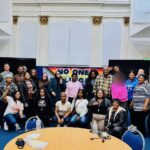
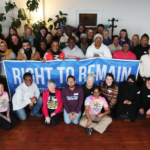
We are surviving this period of intensifying hate while transforming the world for the better, with defiance and sometimes humour. That is what we collectively witnessed at our recent Radical Solidarity Hub, Building Safety and Solidarity Against Racism and the Far Right. Around 60 of us held the space for each other, hearing raw accounts of being targeted by racism and far-right violence, and celebrating the hard work and sheer determination to create safety and hope. (We are still willing to offer Andy Burnham tips and advice on how to create hope – feel free to get in touch, Andy!)
Our Radical Solidarity Hub meeting kicked off with one of our These Walls Must Fall campaigners in the North West sharing their experience. They, with local allies, organised people in asylum accommodation to keep themselves safe when local far-right groups harassed and demonstrated outside the accommodation. They courageously connected with other neighbours – just across the street – and together stood up against hate to build community relationships. Reflecting on this experience, they said: “Solidarity is power – it is not something you can take for granted.” Maggy, our These Walls Must Fall Organiser, added: “What helped us? The community. What we saw was love and community and solidarity – it was not built in one day. By sharing strength and different strategies, we are building a community of safety.”
We then heard from groups based in the North East, Northern Ireland, Scotland, and the South Coast. They spoke about personal threats and harassment – in person and online – they have been dealing with. About having to implement extra security for their groups. About fighting off vexatious claims made about their work. About seeing people retreating into their homes, not accessing vital services. About witnessing people who do not speak English as their first language developing a hand sign that means ‘far-right flag-waving people’, to warn each other quickly across language barriers about potential dangers, to protect each other. And above all, doing all of these things while ensuring the wellbeing and safety of our diverse communities.
There were also questions: what is safety? Who provides safety when, for many in refugee and migrant communities, state institutions which are, in some ways, tasked with providing safety are also the same institutions that inflict violence upon us? There was also an acknowledgement that while demonstrations and counter-demonstrations are important, many of us want to go beyond reactive actions, to build more community power for our future through care, celebrations, and connections.
When we conducted a poll during the session, about half of those who attended said that they themselves were, or knew someone who was, directly targeted or attacked by racists and the far right. About half also said they had already attended support or well-being sessions organised internally within their groups.
When asked what helped them most to cope with the current hostile environment, the strongest theme that emerged from participants was that they coped through relationships with others – particularly solidarity between organisations, movements, and communities facing the same pressures. Coping was strongly collective, with solidarity functioning not just as emotional support, but as a source of resilience and collective capacity to respond. Participants said:
- “True solidarity across different movements against the far right.”
- “Demonstrations of solidarity and care – both big and small!”
- “The network continuing to show up and strengthening links with other grassroots migrant justice networks.”
And that is what we precisely did in our Radical Solidarity Hub meeting – building strong solidarity by being present for each other. We are grateful to all the speakers who agreed to share their experiences and thoughts at very short notice. We are also grateful to everyone who collectively created a deeply caring and nourishing space for all of us, from which we all drew strength. As we were parting, people shared with each other what gave them strength. One of the offerings was this playlist, which we would like to share here with their permission.







Discussion: