
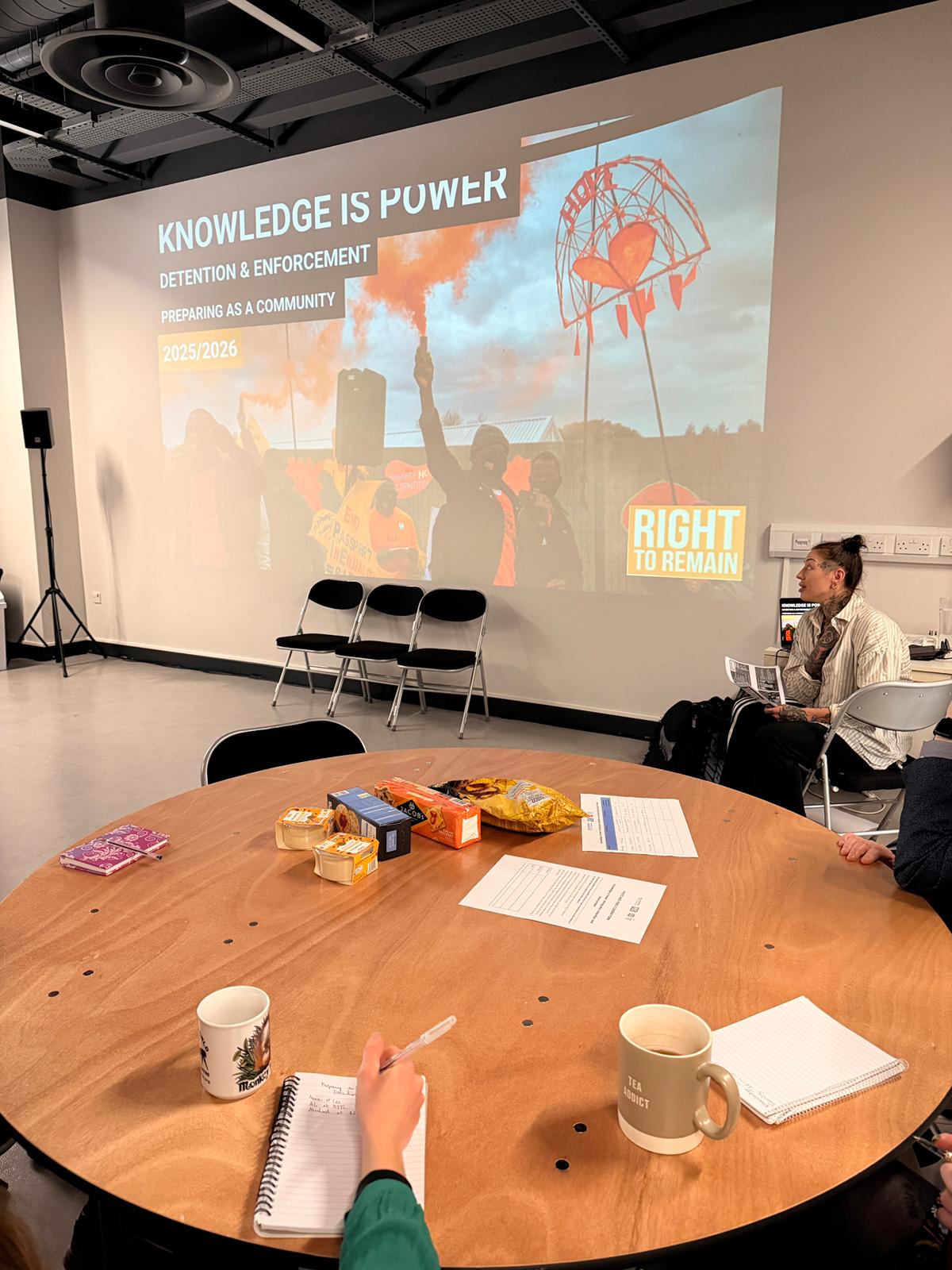
At Right to Remain, we have been focusing on preparing our community for the reality that many people are forced to prepare for, and attend, their appeal without a lawyer or any legal advice at all.
At the same time, the government is using the large number of people waiting to appeal to tell a particular story: that the appeals system is broken and needs replacing, through the proposed Independent Appeals Body. Even without much detail yet, we can see the direction of travel: appeals are being treated as a backlog to be cleared, rather than as an essential safeguard against poor Home Office decisions.
We have already run two Knowledge is Power sessions on preparing people seeking asylum and their supporters to go to an appeal without a lawyer. We then held a Radical Solidarity Hub session at the end of April to share our observations of the sessions we ran and seek people’s input.
Building on what we learned, we decided to divide the workshop into two separate workshops: 1) going to your asylum appeal, and 2) evidence. Each can be attended on its own, but we recommend coming to both.
- Thursday 25 June, 10am–1pm: Going to your asylum appeal without a lawyer
- Tuesday 21 July, 10am–1pm: Evidence in asylum and immigration cases
- Wednesday 9 September, 10am–1pm: Going to your asylum appeal without a lawyer
- Thursday 10 September, 10am–1pm: Evidence in asylum and immigration cases
All sessions are online and are not recorded.
Why are these sessions important?
Our Knowledge is Power workshops, alongside our wider Public Legal Education work, are designed to respond to this reality: to give people the practical tools to prepare for their appeal, and the space to connect with and learn from others facing the same situation. As a team, we have found ourselves saying this more and more: no one is coming to save us – including lawyers. We recognise that these sessions do not and cannot replace good quality legal advice, but we also have to be honest about the context people are actually navigating.
Going to your asylum appeal without a lawyer
As part of the government’s pledge to “clear the asylum backlog,” the Home Office has been making asylum decisions quickly. In the year ending March 2026, 128,300 people received an initial decision and nearly 80,000 were refused. We know, from our communities and the Home Office’s own quality checks, that these decisions are frequently inconsistent and wrong. Poor decisions push more and more cases to appeal which has moved the backlog of cases from the Home Office to the tribunal. By the end of December 2025, the First-tier Tribunal (Immigration and Asylum Chamber) had around 139,000 cases outstanding, up from around 75,000 a year earlier – most of them asylum appeals, now taking an average of about 63 weeks to conclude. (Updated statistics are due later this month, June 2026.)
People are left waiting a very long time, often without any legal advice but that waiting is also time to prepare. It is even more critical for people to take an active role in their case, especially as we see the government make rules more and more difficult for people in the system, including shortening the grants of leave from 5 years to 30 months for anyone claiming asylum after 2nd March 2026.
This session will cover the journey from submitting your appeal to going to your hearing. We will look at how to read and understand the Home Office refusal letter, a brief overview of different kinds of evidence to help you prepare, what kinds of questions and legal tests the Immigration Judge will be using to decide whether or not to give you leave to remain and how to prepare for the hearing itself and what to expect on the day.
Please remember that we cannot give legal advice. This session will also not be a run-through of how to submit the appeal or using the HMCTS system.
Evidence in asylum and immigration cases
This session runs alongside our appeals workshop. However evidence is not only an issue relevant to appeals. Strong, well-organised evidence matters across every kind of immigration case which is only going to become more important. As we await the government’s response to the earned settlement consultation, the direction of travel is towards a system where people have to actively demonstrate their “contribution”, their residence and their circumstances over a longer qualifying period. It is clearly important for people to be prepared and organised with their evidence as early as possible.
In this session we will look at what “evidence” is and when it matters, the different types of evidence, what tends to make evidence strong, how the Home Office and courts will consider evidence and the kinds of evidence the Home Office tends to give little weight to.
Please remember that we cannot give legal advice or advise on specific cases.
How to join a workshop
Right to Remain strives to ensure our Toolkit remains free of charge, allowing easy and unlimited access to people who are going through the asylum and immigration system, their friends and families, and unfunded and underfunded grassroots groups.
We offer free places at our workshops and events for people going through the asylum and immigration system and unfunded or underfunded groups. However, in lieu of donation, we ask for fees from funded groups, organisations and institutions, when their staff members, volunteers and other associated persons attend our workshops and events. The level of fees we seek per person is determined by the size of the group’s annual income, which we review regularly. We ask for larger donations from organisations with larger income. These fees and donations support our work to maintain the Toolkit and Right to Remain, and ensure individuals, grassroots and unfunded groups can use our resources who would otherwise face barriers in accessing knowledge. Read more about how to request a workshop and why we ask for some people to pay here.












Discussion: