

We would like to take a moment to explain how groups can request a workshop from Right to Remain and why we ask some organisations to pay. We have given this a lot of thought, though we have not had any opportunity to fully explain our position.
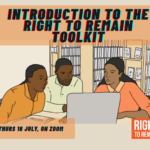
Right to Remain exists to help people understand the asylum and immigration system, build confidence, and act in solidarity. Our Toolkit is a free, step-by-step guide to the UK immigration and asylum system, created for people who want to understand the legal process, a particular stage of that process, or how to help someone else through it.
We developed the Toolkit because our communities told us they needed clear information about the legal process, and about what they and the people around them could do to help strengthen a case. That need has only grown as asylum and immigration law, policy and practice have become harsher, more hostile, harder to understand, and therefore harder to organise against. At the same time, enforcement is increasing, detention bed spaces are expanding, and far-right sentiment is becoming more emboldened. We felt the reality of that in our own community when Fatou was detained last year. In that moment, the importance of both knowledge and connection came into sharp focus. The Toolkit offers not only information, but tangible ways for people to step into solidarity and act together.
Many people are forced to make their way through this system without legal representation. Even when someone does have a lawyer, it is still crucial that they understand their own case, what stage they are at, what rights they have, what options are open to them, and what could come next. Knowledge helps people prepare, ask better questions, act earlier, support one another, and respond together when enforcement threatens someone in the community.
For us, public legal education is part of shifting power, and the foundation of the migration justice movement. Knowledge does not only belong with lawyers and professionals. It should be shared across communities, in plain language, in forms people can actually use. The Toolkit is not just there to explain the system but it is also there to help people take action, give legal support without giving legal advice, and build the confidence to act in solidarity. Fundamentally, you need to understand the system to challenge it, and we see our public legal education and our Toolkit a tool for that fight.
A critical part of this work is making sure the Toolkit stays free to access for people going through the system, their friends and families, and small grassroots groups, who are often doing the most immediate and vital support work without the resources of larger organisations, but also without the layers of bureaucracy that can delay action when people need support quickly.
We can see that the need is huge. Every month, around 50,000 people use the Toolkit, and we receive around 50 to 60 individual emails from people looking for information, guidance, or support. Many are in detention, facing removal, preparing for an appeal, or trying to navigate the system in a moment of crisis. Our resources can also be copied, shared and adapted for non-commercial use with credit to the original source. We want knowledge to move. We want it to be used. We want it to help people organise, support each other, and challenge harm.
As demand for workshops and training has grown, we have had to be clearer about how requests come in, what we can take on, and how funded organisations contribute to the work they are asking us to do.
At the same time, Right to Remain is a very small team. As we start the 2026/27 financial year, we have 3 full-time and 2 part-time staff members, and we continue to maintain and update a public legal education resource that many thousands of people rely on every month. That means we have to be thoughtful about the requests we take on, clear about what support we can offer, and transparent about when we ask funded organisations to contribute through workshop fees and why.
We will continue to offer free places at workshops and events for people going through the asylum and immigration system, and for unfunded or underfunded groups, while asking funded organisations and institutions to contribute through workshop fees. These fees are scaled according to organisational income, so that groups with more resources contribute more. This is not about putting knowledge behind a paywall – it is about protecting free access to knowledge and building the culture of solidarity: well-resourced groups helping grassroots groups and unfunded individual activists and supporters to access our resources.
Many of the people and groups who use our Toolkit are doing vital work with very little money and very little infrastructure. But there are also larger organisations, including charities, statutory service providers, legal advice agencies, universities, researchers and private practitioners, who use the Toolkit regularly in training, casework and support work. We request better-resourced organisations to help sustain the work they draw from.
What stays free
Free spaces will continue to be available in our regular workshops for people going through the asylum and immigration system. We also continue to offer free or low-cost access for unfunded and underfunded groups as part of our organisational strategy.
In our regular online programme, for example:
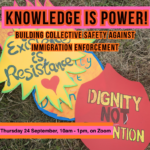
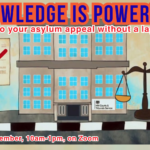
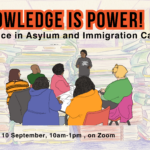
- Knowledge is Power workshops remain free for NGOs with annual income under £250,000
- Radical Solidarity Hub and How to Use the Toolkit workshops remain free for NGOs with annual income under £1 million
- Some workshops also remain free for statutory organisations, depending on the event type.


Commissioned workshops
We also offer commissioned workshops when we have capacity and where the request fits with our priorities. These are based on Toolkit material and include sessions such as How to use the Toolkit, Stages of the asylum system, Asylum appeals, and Detention and enforcement.
If an organisation wants a bespoke workshop, we may ask for an additional fee to cover staff time. We are also more likely to take on commissioned work where it supports wider movement-building, for example by including smaller grassroots groups and non-specialist organisations in the same local area, and by making space for people going through the asylum and immigration system and supporting them to attend.
Because our team is small and overstretched, we cannot say yes to every request. We only deliver commissioned workshops when we have capacity to do so and when the request aligns with our priorities. When deciding whether to take on commissioned work, we do not just ask whether we can squeeze it in. We ask whether it is a good use of our limited time and resources, whether it supports our mission, who will benefit from it, whether the learning gained from the workshops will be cascaded to the community of people going through the asylum and immigration system, and whether the fee reflects the real cost of preparation, delivery, travel, administration and follow-up. Our priority remains work that strengthens access to knowledge, justice and power for people going through the asylum and immigration system and helps build grassroots solidarity.
Our hope is not to expand fees forever. It is to reach a point where this work is reliably funded and barriers can be reduced further. And our longer-term hope is bigger still: a world where Right to Remain no longer needs to exist because everyone can remain where they need to be with dignity and humanity, and because no one is illegal.
Before getting in touch about a workshop, please use our new request form, think carefully about the kind of support you are asking for, and read our fee structure in advance. This helps us use our limited capacity well, respond more fairly, and keep prioritising work that strengthens access to knowledge and power for people going through the asylum and immigration system.




Discussion: