
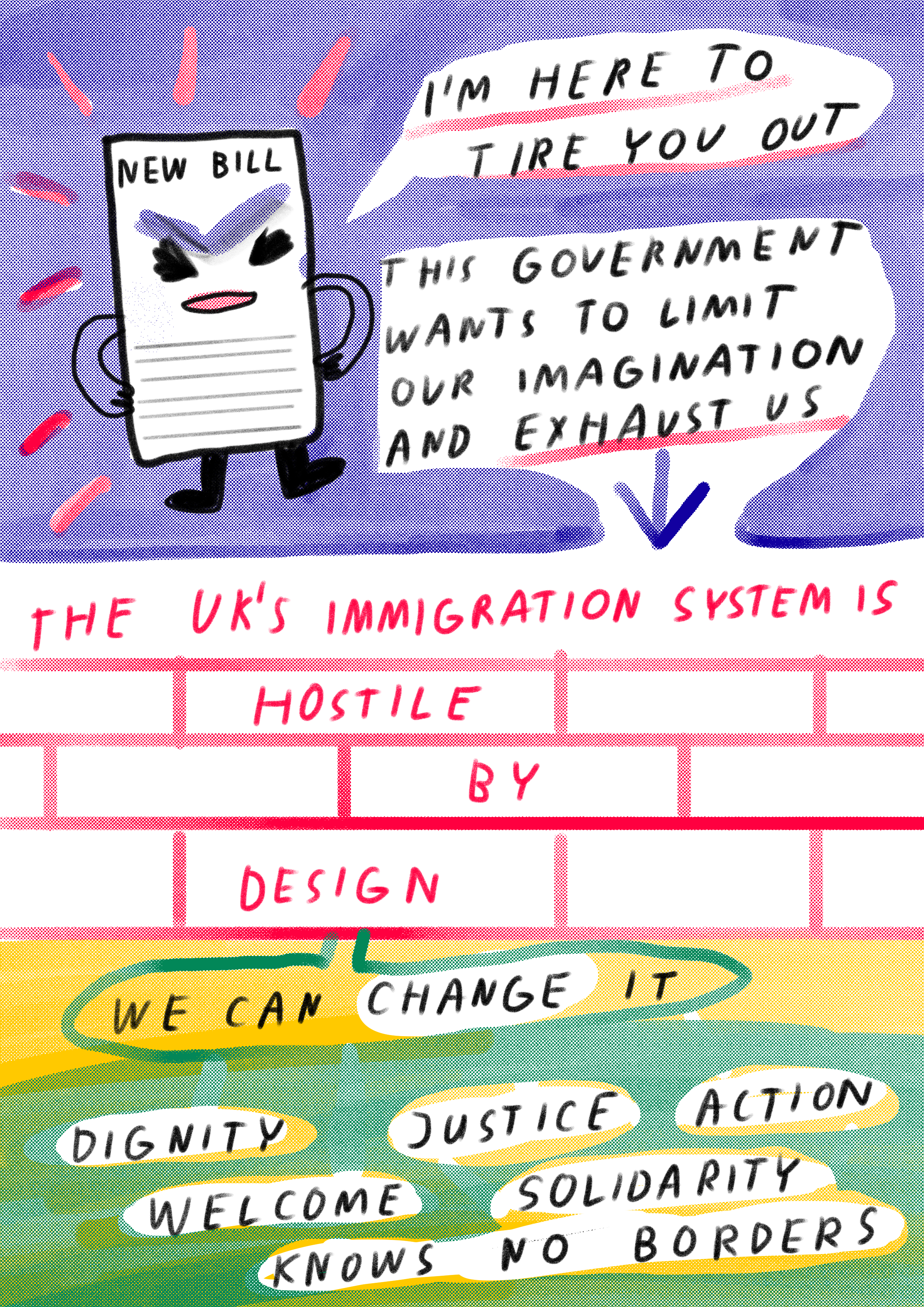
On 13 May 2026, the King made a speech about upcoming changes and announced plans for a new Bill called the Immigration and Asylum Bill (“the Bill”). The Bill was published on 30 June 2026 alongside announcements by Home Secretary Shabana Mahmood about the government’s plans for the asylum system. The Bill is how the government will turn the main changes in the “Restoring Order and Control” statement (published in November 2025) into law. These changes also build on other changes that became law in March 2026. Like earlier announcements, the Bill follows the same pattern of increasing enforcement and control while punishing migrant and working-class communities and failing to address the actual causes of the problems.
Remember that the Bill is not law yet. It needs to go through several stages in Parliament, where it will be discussed, debated, and voted on. This process usually takes several months, and the Bill could still change before it becomes law. You can read our blog about how announcements become law here.
The Immigration and Asylum Bill is 82 pages long. Alongside it, the government has published a 102-page impact assessment, which tries to explain what the Bill is meant to do, what it might cost, and who might be affected. There is a lot of information in these documents and many details are unclear. In this blog, we explain some of the changes the government wants to make that are most likely to affect our communities.
You can also read Work Rights Centre cost and impact analysis of the Bill here.
What does the government want to change in the new Bill?
- A new system for asylum appeals: “Independent Immigration Appeals Authority”
The Bill gives more information about the new “independent appeals system”. This was previously referred to as the Independent Appeals Body, but in the Bill it is called the Independent Immigration Appeals Authority, or the IIAA. This is not the same as the Immigration Advice Authority or IAA, which regulates immigration advice.
Currently, asylum and immigration appeals are heard by the First-tier Tribunal (Immigration and Asylum Chamber). This tribunal is part of the independent court and tribunal system, which is separate from the government. The government wants many appeals to be heard by the new IIAA, including protection and human rights appeals, some immigration bail applications, deprivation of citizenship appeals, and some appeals connected to EU rights.
The government says the IIAA will be independent, but it would be a new public body set up by the government, and the Home Secretary would have important powers over how it is set up, including choosing some of the senior people who will run it at the beginning. This raises questions about how independent the new system will be in practice, especially because the government says one of its aims is to make appeals faster and speed up removals.
Instead of immigration judges in the current tribunal system, IIAA cases would be decided by adjudicators whose job is to look at the evidence in an appeal and decide whether the Home Office decision was right or wrong. The government says these adjudicators will be trained but they will not require the same amount of training as an immigration judge.
The Bill also allows new procedure rules to be made for the IIAA. These rules would explain how appeals should work in practice, including deadlines, hearings, evidence, legal advice, representation, fees, costs, and what happens if someone does not follow a rule or deadline.
The rules could also say how late evidence should be treated. The Bill says that if someone sends evidence late, the adjudicator must treat this as damaging their credibility, unless there are good reasons why the evidence was late.
If an appeal is unsuccessful, there would still be a route to challenge the decision in the Upper Tribunal, but only on a point of law. This means the Upper Tribunal would not usually look at the whole case again. It would look at whether the IIAA adjudicator made a legal mistake. This is called an error of law. A person would usually need permission to appeal to the Upper Tribunal.
The Home Office claims that the new IIAA will make appeals faster, reduce waiting times and help remove people from the UK more quickly if their appeals fail. However, the impact assessment also says many details remain unclear. The Home Office does not yet know the full cost of setting up the new system, how many staff it will need, how legal aid will be affected, how the Upper Tribunal will manage more cases, or how the old tribunal system will be closed down.
- Some people seeking asylum will be asked to pay back their asylum support
One of the proposals in the Bill is to allow the Home Office to ask some people to pay back money for asylum support they received while they were in the asylum system. This could include asylum accommodation and financial support.
The Bill does not give many details about how this would work. The Home Office would make more rules later about who has to pay, how much they have to pay, when they have to pay, and how the money will be collected. The Bill says unpaid amounts could be recovered as a debt, and HM Revenue and Customs (HMRC) may be involved in collecting payments.
The Bill also says people should not have to pay if this would make them destitute. This means they should not be pushed into a situation where they cannot meet their essential living needs or do not have adequate accommodation. Children who were under 18 for the whole time they received asylum support would not have to pay. People who started receiving asylum support before this part of the law comes fully into force would also not have to pay.
This could also affect people’s long-term immigration status. This detail is not set out clearly in the Bill itself, but a Home Office update published alongside the Bill says that people will need to pay back the full amount before they can be eligible for settlement. It also says that people who leave the UK will need to make payments if they want to return in the future. If the Home Office takes this approach, asylum support debt could become a long-term barrier to security. People may be kept in temporary immigration status for longer, not because they do not need stability, but because they cannot afford to repay a debt created while they were prevented from supporting themselves.
The Home Office’s own impact assessment recognises that this proposal could have serious risks, including pushing people into informal work, creating debt traps, and increasing hardship, homelessness and pressure on local authorities.
We also need to remember why people need asylum support in the first place. Many people are waiting for slow Home Office decisions and are not allowed to work. This means people could be asked to repay support they had no real choice but to rely on.
- Article 8 – a more narrow definition of family life
The Bill would make it harder for some people to use Article 8 as part of an immigration case. Article 8 is part of human rights law and it protects a person’s right to respect for their private life and family life.
The government wants to change how the Home Office, courts and tribunals understand the definition of family life. The Bill says a person’s family life would normally be limited to their “core cohabiting family”. This means close family members who live together, such as a partner, a child under 18, or a parent if the person is under 18. This could make it harder for people to rely on wider family relationships, such as adult children, nieces or nephews, parents, siblings, or relatives who live in another country.
For family members outside the UK, the Bill says some Article 8 applications would need to be made by the family member in the UK, called the sponsor, rather than by the person overseas.
The government also wants Article 8 decisions to focus more on the public interest. This means decision-makers would give more importance to things like immigration control, money and debt, public services, criminal convictions, and whether a person has followed immigration rules.
The Bill also proposes changes to Article 8 cases involving people who may be deported from the UK because of criminal offending. The Bill says that in these cases deportation will usually be in the public interest. A person may still be able to argue that deportation would have a serious impact on them and their family, but they would need to show that the impact would be very serious and outweigh the public interest in deportation.
The impact assessment focuses heavily on the financial cost of people being granted permission to stay under Article 8. However, it also acknowledges that the impact of the reforms is uncertain, including what may happen to people who are refused but remain in the UK without legal status, and the possible impact on families.
- Changes to how Modern slavery cases are assessed and how support is given
The Bill would make changes to the modern slavery system based on the government’s assumption that people are currently “misusing” the system. The Bill says that if someone delays saying they may be a victim of modern slavery that, this can damage their credibility (whether or not someone is believable) unless there are good reasons for why they did not say earlier. This means a decision-maker may think someone should not be believed because they did not explain what happened earlier. Needless to say, many people who have experienced modern slavery do not talk about their exploitation straight away – they may be scared, traumatised, controlled by exploiters, worried about trusting the Home Office or police, or not understand that what happened to them is legally relevant.
The Bill would also change the recovery period for potential victims of slavery or trafficking. A recovery period starts after someone receives a positive reasonable grounds decision which means that based on the referral, there is enough information to believe they may be a victim. During the recovery period, the person should be protected from removal and able to access support. At the moment, this period must last for at least 30 days. In practice, it often lasts much longer because conclusive grounds decisions can take a long time. The Bill would allow a conclusive grounds decision to be made during the first 30 days. If that decision is negative, the recovery period would end straight away. This means some people could lose support and protection from removal before the full 30 days have passed.
The government also wants to make it easier for some people to be disqualified from modern slavery protection. This could happen because of public order or national security reasons, or because the Home Office says the person made a claim in “bad faith”. The Bill says a claim may be treated as made in bad faith if it is made when someone is due to be removed from the UK, or if the person knowingly gives false or fabricated information. There are some exceptions, including when the person responded to a claim notice in time, or where the Home Office accepts there were compelling reasons why the claim was not made earlier.
The organisation Focus on Labour Exploitation (FLEX) have written a powerful statement on the proposals and what they would mean for people who have been exploited, which you can read here.
- One new protection status
Currently, if someone needs protection, they may be granted refugee status or humanitarian protection. The Bill would allow the Home Office to create one new protection status. The government refers to this as core protection.
The government says combining these into one protection status would make asylum decisions simpler and faster because it will stop some appeals where a person has been granted humanitarian protection but wants to challenge the decision because they believe they should have been granted refugee status.
The Bill also includes a change for some people who have been convicted of very serious crimes, or who the government says are a danger to UK security. If these people cannot be removed from the UK because of human rights law, the Bill says they should not be treated as “lawfully staying” under some parts of the Refugee Convention. This could affect what rights or support they can access.
The Bill gives the Home Secretary power to make more rules about how this new protection status would work. This means many important details would be decided later in regulations.
- A potential new refugee sponsorship route.
The government has also announced plans for new refugee sponsorship routes, including community sponsorship, university sponsorship and a future refugee work route building on the Homes for Ukraine Scheme. These are mentioned in the Home Secretary’s announcement on 30 June 2026 but are not explained in the Bill.
What happens next?
The Bill had its First Reading in the House of Commons on 30 June 2026. This is the formal stage where the Bill is introduced. The Bill is scheduled to have its Second Reading on Monday 13 July 2026. This is when MPs debate the main principles of the Bill.
After this, the Bill will need to go through more stages in Parliament before it can become law, which can take a long time. This includes detailed scrutiny, possible amendments, further debates and votes in both the House of Commons and the House of Lords. The government explains how a bill becomes law in detail here and we also explain this in our blog.













Discussion: