
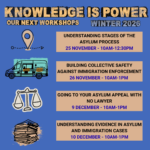
With more and more people going through the process of claiming asylum without lawyers, we need to step up and support each other to be prepared and organised. Well-presented evidence can make a huge difference to a case but finding and presenting evidence can be confusing. This is why we have created a new Knowledge is Power session on Evidence to bring our community together to share practical tips and information. Making sure that your story is clear is important, and we want to explain one way of setting out what happened: a chronology.
What is a chronology?
A key piece of evidence for any case can be a witness statement (your story written down clearly). We explain witness statements more in our Evidence Key Guide. Sometimes a well-written witness statement by itself can be enough to prove a case without any other evidence. Part of your witness statement can include a chronology or timeline – this means a clear written explanation of key events and details and when they happened.
You can write a chronology by yourself but it might be helpful to sit with someone and write it together. We all understand and interpret things differently, and sometimes when we tell a story, we can miss details that can give a background, or help explain why something happened or what it might mean. Helping someone write their chronology is really useful and important legal support.
How should I write a chronology?
Your chronology should be as clear and detailed as possible but you should focus on key events. It is important not to guess – it is OK if you don’t remember exactly when something happened. It is not always necessary to give a specific date or time, you can think about things differently. Here are some examples of how you might explain when something happened:
- It was during the rainy season.
- I remember we were fasting so it was during Ramadan.
- We travelled in the car for a long time. I saw the sunset and sunrise.
- There was a big celebration while I was there, everything was closed and there were parties in the streets.
- I remember carrying my daughter as she couldn’t walk yet so she must have been a baby.
- There was heavy snow that week and the roads were blocked.
- A few days after New Year celebrations
If you are writing a chronology in the early stages of your case, for example before an interview, this can be a helpful way of organising your thoughts so that you can explain things clearly. Sometimes, things have happened in your life that might be relevant for your case, so if you can, start your chronology from the early stages of your life. This could mean first stating your date of birth, and when you attended school, then explaining where you lived, if you had work, or how you met people connected to your case. Giving lots of details at the start can mean less questions are asked later on.
As you get to parts of your story where a lot of things happened, or you are explaining key events, the chronology might be busier, and the descriptions might be longer. You may find it helpful to focus on the main events that made you leave your country, and the reasons you would be at risk if you had to return now. This could include things that happened after you travelled to the UK. You might be asked about these events at a later stage and your responses will be compared to your statement, as well as any interviews.
If you are writing a chronology after a decision, then you will also need to consider whether there are mistakes in the decision or in your interview, or anything that was unclear in your case. To do this, it is important that you have copies of all your documents, including interview records. You can request these from the Home Office by making a subject access request or emailing the Home Office – this is also explained in our Evidence Key Guide.
An example of how your chronology might look:
2015 – I got a job in Kahwa cafe in Baghdad
2017 – A local communist group started meeting in the cafe. I served them as I would any other customer.
2017 at the end of winter – I had some longer conversations with members of the group. They shared leaflets with me. By the start of summer, I had learned a lot and decided to join the group myself.
14th June 2017 – I went to my first meeting with the group. I remember the date because it was on my birthday.
A few weeks later – the police came into the cafe during a meeting. They took any leaflets or notebooks that members of the group had and told them they were not allowed to hold meetings anymore. They arrested two members but I was working on this day and was not targeted.
During Ramadan – I attended an Iftar meal with the group. The police stormed in as we were about to eat and arrested everyone. I was taken to a police station and detained
Do I have to write a chronology?
Some people might not be able to write a chronology, or complete a statement. This could be because it is too traumatic to think about what has happened or talk about it. Trauma can also impact memory, making it difficult to remember what happened or when it happened. If you are experiencing trauma, then you can explain this so that the Home Office or Judge understands why you don’t remember, and why your story might be missing details or information. You don’t have to write a statement or provide a chronology but having a written account can help avoid you having to explain things repeatedly. Think about whether it would help you to do this with someone, or if someone could read through your story after you write it to help make sure it is clear.
If you are experiencing trauma, it is important to seek help from a medical professional. This could help you to feel better and process what has happened to you, but it could also help you explain your trauma by showing that you have tried to find support. A doctor or therapist might also agree to write a letter or statement confirming whether you have been diagnosed with a mental health condition, or are receiving treatment of any kind – this could be medication or therapy, or a planned treatment.
We need to support each other
Right to Remain started off as the National Coalition of Anti-Deportation Campaigns, fighting to stop migrants being removed from the UK. Enforcement remains a key focus of the current government, and something we need to prepare for as communities. We talk more about how to do this in our Knowledge is Power session on Detention and Enforcement and if you want to be part of a focused practical action opposing the government consultation to expand Campsfield immigration removal centre, you can learn more about this here.
We are in a legal aid crisis, and the hostile environment has not gone away. It is in this context that we have been telling our communities that nobody is coming to save us, so we need to step up and give legal support. We can prepare ourselves by gaining and sharing knowledge, and building power through our communities. Helping someone explain their story in clear terms is one way of doing this – every act of solidarity, however small it may seem, is important and meaningful.










Discussion: