
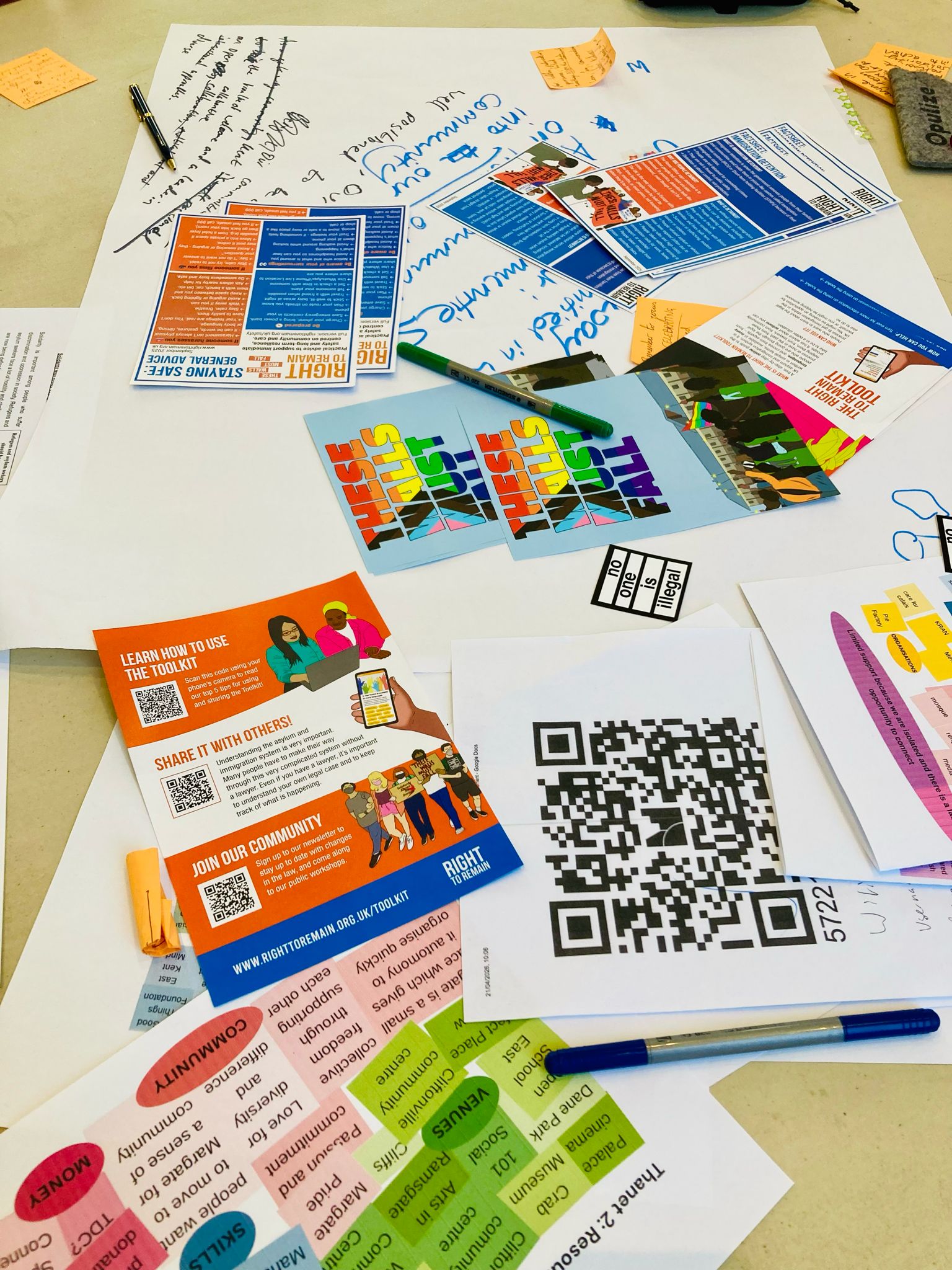
Building on our work on asylum appeals so far
Asylum appeals is one of Right to Remain’s thematic focuses. In 2025/26, we updated and expanded relevant Toolkit pages. We developed a new workshop on appeals and ran it twice, training 67 people from 34 groups. We know that asylum appeals will remain a major issue for our communities for years to come and so we will continue to run our workshops throughout 2026/27. We need to cultivate shared strategies for understanding the system, supporting one another, and responding collectively; that’s why we dedicated our Radical Solidarity Hub on 29 April on asylum appeals.
Our Radical Solidarity Hub meetings bring people together every quarter to connect, share space, exchange practical tips, and learn from each other’s experiences. These meetings are held primarily for grassroots groups without in-house legal or policy teams, and for people directly caught up in the system. On the day, 66 people joined us from across the UK, including Bradford, Manchester, Leeds, London, Birmingham, Portsmouth, Bristol, Lancaster, Swansea, Glasgow and Derry, demonstrating our wide reach and potential to build a national picture of what’s happening.
Amid the legal aid crisis, the challenges of asylum appeals are not going away. Currently over 80,000 asylum appeals are waiting in the Tribunal with an average wait of around 63 weeks. In December 2025, the National Audit Office released a report that found significant errors in 42% of sampled asylum decisions, which raises serious questions about why so many people are being forced to appeal in the first place.
We opened the meeting with our Director Eiri acknowledging that we are in a period of heightened political tension with the recent UK-France deal and uncertainty around the upcoming local elections (well, we now know the results!) – we could sense our collective weariness in the room, and it was important to name it. Our Lead Legal Education Officer, Ally, then gave an overview of what we know so far about major changes affecting asylum appeals, including the proposed Independent Appeals Body, the new 24-week timetable for some asylum appeals, and the Home Office’s voluntary process inviting people to supply new evidence after lodging an appeal.
Community experiences of the current asylum appeal process
We asked the group which parts of the appeal journey feel most daunting. Again and again, people came back to the same things: the legal aid crisis, how hard it is to find a good solicitor, poor-quality advice, missed deadlines, and the worry about how much supporters can do without crossing into legal advice. People also talked about what happens when there is no proper advice available as people still have to prepare for their appeal, respond to refusal letters, prepare evidence and write statements. We do not expect a sudden supply of legal aid lawyers to appear in the near future: we must think what to do right now. In that gap, we discovered that some people are turning to tools like ChatGPT to write witness statements or translate documents and people raised their concerns about accuracy, confidentiality, and whether someone could accidentally damage their own case. People also shared worries about practical barriers such as communicating with the Tribunal, applying for fees to be cancelled and tight deadlines for submitting further evidence.
Reflections on the proposals for an Independent Appeals Body
The government is presenting the proposed Independent Appeals Body as a solution to the asylum appeals backlog, but the plan remains extremely vague. Instead of appeals being heard by immigration judges in the First-tier Tribunal, the new body would use “adjudicators” trained by the body itself. The government says this would make appeals faster, but there is still very little detail about who these adjudicators would be, what legal training they would need, how the body would operate, or how its independence would be protected. The plan was first announced by the previous Home Secretary, Yvette Cooper, in August 2025 repeated in the government’s November 2025 policy statement, Restoring Order and Control: A statement on the government’s asylum and returns policy and followed by a Home Office call for evidence in March 2026. Despite all this, many basic questions remain unanswered.
However, even with the lack of detail, we can see the direction of travel. Appeals are being treated as a backlog problem, rather than as an essential safeguard against poor Home Office decisions. Independent judicial oversight risks being weakened, while speed and the appearance of control are prioritised over fairness, preparation and proper scrutiny. In the meeting, many people shared their frustration at poor Home Office decision-making, “appalling errors” and the harm this causes in people’s lives and communities who remain stuck in the system.
Reflections of the 24-week timescale for appeals
As part of the Border Security Asylum and Immigration Act 2025, which became law in December 2025, new rules were introduced under Section 49 and Section 50. These say that some appeals are supposed to be decided within 24 weeks, which is about 6 months, from the day after the appeal is made.
The new rules will apply to people who are receiving money and housing from the Home Office (asylum support) when they submit their appeal and people who are not in immigration detention but the Government is trying to deport them because of a criminal offence. We explain more about the impact of this change here.
At the time of writing, there is no updated published tribunal guidance explaining exactly how the 24-week timetable will work in practice and when it will start. Some law firms have said they believe cases will begin from May 2026 which was echoed by other people in attendance, however we continue to wait for a new edition of the Tribunal Practice Guidance.
Community experiences of the voluntary “supply new evidence” process
We have been hearing about many people receiving a letter from the Home Office after submitting an appeal, inviting them to send additional evidence within 14 days. This is a voluntary process, where the Home Office reviews the case again before the appeal hearing. In some cases, this may lead to a grant of leave. If the Home Office maintains the refusal, the appeal should continue as normal.
We have not found a public Home Office policy that clearly explains this process. It appears to be connected to the Home Office’s duty to review cases during the appeal process, and to existing guidance which allows the Home Office to withdraw a refusal where new evidence means the decision should be changed.
People shared mixed experiences of this process. In some cases, decisions were reversed but many raised concerns about tight deadlines, lack of solicitor capacity, risks for unrepresented people, and the possibility that rushed or unsupported evidence could harm the appeal or other future applications.
Legal support as our community power
We shared our learnings from the ‘Knowledge is Power; asylum appeals’ workshops that we piloted. We explained that because there is so much to cover in appeals, we struggled to squeeze everything into a workshop. A couple of ideas that emerged as we shared our reflections included, for example, for some local groups to come together and organise trips to the tribunal to observe appeals hearings, or accompany people who have hearings. Those present felt that this was something achievable, with careful planning and coordination, and would enable our communities to cascade knowledge in a practical, tangible way. Another was for Right to Remain to run a stand-alone workshop on how to prepare evidence. This is something we have been thinking about for a while, and we will consider if our capacity allows us to do this.
(Please remember, we only had one Legal Education Officer until May who had to research, update the Toolkit, write legal updates, develop and run workshops, in between everything else. Our second Legal Education Officer joined us only recently. If you would like us to have more Legal Education Officers, please speak to your funders and encourage them to fund us!)
The group discussions were an opportunity for people to share how their communities/organisations/groups already support someone after an asylum refusal, what feels most difficult in appeal work, and what further support or sessions might help people prepare, gather evidence and understand the appeal process together.
It was clear from these discussions that so much legal support work is already being done by grassroots groups, ranging from helping people cope with an emotional shock of receiving a refusal to going through their refusal letter together to help people understand why their asylum applications were refused. It was also clear that each act of legal support and solidarity needed a lot of time, energy and humanity: sitting down with people and showing up for them. We salute everyone who is continuing this invisible work of legal support, sometimes spending hours at a time with one person, day in day out.
It was also acknowledged that sharing information alone is not always enough: people preparing asylum appeals may know they need to start gathering evidence or working on statements, but still need someone to sit with them, help them begin, and support them to keep going. Preparing for an appeal is a daunting task. We need to tend to this human aspect of navigating the legal system, work that can only be done through trust, connections and relationships.
We would like to thank everyone who came and shared their thoughts. We listened carefully and were awed with the incredible amount of legal support work that’s been done, and feel honoured to work with these groups in the migration justice movement. We know that the appeal backlog will continue and it is a marathon. We will continue to hold space for those who are using our Toolkit, and are proud of our community united by the power of public legal education.
Our next Knowledge is Power Asylum Appeals session will take place on 25 June. We will open our booking soon, so stay tuned!
Ally Swadling, Lead Legal Education Officer & Eiri Ohtani, Director










Discussion: