
Last Updated: 30 January 2026
An appeal is a formal legal challenge to a Home Office decision.
This page explains how to submit an appeal, what happens after you submit it and how to prepare for your appeal. It also explains how to read a refusal letter, and how to start preparing your evidence and appeal bundle (including country information, expert reports, and a short video about case law).
This page assumes you do not have a lawyer, but it is still useful to read even if you do, because it is important to understand your own case and keep track of deadlines.
To read about what happens on the day of an appeal hearing, and tips for representing yourself, you can read our Toolkit page on Your Appeal Hearing at the First-tier Tribunal.
On this page, you will find the following information:
- What is an appeal?
- Useful words
- How to submit your appeal
- Appeal fees: when you do not need to pay, and what to do
- Guide to submitting your appeal online
- What happens after you submit an appeal?
- How to prepare for your appeal hearing
- Getting evidence for your appeal
- Country guidance information
- Video: Understanding case law
- Expert evidence
- Action section: for expert evidence
- Objective evidence
- Digital evidence: social media, messages, and screenshots
- Documents sent from your country or from abroad
- Witnesses (witness statements and the hearing)
- Action section: Prepare and organise your bundle
- How long do I have to wait for my appeal hearing?
- Preparing for your hearing
There is a lot of information on this page, which might feel overwhelming. It may be helpful to watch our video about appeals before you read this page.
What is an appeal?
If the Home Office refuses your application, you may have the right to appeal the decision. An appeal means you ask an Immigration Tribunal (a type of court) to review your case.
At the Tribunal, an independent judge looks at the Home Office decision and the evidence in your case. You (or your representative) can explain what you think the Home Office got wrong, and you can send evidence to support what you say. The Home Office can also send its reasons and evidence.
An appeal is not just “checking the paperwork”. It is a chance to challenge the Home Office refusal and ask a judge to decide your case fairly, based on the evidence.
What can happen at the end of an appeal?
If you win, the judge may allow your appeal (meaning the Home Office decision is not accepted). If you lose, the judge may dismiss your appeal (meaning the refusal decision stays in place). Sometimes, the Tribunal may send the case back to the Home Office to make a new decision.
An appeal is not a judicial review.
An appeal is different from a judicial review. An appeal is about the main decision in your case. The question is: was the Home Office right to refuse you, when you look at the evidence?
A judicial review is different. It is usually a challenge about whether the Home Office made the decision in a lawful and fair way (the process). A Judicial review is more limited than an appeal, and it is more complex. To find out more about judicial reviews, read the Judicial Reviews page of our guide.
USEFUL WORDS
When you submit an appeal, you may come across unfamiliar words and phrases. Below are a few definitions that might be useful to know:
Appellant: This is you!
Respondent: This is the Home Office. You might also hear people use the phrase, ‘Secretary of State for the Home Department’, the ‘Home Secretary’, or ‘SSHD’.
Party to Proceedings: This is used to describe both you and the Home Office. If you read the phrase “parties must provide…” it is referring to both the appellant (you) and the respondent (the Home Office).
Immigration Judge: The judge is responsible for considering the evidence in your case. They will decide whether the original Home Office decision was correct or not.
The Hearing or The Substantive Hearing: This describes your time in court. At your substantive hearing, you will be given the chance to tell the judge why you think the Home Office was wrong to refuse your application. If you have a lawyer, they will be telling the judge this information, but you will also have a chance to share your story.
Home Office Presenting Officer (HOPO): The HOPO is employed by the Home Office and may represent the Home Office at your hearing. They will be arguing that your case should be dismissed.
Determination: This word is used to describe the judge’s decision.
Appeal Allowed: If your appeal is allowed, this means that the judge has decided that your claim should be accepted.
Appeal Dismissed: If your appeal is dismissed, this means that the judge has decided that your claim should be refused.
Lodging an Appeal: this just means submitting an appeal.
Notice: This word is used to describe important information, usually in writing, communicated by the Tribunal or one of the parties. When you submit your appeal, you are sending a Notice of Appeal. When the Tribunal sends you a letter with the date of your hearing, this is called a Hearing Notice.
File: Filing a document just means sending it to the Tribunal ahead of the hearing.
Directions: These are instructions from the Tribunal. They will tell you what you need to do next.
Bundle: This word is used to describe a collection of important documents. The appellant bundle is submitted to the Tribunal by you (the appellant) and will contain all the documents that you would like the judge to see. This will include evidence that you are relying on, such as country of origin information. The respondent bundle will be prepared by the Home Office and will include documents that they wish to rely on. You will need to send a copy of the appellant bundle to the Tribunal and the respondent (Home Office). You can read more about bundles below.
Adjournment: An adjournment is when the hearing date is moved back (delayed). You can read more about adjournments below.
First-tier Tribunal: For most people, the First-tier Tribunal is the first court you have access to if you are appealing a refusal by the Home Office.
Upper Tribunal: If you lose your appeal at the First-tier Tribunal, you may be able to appeal again at the Upper Tribunal. This is the court one level above the First-tier Tribunal.
Immigration and Asylum Chamber: Together, the First-tier Tribunal and Upper Tribunal form the Immigration and Asylum Chamber. A Chamber is a section of the UK court system which deals with legal disputes in a particular area of law.
In the UK, there are various levels of court; the diagram below outlines these levels, starting with the “lowest” (likely the first court your case will go to) and ending with the “highest”. Decisions from lower courts can be overruled (rejected) by higher courts.

How to submit your appeal
If you do not have a lawyer and need to submit (lodge) your appeal within 14 days of a Home Office refusal decision – you can do this online yourself. It is important you do not miss this deadline.
You do not need to include any legal arguments or evidence when you submit your appeal, you can do this later once you have found legal representation or received legal advice.
Different ways to submit an appeal
For most people, the easiest way to appeal is online. You can appeal by email or post, but it is usually slower and it can be harder to keep track of what is happening.
If you appeal online, you create an account and can use the service to submit your appeal, upload documents, ask for a hearing, request support (for example an interpreter), and later see the decision. You will need your Home Office reference number and an email address.
If you are detained in an immigration removal centre or prison and you do not have a lawyer you will need to appeal by post or email.
If you appeal by post or email, you usually use form IAFT-1. After The Tribunal receives your appeal, they will check it over and tell you what happens next.
Visit the government website to learn about how to submit an appeal here.
If you missed the deadline
If you missed the deadline, you can still try to appeal, but it will be an out of time appeal (a late appeal). You will need to explain why your appeal is late and, if you can, give evidence to support your reason (for example: you did not receive the decision in time, you were unwell, you were in hospital, you did not have access to your documents). You can do this through the online system (see below). The Tribunal may or may not accept an out of time appeal. If possible, get legal advice.
If you are receiving asylum support, a late appeal can also affect your support, because support usually continues during an appeal only if the appeal is lodged in time. It is a good idea to contact Migrant Help as soon as you lodge your appeal. Keep proof that the appeal has been submitted (for example, the confirmation email or a screenshot from the online system) and share it with them if needed. Read our page about asylum support here.
Appeal fees: when you do not need to pay, and what to do
Most appeals to the First-tier Tribunal (Immigration and Asylum Chamber) have a fee. The fee is usually £80 (without a hearing) or £140 (with a hearing)
When you do not need to pay (fee exemption)
Some people do not need to pay the fee. This is called “fee exemption”. You do not need to pay the appeal fee if you:
- receive asylum support from the Home Office
- receive legal aid
- are appealing deprivation of British citizenship or revocation of refugee status (revocation of protection status)
- are under 18 (or you have parental responsibility for a child under 18) and the child is receiving certain support from the local council under children’s law
- have had the fee waived by the Home Office for your application in certain human rights situation
If you are fee exempt, you should provide proof when you submit your appeal (for example, a letter confirming asylum support or legal aid).
If you do not have the proof on the day you lodge the appeal, lodge the appeal in time and send the proof as soon as you can.
If you are on asylum support, you can ask Migrant Help (or your asylum support provider) for a letter or confirmation you can use as proof.
Sometimes people later get a letter asking them to pay because the Tribunal has not yet received the proof. If this happens, don’t panic – send the evidence as soon as possible. You can find contact details for the Tribunal at the top of the letter or on the UK Government website here.
If you are not fee exempt
If you do not fit into a fee exempt category, you may still be able to get help to pay the fee. This is for people on a low income who cannot afford the fee. You apply online and get a reference number to use when you submit your appeal. Read more about how to get help with court and tribunal fees here.
Guide to submitting your appeal online
This guide was created at the suggestion of and in collaboration with Rainbow Migration. Many thanks to colleagues there for their wisdom, support, and tips.
If you do not have a lawyer and need to submit your appeal within 14 days of a Home Office refusal decision, you can do this online yourself. It is important you do not miss this deadline.
You do not need to include any legal arguments or evidence when you submit your appeal, you can do this later once you have found legal representation or received legal advice.
If you missed the deadline and your appeal is late, please seek legal advice before submitting your appeal online.
Visit the government website to learn about how to submit an appeal online here.
ACTION SECTION
STEP 1: When you sit down to submit your appeal online, make sure you have all the below information with you, and that you have enough time to complete the whole application, because you must complete each section of the application before moving onto the next. If at any point you need to stop filling in the online form, you can click on ‘Save for later’ so anything you have completed is saved. You can then log back in later and continue.
Make sure you have:
- Your Home Office reference number – usually on the refusal letter, and
- A copy of the Home Office refusal letter saved in PDF format because the system sometimes will not allow other formats such as pictures (you can create a PDF on a computer, or by Googling ‘create free PDF’), and
- An email address or phone number you would like to use.
STEP 2: Visit this website to create an account.
STEP 3: Create an account using your preferred email address. You should see a page asking you to go to your email inbox to follow the instructions to finish creating your account. You should then receive an automated email from HM Courts and Tribunals Registrations asking you to confirm your email address. Click on the link that says ‘Confirm your email address’.
STEP 4: You will then be taken to a page that asks you to create a password. Make sure you use a password you will remember, but that is strong. Keep a record of your password somewhere safe. Then click ‘Continue’.
STEP 5: You will be taken to a page to confirm your account has been created, and you can now sign in. Click ‘Continue’. You will then be taken back to the account page. Ensure your email and password are entered correctly then click ‘Sign in’.
STEP 6: Once you have signed in, you will be taken to a page that looks like this.
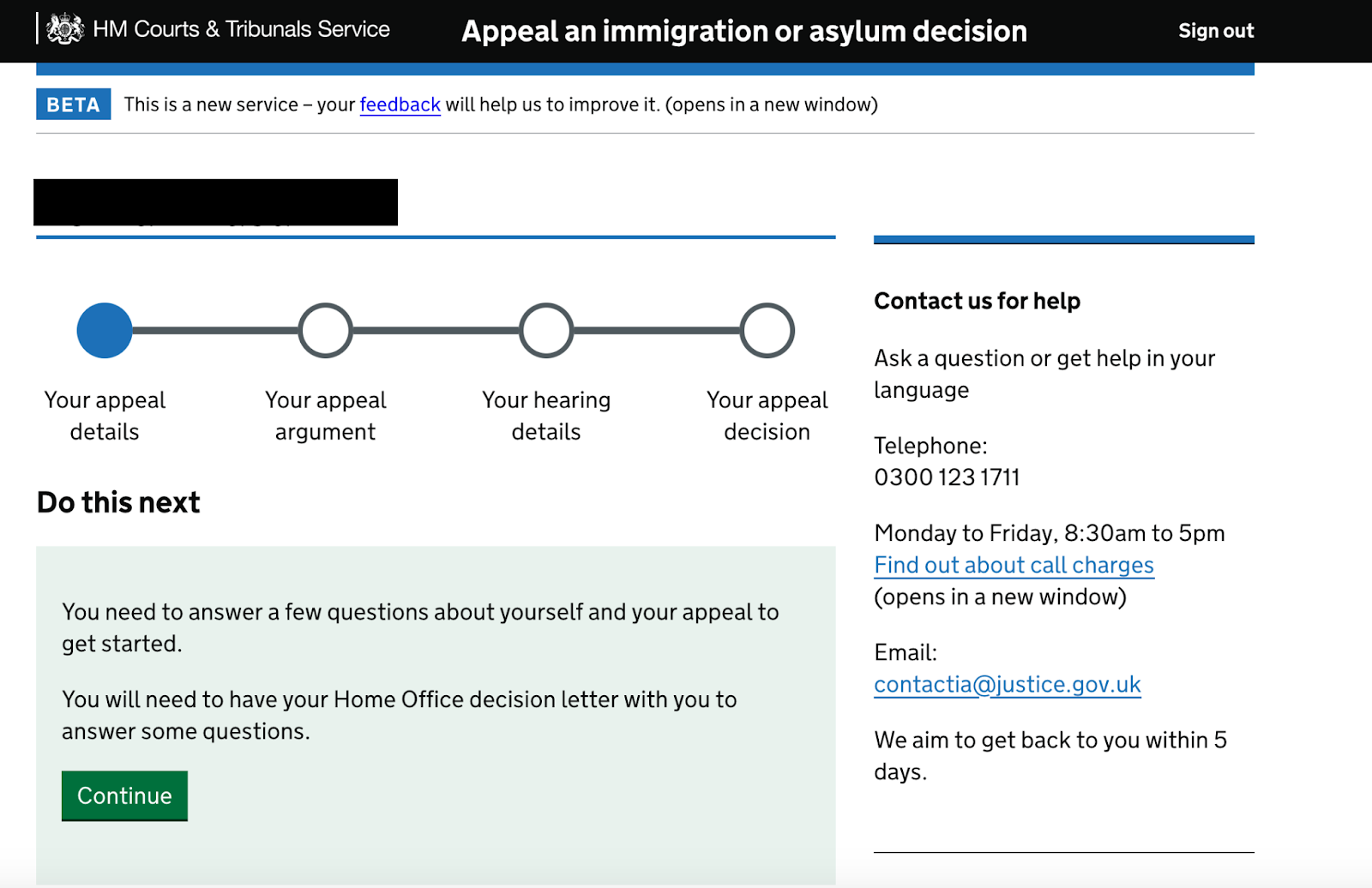
This account is where you will be able to monitor the progress of your appeal. To start the process of submitting your appeal online, click ‘Continue’.
STEP 7: You will be taken to a page that says ‘Tell us about your appeal’. This is like the menu page for filling out the different sections of the application. The first section you need to fill in is called ‘1. Your details.’ Remember, you need to finish each section before you start the next section.
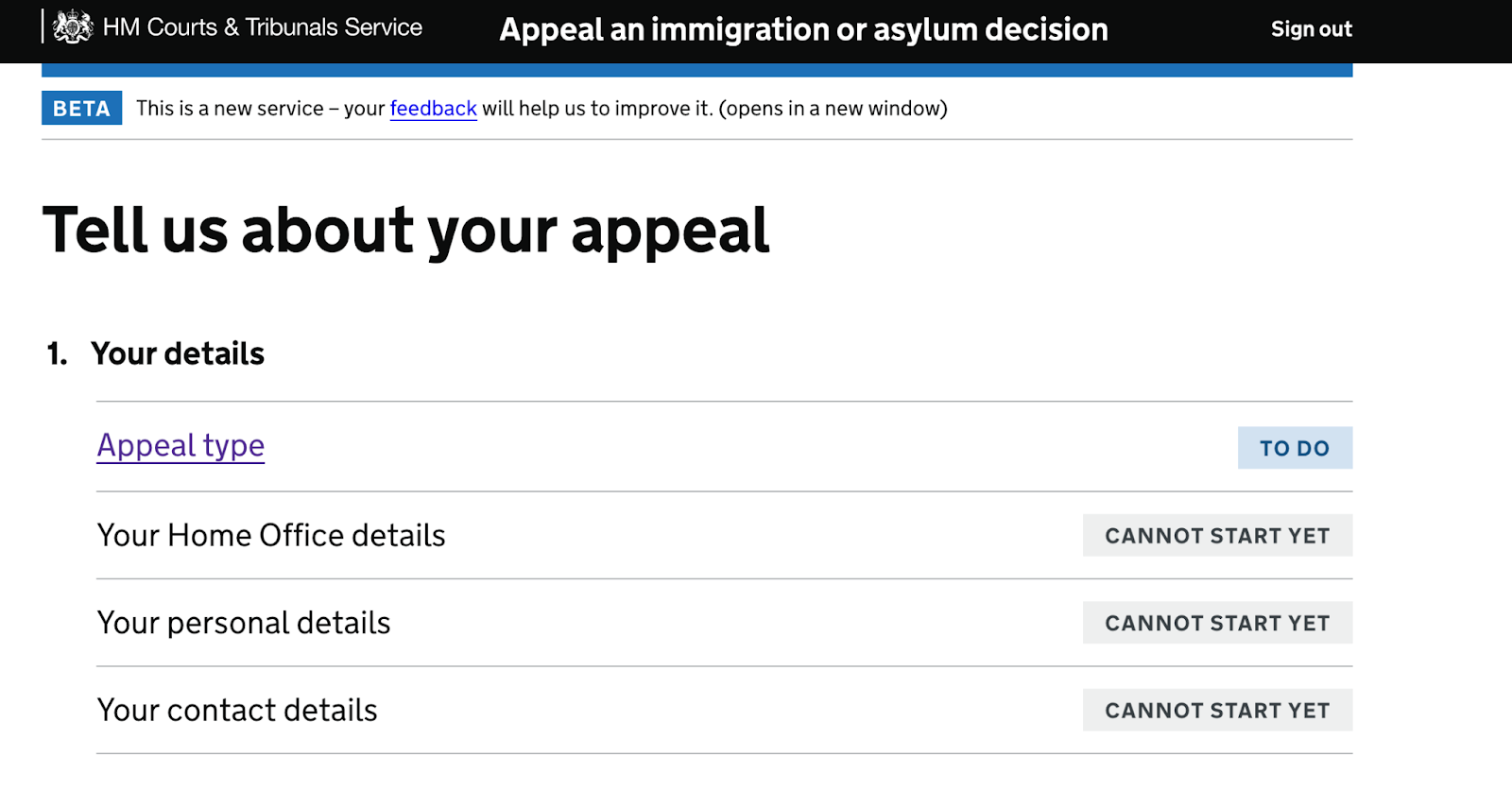
Begin by clicking the link that says ‘Appeal Type’ and input the following answers:
- If you are currently living in the UK, click ‘Yes’ and click ‘Continue’;
- If you are claiming asylum, then click ‘Protection’ for ‘What is your appeal type?’. Then click ‘Save and continue’.
- Note: You can only select one option, so even if you have human rights as part of your claim just select ‘Protection’ for now. You can inform the Tribunal of other issues later.
Remember, if at any point you need to stop filling in the online form, you can click on ‘Save for later’ so anything you have completed is saved. You can then log back in when possible and continue.
STEP 8: After this, you will be taken back to the ‘Tell us about your appeal’ page, and can start the next section called ‘Your Home Office details’.
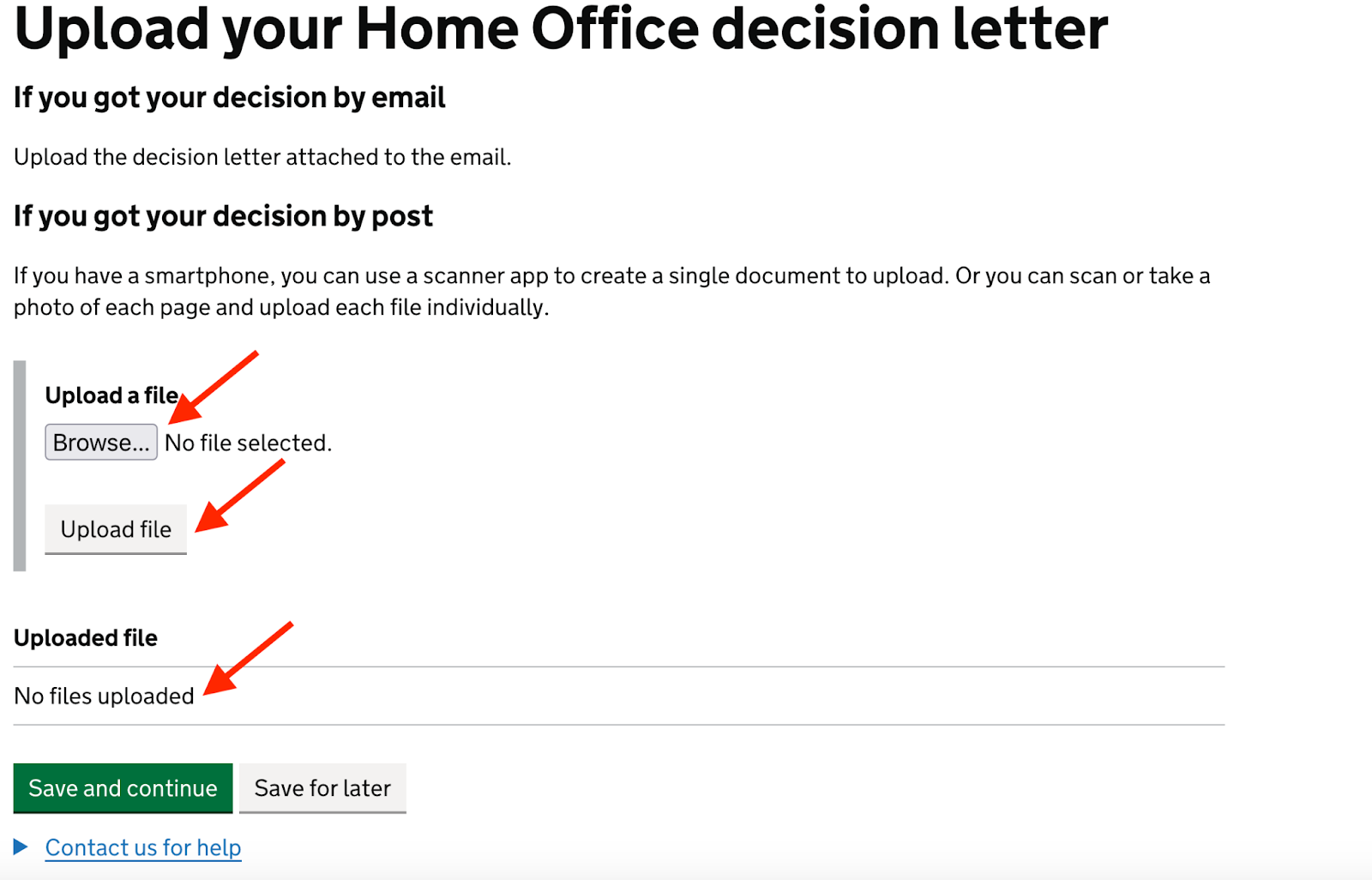
Click on this link that says ‘Your Home Office details’ and input the following:
- Enter your Home Office reference number. There is a number to call if you cannot find the correct number. Click ‘Continue’;
- Enter the date your Home Office decision letter was sent. If you received it by email, this will be the date the email was sent by the Home Office. If you received it by post, it will be the date stamped on the front of the envelope. If you don’t have the envelope, enter the date on the first page of the decision letter. Click ‘Save and continue’;
- You will then need to upload your Home Office decision letter:
- First, make sure you have a PDF version of the decision letter saved on the computer or device you are using;
- Second, click ‘Browse’ and select the Home Office decision letter;
- Third, click ‘Upload file’;
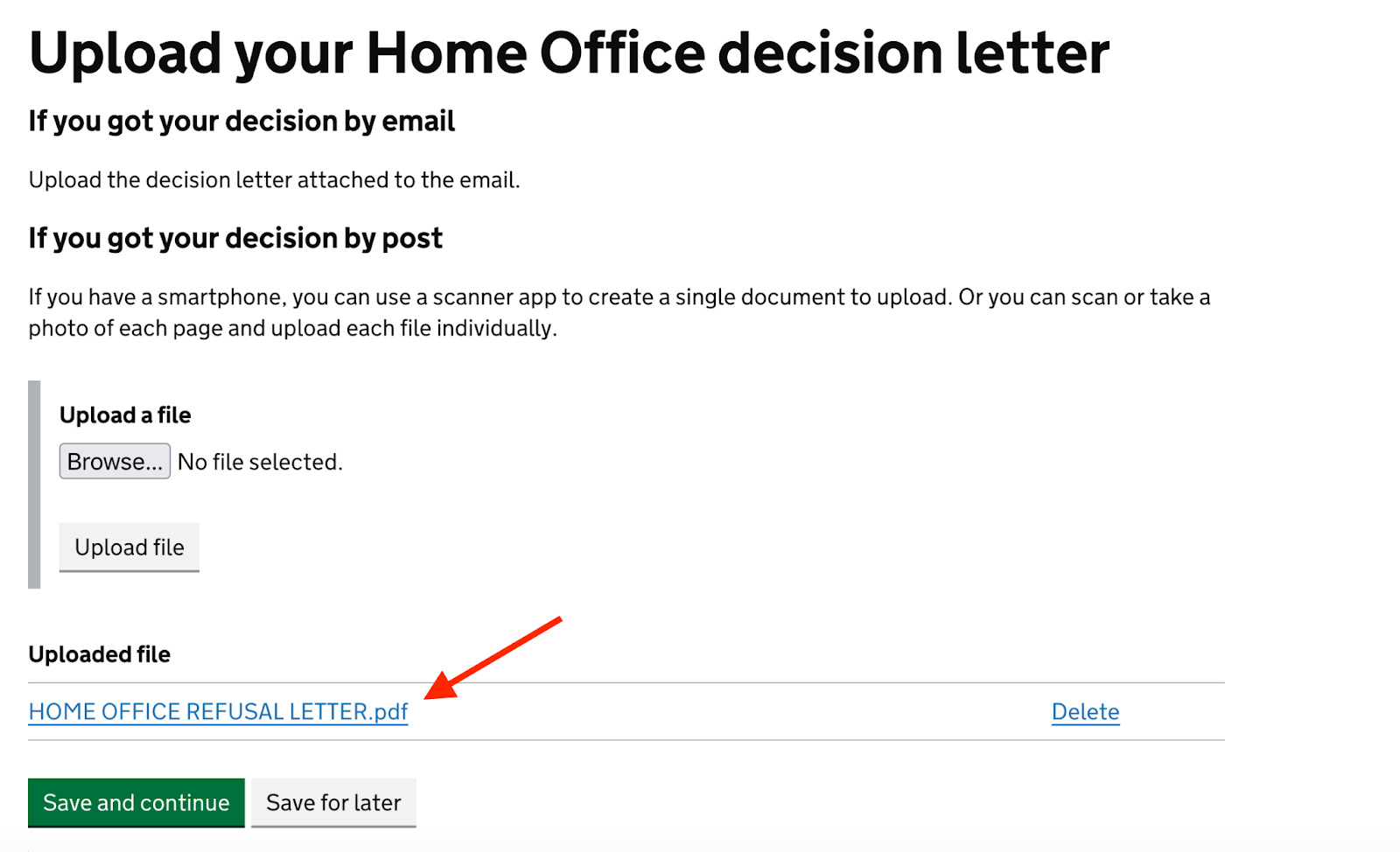
- Fourth, check that the file has been uploaded under the section stating ‘Uploaded file’.
- Finally, once you are sure the decision letter has been correctly uploaded, click ‘Save and continue’. If it has been uploaded properly, it should look like this:
STEP 9: Back on the ‘Tell us about your appeal’ page, you should then be able to click on the link that says ‘Your personal details’ and enter the following:
- Your given names as used on your application form (any first names and middle names) and your family name (surname) as used on your application form. Click ‘Save and continue’;
- Your date of birth;
- Select your nationality from the drop-down list (or click ‘I do not have a nationality’ if you are stateless);
- Enter your UK postcode and then click ‘Find address’, and select your address from the drop-down list. If you cannot find your address, click the link saying this and enter your address in full. Click ‘Save and continue’.
STEP 10: Back on the ‘Tell us about your appeal’ page, you should then be able to click on the link that says ‘Your contact details’. Click on it and enter the following:
- Select how you would like the Tribunal to contact you – by email or mobile phone, or both;
- Then enter your email address and/or phone number. Make sure the details you input are correct. Then click ‘Save and continue’.
You have now completed section 1!
STEP 11: You will now be able to move onto the next section called ‘2. Decision type’. Click the link that says ‘Decision with or without a hearing’.
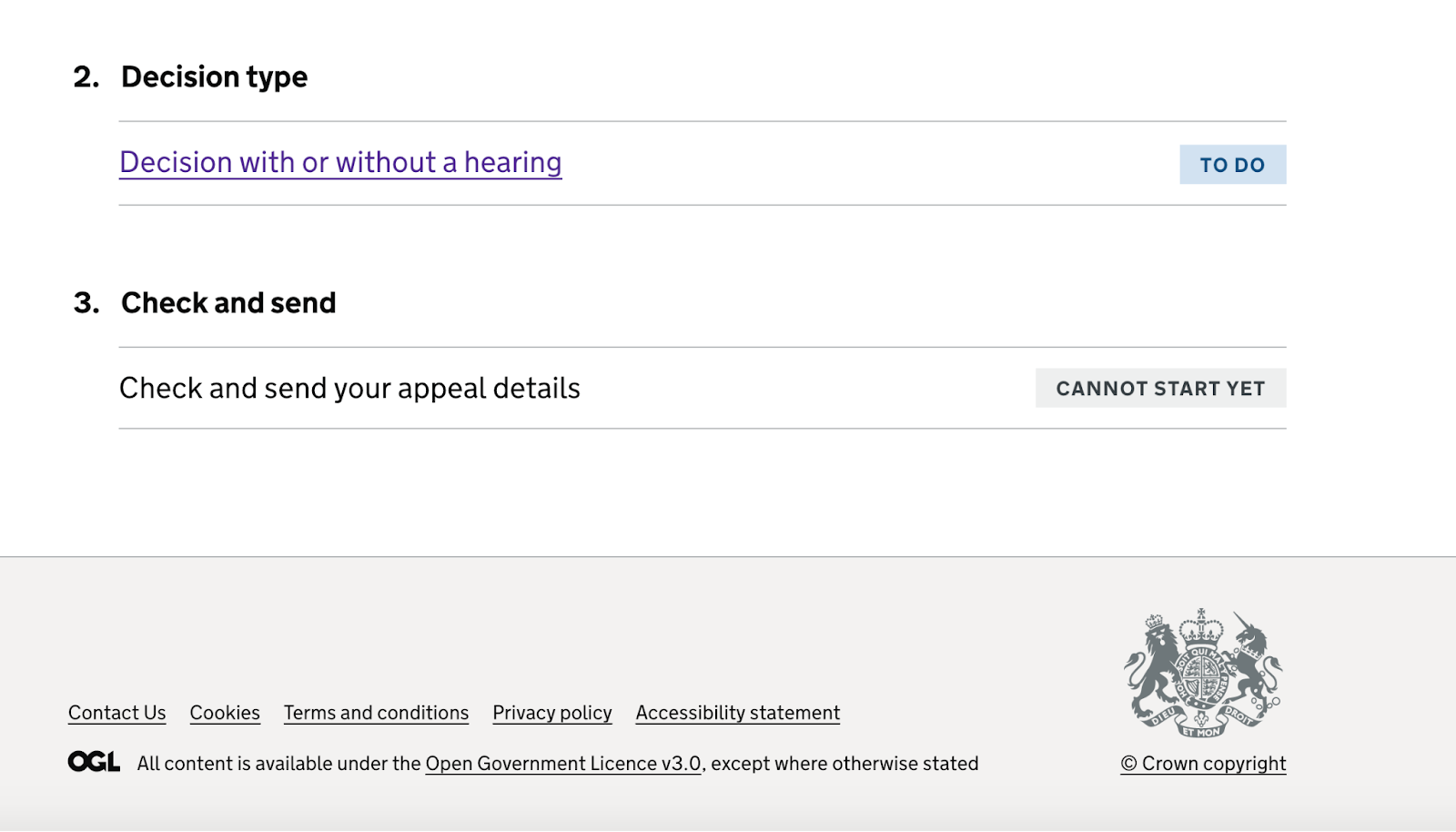
You will then be taken to a page that asks ‘How do you want your appeal to be decided?’
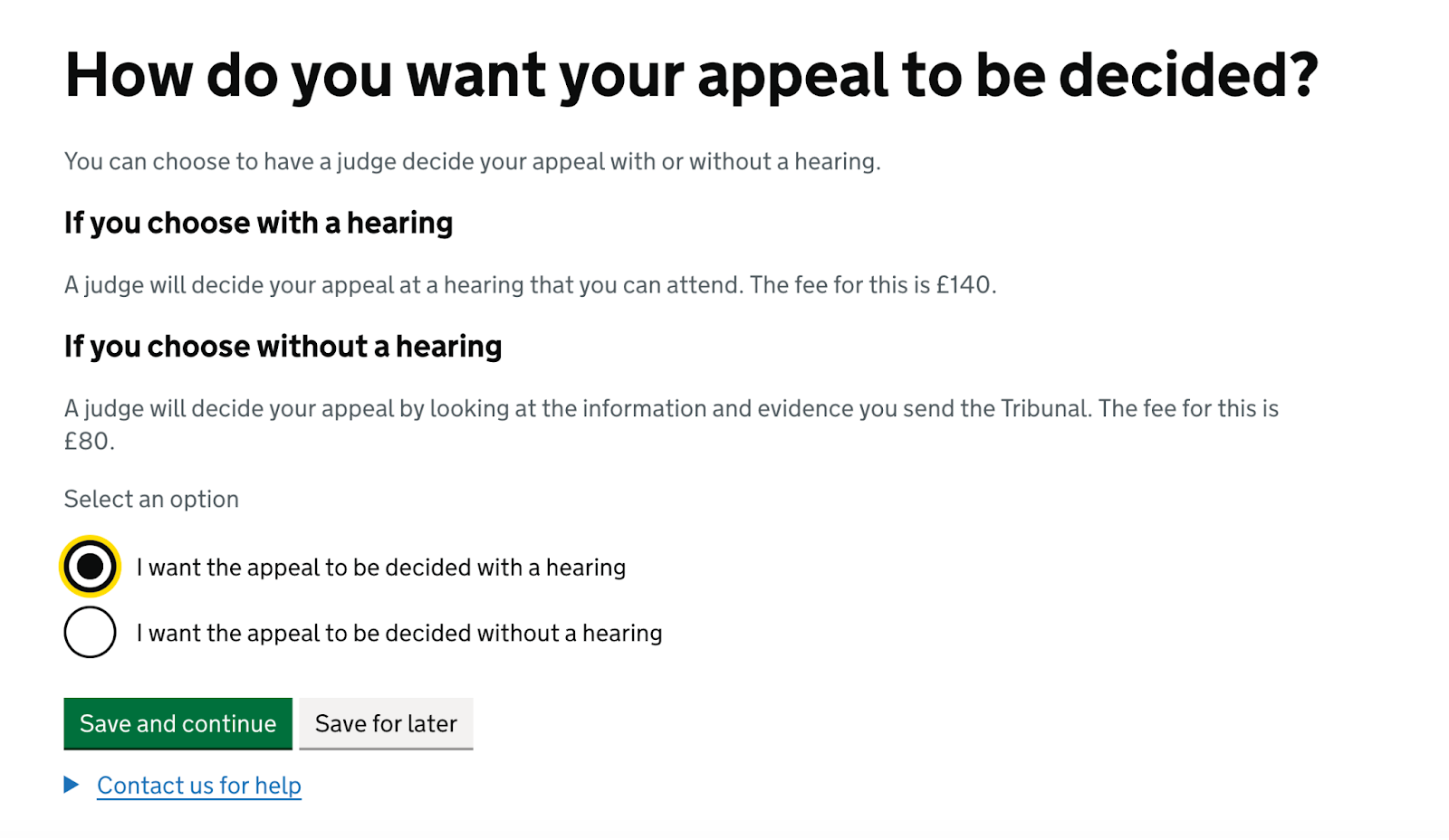
- Please select ‘I want the appeal to be decided with a hearing’. This means you and your lawyer will go to the Tribunal and be able to speak to the judge about your case;
- There is a fee of £140 for this, but you do not have to pay this now and if you are on asylum support or do not have the means to pay this, you may not have to pay. You can discuss this with a lawyer or seek legal advice later.
- Click ‘Save and continue’.
STEP 12: You will be asked if you want to pay the fee now. Select ‘No, I will pay later’ if you don’t have a lawyer and think you might be exempt.
STEP 13: You will then be taken to a screen saying ‘Equality and diversity questions’.
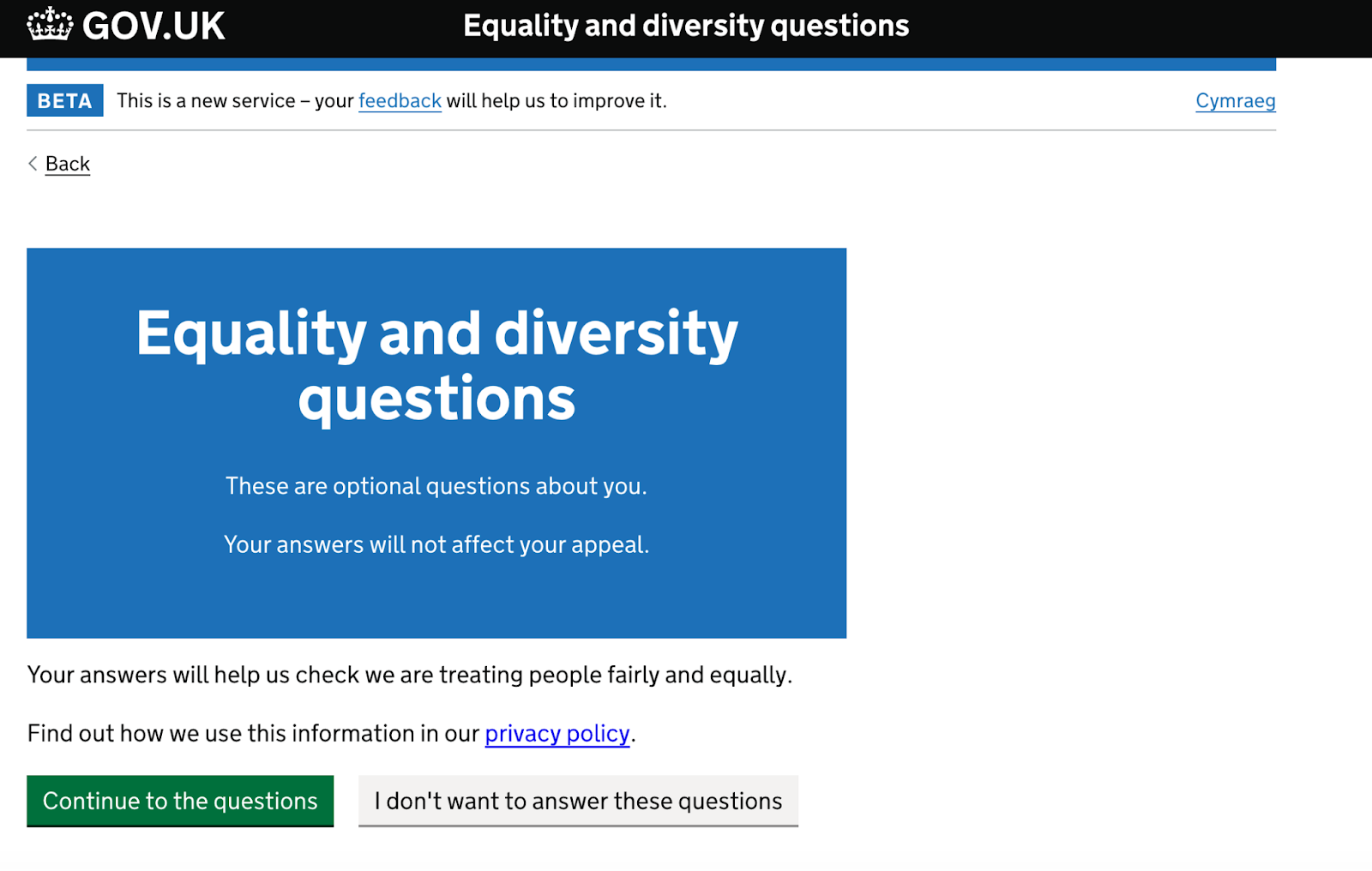
- These are questions about your background and identity, which the Home Office uses to monitor how they are treating people from different communities.
- These questions are optional, which means that you do not have to answer these questions and if you choose not to answer, this will not affect your appeal.
- If you do want to provide this information, click ‘Continue to the questions’. If you do not want to, then click ‘I don’t want to answer these questions’.
STEP 14: After this, the last thing to do on the ‘Tell us about your appeal’ page is section ‘3. Check and send’. When you are ready to check and send your appeal details, click on the link that says ‘Check and send your appeal details’. Check all your answers carefully. If you need to change anything, click on the ‘Change’ button next to the answer that you want to change.
STEP 15: Once you have checked your application, and are ready to submit your appeal, tick the ‘Statement of truth’ and click on the ‘Submit your appeal’ button.
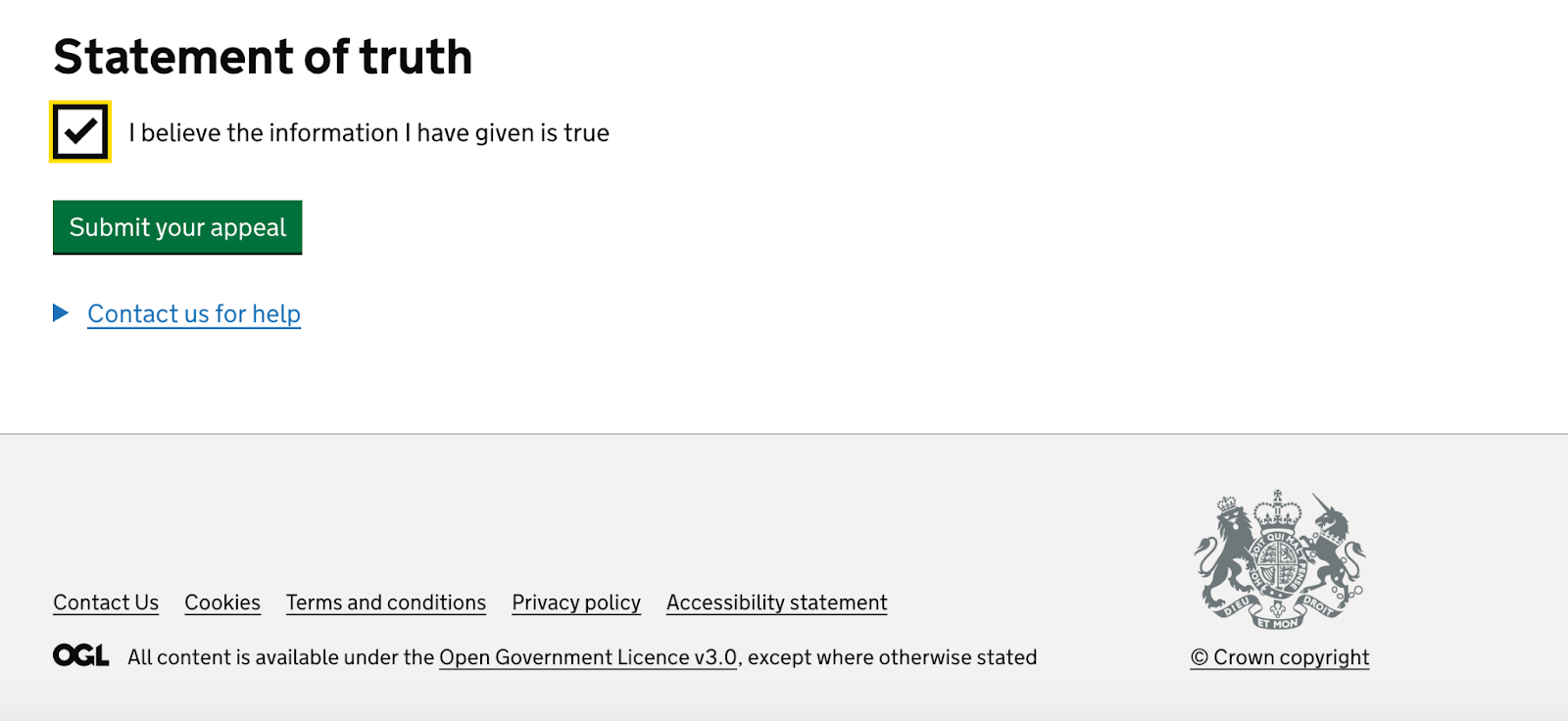
You have now submitted your appeal! You should be taken to a page which has an appeal reference number written on it (usually starting with PA/XXXX). Make sure you keep a copy of this appeal reference number somewhere safe, as you will need to take it with you if you need to report to the Home Office and to prove any continued eligibility for asylum support (or to show at a reporting centre to prove that you have lodged an appeal).
This page will also say that a Tribunal Caseworker will be in touch with you by a specific date. This is just so the Tribunal can check your appeal is valid and was submitted within the deadline. After this you can follow what should happen next on the online system by logging into your account. If anything changes on the system, you should receive an alert via email or phone.
What happens after you submit your appeal?
After you submit your appeal, you will receive updates and deadlines from the Tribunal. The exact timing can be different for different cases, but the steps are often similar. This section explain whats usually happens next.
1. Directions Letter
After you submit your appeal, the First Tier-Tribunal (IAC) will send you Directions. Directions are a letter (or an email) from the Tribunal with instructions about what you must do, what the Home Office must do, and the dates things are due. Always follow the dates on your own Directions letter.
2. Give contact details (often within 5 working days)
The Directions may ask you to confirm your phone number and email address (even if you appealed using the online system), so the Tribunal and the Home Office can contact you.
If your address, email address, or phone number changes after you submit your appeal, make sure that you tell the Tribunal (and the Home Office) as soon as possible. If the Tribunal cannot reach you, you might miss important letters or deadlines (for example your hearing notice or the decision). If you appealed online, you may be able to update details in your online account. Even if you update online, it can still be sensible to send a short message confirming the change, so there is a clear record.
If you are not using the online service, you can usually tell the Tribunal by email or post (and you can use the Tribunal’s form IAFT-4 to notify changes and make requests). Always include your appeal reference number on anything you send, and keep proof that you sent it.
If you get a legal representative after lodging your appeal, or if your representative stops acting for you, make sure to tell the Tribunal as soon as you can. This helps make sure the Tribunal sends important notices to the right person, and avoids delays or confusion. Using the online system (if you have one) or the IAFT-4 process can help keep the record up to date.
3. Tell the Tribunal early about any support you need
You may have different needs to make sure your hearing is fair and you understand what is happening.
Remote hearings: Some appeal hearings take place remotely using the Tribunal’s video system (often called CVP). If you want to ask for a remote hearing, or if you cannot travel to the hearing centre, tell the Tribunal as early as possible. Explain why you are asking (for example: serious illness/disability, pregnancy, risk/safety concerns, caring responsibilities, or practical barriers to travel). The Tribunal will decide whether to list the hearing remotely.
Interpreters and judges: If you need an interpreter or other help to take part in the hearing (for example step-free access, a hearing loop, breaks, or extra time), tell the Tribunal as soon as you can. If you want to ask for an all-female or all-male judge (or raise any vulnerability concerns), you should give clear reasons linked to your case. The Tribunal will decide if it can do this.
Public and private hearings (“in camera”): Appeal hearings are usually held in public. This means members of the public may be allowed to sit in the hearing room. If you do not want your hearing to take place in public (for example because of safety risks, very sensitive evidence, or because a child is involved), you can ask the Tribunal for a private hearing. A private hearing is sometimes called an “in camera” hearing. You should ask as early as possible and explain your reasons clearly. The Tribunal will decide whether the hearing (or part of it) should be in private.
Anonymity Anonymity is different from a private hearing. An anonymity direction is about not publishing identifying details (for example using initials in written decisions and not naming you in public documents). Anonymity is commonly used in protection cases (asylum) and the Tribunal may anonymise you and others in the case (including witnesses) to reduce risk of harm. Still, it’s sensible to check what your Tribunal notices/directions say and if you are worried about identification (including “jigsaw identification” through detailed facts), raise it with the Tribunal as early as you can. In non-asylum immigration appeals: anonymity is not automatic. If you want anonymity directions, you usually need to ask, and explain why identification would create a real risk or injustice.
How to make requests: In many cases, the Tribunal will send you a form called IAFT-3 (“Tell us what you need at your hearing”) and ask you to return it by a certain date. The form asks what support you need (including your language and dialect if you need an interpreter). You can send IAFT-3 by email or post. If you email it, include your appeal reference number in the subject line. You can find it online here.
4. The Home Office sends their document to you and the Tribunal
The Tribunal will tell the Home Office to send a set of documents to you and to the Tribunal. This is called the respondent bundle. (The Home Office is the “respondent”. You are the “appellant” – the person appealing.) The respondent bundle usually includes the refusal decision and the main documents the Home Office relies on in your appeal. If you had a Home Office interview, it usually includes a record of the interview.
When you receive the respondent bundle, check that you have all the documents the Home Office and Tribunal are using in your case.
For example:
– the decision letter you are appealing
– your application form and any evidence you sent with it
– your screening interview record
– your witness statement or any written statement you gave
– your asylum interview record
– any further submissions you may have made later
– any country information the Home Office used in the refusal letter
– any other documents mentioned in the refusal letter
– any older refusal letters or appeal decisions, if your case had an appeal before
Also check:
- Can you read the documents?
- Are the right documents there?
- Do the dates, names and references match what’s in your refusal letter?
If something is missing then add the missing or clearer document to your own bundle (see below), send it to both the Tribunal and the Home Office and explain briefly what is missing or wrong
The deadline for the bundle will be written in your Directions letter. Sometimes it is 14 days. Sometimes it is longer (for example 28 days). Sometimes the Home Office is late. Always follow your Directions letter.
5. You send your written explanation (AEC) and any documents you want the Tribunal to read for your appeal hearing
If you do not have a lawyer, the Tribunal will usually ask you to send a written explanation of why you disagree with the refusal letter. This is called the Appellant’s Explanation of Case (AEC). The AEC is your main written response to the refusal letter. You can also send a witness statement (your story in your own words) if it helps, either as part of the AEC or as a separate document in your bundle. You can read our guidance on how to respond to your refusal letter here. If you have a lawyer, they should instead prepare an Appeal Skeleton Argument (ASA) and a bundle.
The deadline for your AEC will be written in your Directions letter. Some Directions use a rule like “28 days after the Home Office bundle is sent, or 42 days after the Notice of Appeal (whichever is later)”. But the safest rule is to follow the Directions letter.
If you send documents, put them in a simple bundle
If you are sending documents that are not already in the Home Office bundle, put them together as a bundle. A bundle means all your documents in one place, in the order you choose, with page numbers.
if you are uploading online, a bundle is usually one PDF file. If you are posting, a bundle is the pages kept in order in one envelope.
To make it easy to read:
- number every page (page 1, 2, 3…)
- add a short contents list at the front (document name + page number) – this helps the Judge and Home Office find any specific documents quickly and easily in the bundlSave a copy of everything you send. If possible, also save a copy with a trusted person (or in a safe online folder), in case you lose your phone or papers.
Translations (if any documents are not in English)
If you send a document that is not in English, you should also send the original document and a certified English translation (signed by the translator, confirming it is accurate). Do not use online tools like Google Translate.
If you pay for a translation, use a certified translator (with their name/contact details, signature/date, qualification, and a statement that it is a true and accurate translation). Keep the original document and translation together. If you cannot afford certified translations, focus on the documents that matter most and explain this in writing. Read our detailed translation guidance (including warning signs of poor-quality companies) here.
If you cannot get a translation in time, send what you have and explain this briefly in your covering email/letter. The Tribunal may give directions about translation.
Late documents (important)
Try to send your AEC and evidence by the deadlines in your Directions. If you send documents late (especially in the last 5 working days before the hearing), the Judge may refuse to accept them unless you explain why they are late. If something is late, keep the explanation short and factual (for example: you only received it recently, you were unwell, or it took time to obtain).
Page limits (rules from 1 November 2024)
From 1 November 2024, there are page limits for some documents. These limits mostly affect experts, the Home Office, and people with legal representatives. But two limits may matter if you are preparing your own case: - Country information summary (sometimes called a “country evidence schedule”): 12 pages
- Expert report: 20 pages
Other limits you may see: - Home Office respondent review: 6 pages
- ASA (legal representative): 12 pages
If someone needs more pages than the limit, they must ask the Tribunal for permission and explain why. If you are writing an AEC, there is no fixed page limit in these rules. Focus on being clear and organised.
Format - If you can, it is best to type these documents (or ask someone to help you type).
- If you cannot type or do not have access to a computer, the Tribunal may still accept handwritten documents, but ensure you write very clearly. It is a good idea to:
- use black ink
- put your name and appeal reference on each page
- scan or photograph the pages clearly so they can be read easily and save a copy for yourself
6. The Home Office review (usually within 14 days)
After the Home Office receives your AEC (or ASA) and documents, they must send a written respondent review within 14 days. They may withdraw the refusal and make a new decision, or they may keep the refusal and explain their reasons.
7. Notice of Hearing (hearing details)
After these steps, the Tribunal will organise the next part of the appeal. If there will be a hearing, the Tribunal will send you a Notice of Hearing. It tells you the date and time, and how the hearing will happen (in person or remote).
Late documents: Directions often say that if documents are sent late, the Tribunal may not accept them unless you get permission.
If you are on asylum support: If you are receiving asylum support, you can ask for help with travel to your appeal hearing.
8. Interim hearings (sometimes called a Case Management Review / “CMR”)
Interim hearings (sometimes called a Case Management Review / “CMR”. Sometimes the Tribunal will arrange a short hearing before your main appeal hearing. This is not the full hearing where the Judge decides your appeal.It is a planning hearing to help the Tribunal organise the case.
At a CMR, the Judge may:
- Decide what the main issues are (what the Home Office accepts and what it argues about)
- Decide what evidence is needed (what documents or witness statements are important)
- Check what has been sent in (and whether deadlines have been followed)
- Decide practical things, for example:
- whether the main hearing will be in person or by video (CVP)
- whether the hearing needs an interpreter
- whether any special arrangements are needed (for example breaks, step-free access)
- Decide requests, for example:
- a request to delay the hearing (adjournment)
- a request for a remote hearing
- Set the date for the main hearing (or sometimes list another short hearing)
Important: Sometimes the Tribunal may say that an interim hearing could become the full hearing. If this happens, the Tribunal should tell you in advance.If you get a notice for a CMR, read it carefully and follow the instructions.
The Tribunal expects you (and any representative) to attend an interim hearing if one is listed. If you cannot attend, contact the Tribunal as early as possible and explain why.
How to prepare for your appeal hearing
Understand why you were refused
If you want to challenge the Home Office refusal of your claim, you need to look closely at their decision letter. If you have a lawyer, you should do this with them.
When the Home Office makes a decision, they usually rely on a few key things: what you said in your interviews (and any written statement), any documents or other evidence you provided, whether your account stays consistent across different stages, and general information about your country (often called “country information”). The refusal letter explains how they examined these things, and why they refused your claim.
You can read the official Home Office policy on how they make decisions on asylum claims here.
ACTION SECTION: Understanding your refusal and preparing your AEC
If you are appealing without a lawyer, you will usually need to write an Appellant’s Explanation of Case (AEC). The AEC is your written response to the refusal letter. It explains what the Home Office said, and why you disagree.
You may also write a witness statement. This is your story in your own words (what happened to you, and why you are afraid to return). Some people put their story inside the AEC. Some people also send a separate witness statement. You do not have to do both. The aim is to be clear and organised.
The AEC is usually built from your notes on the refusal letter. Many people cannot get a lawyer. This guide cannot replace legal advice, but it can help you understand the refusal letter, organise your evidence, and write a clear response for the Tribunal. Your AEC and any other documents you send will form part of your bundle. (See the section above on preparing your bundle.) You can read about how to write a witness statement on our Evidence Key Guide here.
1. Keep proof of when you received your refusal letter
If your refusal letter came by post, keep the envelope. Write the date you received it on the letter and keep the envelope safe. This can help if there is a dispute about deadlines.
2. Read the Home Office summary carefully
Refusal letters usually start with a summary of your case. Sometimes this summary is wrong, missing information, or misleading. It is a good idea to compare what has been said in the refusal letter with what you actually said in your interviews and statements. Check the refusal letter covers all the parts of your claim you told the Home Office about. For example, it should deal with the main reasons you said you cannot return, and any human rights reasons you raised.
3. Make a list of the refusal reasons
After the summary, the refusal letter usually explains the Home Office’s reasons for refusing your claim. This is the main part of the letter. It tells you what the Home Office thinks is wrong with your case and why they refused you. To challenge the decision, you need to understand these reasons clearly, and then explain (and show evidence) why you disagree.
Read the refusal reasons carefully and take one reason at a time. This can be hard, and it’s normal to feel overwhelmed, angry, upset, or frustrated.
A simple way to organise your notes is this: for each refusal reason, write down:
- what the Home Office says
- why you think this is wrong
- what evidence might support you
You can write a statement explaining what you think is wrong or missing in the refusal letter, and you can ask a friend/supporter to help if writing in English is difficult. If you have a lawyer, they should prepare and submit this statement for you. Submit it to the Home Office and, if you have a right of appeal, to the tribunal in advance of your appeal hearing. You can learn more about how to write a witness statement here.
4. Check the interview records and look for misunderstandings or recording errors
Your interview record is the written record of the interviews you have with the Home Office (usually your Screening Interview and your Substantive Interview (the big interview)). It includes the questions you were asked and your answers (interpreted if you used an interpreter). You should be sent a copy by the Home Office (or this may be sent to your lawyer if you have one).
The Home Office treats interview records as very important evidence. The Home Office often compares what you said in your Screening Interview with what you said in your Substantive Interview (and any written statement) to check if your account is consistent (the same). If they think there are differences, they may describe this as being “inconsistent” in the refusal letter.
If the refusal letter says you were “inconsistent”, look at what you said before and see if the difference could be because of:
- a misunderstanding. For example, you gave an approximate answer (not exact) and it was treated as an exact fact.
- a recording error (something was written down wrongly)
- an interpretation/translation problem
Sometimes the Home Office criticises someone for “not giving enough detail”, even when the interviewer did not ask follow-up questions at the time.
Refusal letters may refer to documents using short names like:
SCI = Screening Interview
AIR = Asylum Interview Record
WS = Witness Statement
5. If the Home Office says they do not believe you (credibility)
The Home Office may say they do not believe some or all of what you said. This is often called credibility. Credibility means the Home Office is judging whether they think your account is reliable and truthful.
Common reasons you may see include:
- “It is inconsistent”: they say your account is different in different places (for example, between your screening interview, witness statement, and asylum interview record).
- “It is not plausible”: they say your story does not make sense to them.
- “Not enough detail”: they say you did not explain enough (this may be because you were not asked enough questions).
- “No proof”: they say you did not provide documents or other evidence.
- “Too late”: they criticise when you claimed asylum or when you gave evidence.
When you see one of these phrases it is a good idea to: write down what the Home Office says is wrong and the paragraph or question number. Then check where the Home Office got it from. For example, whether it comes from the interview record or whether it is an assumption added in the refusal letter.
Deal with one refusal point at a time. For each point, try to write:
- what the Home Office said (and the paragraph number)
- your answer in your own words (why you disagree)
- what supports your answer (a document page number, or a question number from the interview record)
- Try to avoid general statements like “I am telling the truth” without explaining why.
6. Check what the Home Office says about risk in your country
Your refusal letter may argue things like:
- you would not be at risk now (they minimise past harm or future risk)
- the police or government could protect you (state protection)
- the risk is from a non-government group (a “non-state actor”) and the state can stop them
- you could live safely in another part of your country (internal relocation / internal protection alternative)
In your AEC (or other written response), address each point separately. You can use country information (reliable reports about your country, from human rights organisations, the UN, or government sources).
7. Missing documents? Ask for your file
If your refusal letter mentions documents you do not have, ask your previous lawyer (if you had one). If you cannot get the documents, you can request your Home Office records using a Subject Access Request (SAR). A SAR is a request for a copy of your personal data held by the Home Office. It often takes longer than one month in practice, especially if the Home Office says it needs more information to confirm your identity. Read more about how to make a SAR here.
8. If traumatic events affected memory or recall
If the refusal letter criticises you for not remembering clearly, it may help to read trusted information about memory and trauma, and to explain this carefully in your appeal statement. You can find useful resources about memory recall and traumatic events on the Centre for the Study of Emotion and Law website.
9. Writing your AEC (turn your notes into a clear document)
Your AEC is your written response to the refusal letter. It is easiest to write it in the same order as the refusal letter.
A simple structure that you may wish to follow:
- Use headings like: “Refusal paragraph 12”, “Refusal paragraph 13” (or any numbers used in your refusal letter).
- Under each heading, write 2–4 short parts:
- What the Home Office said
- What you say back (your answer in your own words)
- What supports this (page number of a document, or interview question number)
- What you want the Tribunal to understand (one short sentence)
Keep the language simple and use clear sentences . Try not to write in an angry or argumentative way, even if you feel upset. This helps the Judge focus on the facts.
If you add new information that you did not say earlier, include one short sentence to explain why (for example fear, shame, trauma, confusion, translation problems, or not understanding the question).
Finish with a short summary. At the end, write a short paragraph saying:
- you disagree with the refusal, and
- you want the Tribunal to allow your appeal.
10. Final checks
If you can, ask a trusted person to read your AEC to check it is clear and easy to follow. Make sure your name and appeal reference number are on the document. Then save a copy for yourself (and, if possible, a copy with a trusted person or in a safe online folder).
Next: read about evidence for your appeal — what it is, how to present it, and how to put it into a clear bundle (including your AEC).
New matters (if you have a “new” reason why you should stay in the UK)
The Tribunal can look at new evidence that helps explain that same decision (for example, a new medical letter or a new witness statement). But sometimes a person wants to add a new reason to stay in the UK that the Home Office has not decided before. This is called a “new matter”.
A new matter is more than new evidence. It is a new issue or new legal ground (a new basis of your case) that would normally need the Home Office to make a new decision about it. The Tribunal cannot decide a new matter unless the Home Office agrees (gives consent). The Home Office may say yes or no to consent. If they say no, the Tribunal usually cannot decide that new matter in your appeal.
If you think something might be a new matter, tell the Tribunal and the Home Office as soon as you can. For example, it happened later, you only found out recently, or you weren’t able to talk about it before (because you didn’t realise it was important, you felt too uncomfortable or embarrassed, or you were scared).
A new matter might be:
- A new reason you fear return. For example, your claim for protection was about political persecution and you didn’t tell the Home Office about your sexuality because you felt uncomfortable about it. You now want the Tribunal to consider sexuality as part of your claim for protection. This is likely to be a new matter because it is a new protection reason the Home Office has not assessed.
- A new human rights “route/ground” that wasn’t decided. For example, you want the Tribunal to consider new Article 8 reason (private life) based on a new relationship/child that was not part of the Home Office decision.
- A major change in circumstances that creates a new claim. For example, You start a relationship / become a parent after the refusal, and you now want to rely on that as a main reason you cannot leave. That may become a new matter if the Home Office has not considered it and would need to make a new decision about it.
Not everything “new” is a “new matter”. For example, new evidence that supports the same claim is often not a new matter. But the rule above still applies if the Home Office says it is a new matter.
If you think you may have a “new matter”, y to raise it early, not at the last minute.Write it clearly in your AEC (or in a short covering email/letter) and explain that it is something the Home Office has not decided before. If you can, get legal advice, because this is a technical rule. (It can affect whether you need to make a separate application/claim.)
Getting evidence for your appeal
Evidence is anything that helps the Tribunal understand why you disagree with the Home Office decision.
If you have a lawyer, they usually collect and send evidence. Many people do not have a lawyer. If you do not have a lawyer, you may need to collect evidence yourself.
It helps to think in three simple groups:
- Your story (your AEC/ your statement)
- Your documents (letters, records, screenshots, supporting letters)
- Country information / expert evidence (general information not written by you)
- Witnesses (supporting statements from other people)
You can also keep this evidence for later. For example, it may help if you make a fresh claim in the future. Read more on the Fresh Claims page of the Toolkit.
If your appeal is about family or private life (human rights), also read our Evidence page.
Country guidance information
Country information means reliable reports about what is happening in your country. It can help show that what you said happened to you is believable, and/or that you would still be at risk if you returned.
The Home Office often relies on its own country documents. You might see these called CPINs (Country Policy and Information Notes). A CPIN is a Home Office document that summarises information about a country (and sometimes sets out the Home Office’s view on how that information should be used in asylum and human rights decisions).
CPINs can be out of date, incomplete, or not reflect the full picture, especially compared with reports from organisations like the UN and human rights groups. It can help to look at other independent sources as well. You can read the Home Office’s guidance for your country here.
Watch our video on Understanding Case Law below.
Expert evidence
Your lawyer may get some expert evidence if your case goes to appeal, but it is something you or a supporter can think about as well. Evidence could come from an academic, university researcher, or experienced professional who is an expert on your country of origin, or a particular part of your case. They can be asked to look at your testimony and comment on whether it fits with what they know about the subject. They could also be asked to comment on why your case might not fit the general pattern.
IMPORTANT NOTE: you are not asking the expert to say whether or not you are telling the truth. You are asking them to use their knowledge to comment on how your story fits into known information on that topic.
If you have physical and/or mental health problems because of what has happened to you, your lawyer may be able to get a report from a medical expert which can be submitted as evidence in your asylum claim. Read more about that in our blog post here.
Usually, a lawyer will “instruct” an expert, and pay them a fee. This fee will normally be covered by legal aid, if your case is eligible for this.
An expert may be useful in other aspects of a case too. If there are reasons why you can’t give testimony easily, because of memory or psychological problems, they can comment on this. If you have had problems understanding things, an expert could comment on language problems or learning difficulties.
If your case includes a claim to a family or private life in the UK, a teacher, psychologist, psychiatrist or social worker may be able to comment on the impact the removal/deportation of you or your child might have on their development. You may find it useful to look at the ‘Best Practice Guide to Asylum and Human Rights Appeals‘ section on expert evidence. This is a guide written by lawyers for lawyers, but you may find parts of it helpful or be able to ask someone with legal knowledge to help you go through and read who an “expert” would be in this situation, and what they can and can’t say.
ACTION SECTION (for expert evidence)
If you do not have a lawyer, you could try contacting experts yourself. If a supporter or local group has connections to an NGO or a university, they may be able to find an expert who is willing to do this for free.
You could also try contacting the experts listed on the Refugee Legal Aid Information website or on the EIN website.
If the expert cannot produce an export report for free, a reasonable price might be £500. Remember this amount is just for producing the report.
An expert may not be required to attend the appeal, especially if they have simply verified they think a document is genuine, but you should check that the expert would be willing to appear in court just in case. If you are paying the expert yourself, they may ask for more money if they are required to come to court.
If the expert asks to be paid, your friends/community could consider fundraising for this. You need to decide if this is a good use of funds – is there a crucial element of your case that the Home Office doesn’t believe, that an expert report could realistically help with?
Objective evidence
Objective evidence means evidence that is not written by you and is not only based on your personal account. It can include country information (reports about your country) and expert reports.
Objective evidence can be especially helpful if the Home Office says it does not believe you (for example, it questions your credibility).
Keep it reliable and up to date. Check who wrote it, the date, and where the information comes from. It can help to use more than one reliable source. Some Home Office country documents have a “cut-off date”, so they may not include newer events.
Keep it focused. The Tribunal is unlikely to read very long country reports. It is better to pull out the key paragraphs that relate to the refusal reasons.
If you are adding important information late, explain why. For example: fear, shame, trauma, confusion, or translation problems.
Good places to look for information on human rights in a country of origin:
For more suggestions of where to look for evidence, see the country information Toolkit page, where sources are also listed by theme.
About sources: The sources listed above are examples that are often treated as more reliable. But no source is perfect. If you use other sources, check who wrote it, when it was published, and whether it explains where the information comes from. Be careful with strong political sources or sources linked to one side in a conflict, as they may be given less weight.
An expert may be useful in other aspects of a case too. If there are reasons why you can’t give testimony easily, because of memory or psychological problems, they can comment on this. If there have been problems understanding things, an expert could comment on language problems or learning difficulties.
If your case includes a claim to a family or private life in the UK, a teacher, psychologist, psychiatrist or social worker may be able to comment on the impact the removal/deportation of you or your child might have on their development.
You may find it useful to look at the ‘Best Practice Guide to Asylum and Human Rights Appeals‘ section on expert evidence. This is a guide written by lawyers for lawyers, but you may find parts of it helpful or be able to ask someone with legal knowledge to help you go through and read what an “expert” in this context is, and what they can and can’t say.
Digital evidence: social media, messages, and screenshots
Social media evidence can be easy to change or “cherry-pick”, so try to keep it complete and clear, not just one image with no context. A screenshot is better than nothing, but it can look selective. If you can, also save a download/export from the platform (this usually shows more detail and context than a screenshot). Some platforms have a “download your information/data” option. Meta, the company that owns Facebook, WhatsApp and Instagram has information about how to do this here.
If you do use screenshots then it’s good idea to try to capture the context like the name/username of the account, the date and time (if shown), the whole message or post (not just one line), and enough of the thread (messages before/after) so it makes sense. If it’s public content, include the link/URL if you can see it. This helps show the Tribunal the evidence isn’t taken out of context.
Keep the original messages/photos on your phone if possible, and try not to edit the image. If you need to hide a phone number for safety, keep an unedited copy saved privately as well.
It can also help to add one short note for each set of messages/screenshots saying what it is (for example WhatsApp messages / Instagram DMs), whose account it is, how you got it (for example screenshot from your phone on [date]), and what it shows (one sentence). If the evidence is not in English, include a simple translation if you can — the Tribunal can also give directions about language/translation.
Documents sent from your country or from abroad
Sometimes people send you important documents from another country. For example a birth certificate, marriage certificate, death certificate, medical records, police papers, or a court document. If you want the Tribunal to rely on these documents, you usually need to send the original and a certified English translation (unless the document is already in English). Keep the original and the translation together. Read more about translating documents here.
If someone sends you documents by post (including from another country), it is a good idea to keep:
- the envelope (front and back)
- any postage labels / tracking numbers
- a note of the date you received it
This can help later if there is any question about when it arrived or where it came from. Tribunal documents can also be sent by post, so keeping the envelope is a simple way to keep proof.
Witnesses (witness statements and the hearing)
A witness is a person who helps the Tribunal by giving evidence about facts they personally know – for example, what they saw, what they heard directly, what they did, or what they have observed over time.
Usually, a witness gives evidence first in writing, in a witness statement. If you want the Tribunal to rely on a witness, the Tribunal usually expects you to provide a witness statement in advance.
The Tribunal’s Practice Direction (PD) (official guidance about how hearings work) says a witness statement should be able to stand as the witness’s main evidence (their “evidence-in-chief”). This means that at the hearing:
- the witness will usually be asked questions about what is already in their statement, and
- the witness normally cannot add lots of new information unless the Judge gives permission (and there must be a good reason).
A witness statement should:
- focus on what the witness knows themselves (not rumours or second-hand information)
- be clear about what they do not know
- avoid guessing
- avoid trying to write “country information” unless the witness is genuinely an expert
If a witness does not understand English but the statement is written in English, the PD says the statement must include a signed note confirming it was read back to the witness in a language they understand and that it is accurate.
Sometimes the Home Office will ask witnesses questions at the hearing. This is called cross-examination. The PD says the Home Office should state in its respondent review which witnesses it intends to cross-examine. If it does not plan to cross-examine a witness, it should still explain any objections it has to the Judge reading that witness statement.
Witnesses can help, but only if they add something useful. Before relying on a witness, ask:
- does this evidence help prove something that is in dispute (something the Home Office does not accept)?
- will the witness’s account match your evidence and documents?
- can the witness cope with questions from the Home Office Presenting Officer (HOPO)?
- is the witness likely to be treated as reliable (for example, have they previously been disbelieved in court)?
A witness may attend in person, or sometimes by video link if they are abroad or unable to travel (you may need to raise this in advance).
If a witness or statement is late: People often wait a long time for a hearing, and witnesses may only be able to confirm quite late (because of work, travel, illness, fear, or short notice). If your witness confirms late, tell the Tribunal and the Home Office as soon as you can, and give a short, honest reason.
If a witness statement (or other evidence) is sent very close to the hearing (for example within 5 working days, or on the day), the Judge will usually decide whether to accept it. The Tribunal may ask why it was not sent earlier. Late evidence is not automatically refused, but it is not guaranteed either, especially if it includes new information. If this happens, try not to panic: send what you can as soon as possible, and keep your explanation simple.
Action Section: Prepare and organise your bundle (what you send)
If you send documents with your AEC, put them together as a bundle. A bundle means your documents are kept together, in a clear order, with page numbers. This helps the Judge and the Home Office find the right page quickly.
Choose what to send (be specific)
Start with the refusal letter. For each refusal reason, ask: does this evidence help answer this point?
Try not to send lots of extra documents “just in case”. The Tribunal is unlikely to read very large bundles. A smaller bundle that is clearly chosen is easier to use.
This also applies to country reports. It is usually better to send the key extracts you rely on, not hundreds of pages.
Country research: identify the most important parts
Country information can be very long. The Judge will not have time to read everything. A practical way to do this is to make a short document called a country information summary. In this document:
- Organise it by the refusal reasons (one refusal issue at a time).
- For each issue, add 2–5 key extracts from reliable sources.
- Keep each extract short. Do not copy whole articles.
- For each extract, write:
- source name
- date
- page or paragraph number (if the report has them)
- the link (if it is online)
You can organise your research like this:
Refusal issue: …
What HO said: …
Country extract 1: Source / date / quote / link / why it matters (one sentence)
Make sure to use sources that are clear about who wrote them and where the information comes from. Check the date. If the Home Office relied on a CPIN, check its cut-off date and look for newer information if needed.
Then add your country information summary into your bundle (with page numbers), and keep a saved copy of the full reports in case you need them later.
Digital evidence (messages, social media, screenshots)
If you include screenshots or online evidence, try to keep the context. For example, include the username/account name, the date, and enough of the conversation or post so it makes sense. Keep an unedited copy saved for yourself if you can.
Documents from abroad
If someone sends you documents by post (especially from another country), keep the envelope (front and back) and any tracking label. Write down the date you received it.
How to organise your bundle
- Put your AEC first (and your witness statement if you are sending one).
- Put your other documents after, in a clear order.
- Add a short contents list at the front (document name + page number).
- Number every page (1, 2, 3…).
If you can, it is best to type documents (or ask someone to help you type). If you cannot type, the Tribunal may still accept handwritten documents if they are clear. If you write by hand:
- use black ink
- write clearly
- put your name and appeal reference number on each page
- photograph or scan pages clearly and save a copy
If you take photos to send make sure to take photos in good light, show the whole page (do not cut off corners) and check the text is readable before you send it. If you can, save the pages as one PDF (many phones can do this)
Save a copy
Save a copy of everything you send. If possible, also keep a copy with a trusted person or in a safe online folder (for example Google Drive, Dropbox, or email it to yourself) in case you lose your phone or papers.
How long do I have to wait for my appeal hearing?
In recent years, more people have appealed Home Office refusals. The Tribunal has increased the number of cases it finishes, but not enough to match the number of new appeals.
Between July and September 2025, the Tribunal received about 30,000 new appeals but finished about 15,000. Because it finished fewer cases than it received, the waiting list grew. By the end of September 2025, there were about 121,000 appeals still waiting in the system (“open cases”).
This means many people are waiting a long time for their case to finish. As of September 2025, official statistics show that, for asylum appeals, the average time to complete a case was around 60 weeks (about 14 months).
If you need to delay your hearing (an adjournment)
Some people ask the Tribunal to postpone (delay) the hearing date because they are not ready, or they are still trying to find a lawyer. This is called an adjournment. But an adjournment is not automatic. The Tribunal looks at the reasons and decides.
The Tribunal’s guidance says:
- An adjournment request must usually be received, at the latest, by 4:30pm, one working day before the hearing, with full reasons and any supporting evidence you can get.
- If you ask after the deadline, you normally have to ask at the hearing (and the Tribunal will usually expect you to attend unless there are exceptional circumstances).
- You should not assume the Tribunal will agree. If an adjournment is refused and you do not attend, then the hearing may still go ahead without you.
If you are asking for your hearing to be delayed because you do not have a lawyer:
If you ask for an adjournment to try to find a lawyer, it can help to explain why it would be unfair to go ahead without a representative in your situation.
Try to keep it short, specific, and about you. For example:
- you do not speak English well, or you cannot read or write well
- you are unwell, traumatised, have a disability, or you find it hard to cope with stress
- your case is complicated, or there is a lot of evidence to organise
- you need an expert report (for example medical or country expert) and you cannot get it in time
- you will struggle to answer questions at the hearing (especially if the Home Office has a lawyer)
If possible, include simple proof, for example a GP letter, hospital letter, or a short letter from a support worker explaining what they have seen.
If your reason is “I am still trying to find a lawyer”, it can help to show what steps you have taken. For example: who you contacted, when, and any replies or appointments..
Even if you ask for an adjournment, keep preparing your case, in case the Tribunal keeps the hearing on the same date.
Jennifer Blair, a Barrister at No5 Chambers and Migrants Organise, has created more detailed guidance and templates about how to ask for an adjournment. You can read these here.
Preparing for your appeal hearing
ACTION SECTION
It can be useful to find out where the Tribunal is in advance, and go and visit it. Find out the travel route you will need to take on the day and how long it takes to get there.
If you are receiving asylum support, the Home Office will pay for your travel to the hearing. They will not do this automatically – you or your lawyer need to ask them to provide a travel ticket before the hearing.
If you need childcare for the day of your hearing, ask friends, family or your community if they can help with this. You may have people who can look after your children, or supporters who may be able to help fundraise to pay for professional childcare.
You may be feeling nervous about going to court. You can ask a few friends to sit in the courtroom in the public area, for moral support. They are not allowed to speak or make any interventions in the proceedings, but it can help to have a friendly face or two in the room.
You may even want to practise by doing a pretend hearing with friends/volunteers, with someone playing the judge and someone else the HOPO.
Because hearings are public, you have the option to go and watch someone else’s hearing to find out what hearings are like. Think about whether you think this would be helpful or not. If you would like to do this, you can use this website to find the Tribunal closest to you – as this may not be the same as where your appeal hearing will be held. Choose “immigration” as the area of law you are interested in, then enter your postcode.
The best way to prepare for your appeal hearing is to make sure that you understand all the evidence being considered. Read your witness statement(s), documents, and interviews several times before the hearing. Think carefully about some of the difficult questions that might be put to you and how you plan to answer them.
Plan what you are going to say to the judge and practice saying it. If you have several points to make, make this clear. You can say “my first reason is”, “my second reason is”, etc. Try to stick to one reason at a time, without mixing up different areas of argument (though if the areas of argument are connected, you can say this).
If you find writing English difficult, a friend or volunteer may be able to help you to fill out the appeal form. You need to tell them what to write, and they write it on the form. They should read back everything they have written for you, to check it is correct. To find out more about how friends or community members (who are not legally qualified) can support you, read our page on Legal Support.
If you are submitting documents with your appeal, all documents in other languages have to be officially translated into English. The documents should be signed by the translator to certify that the translation is accurate and the translation attached to the original document.
If you have children, think about whether anyone can look after them. It might be a long wait at the Tribunal and some judges will not allow them into the hearing room. There are usually some books and basic toys available, but if you are taking children with you, make sure you’ve got food and snacks for them, someone to look after them while you are in the hearing room, and plenty of things to keep them occupied!
You do not necessarily need to send all of your evidence at the point of submitting your appeal application, as it may be many months until your appeal hearing, during which time you may get new evidence.
You may find it useful to look at the ‘Best Practice Guide to Asylum and Human Rights Appeals‘. This is a guide written by lawyers for lawyers, but you may find parts of it helpful or be able to ask someone with legal knowledge to help you go through the relevant sections about process and good practice (some of the information is only relevant to lawyers). If you do not have a lawyer, the First-tier Tribunal has guidance for unrepresented Appellants which you can read here.
To find out what happens at the Appeal Hearing itself, and the types of decision you could receive, take a look at our Toolkit page on ‘Your Appeal Hearing at the First-tier Tribunal’.