
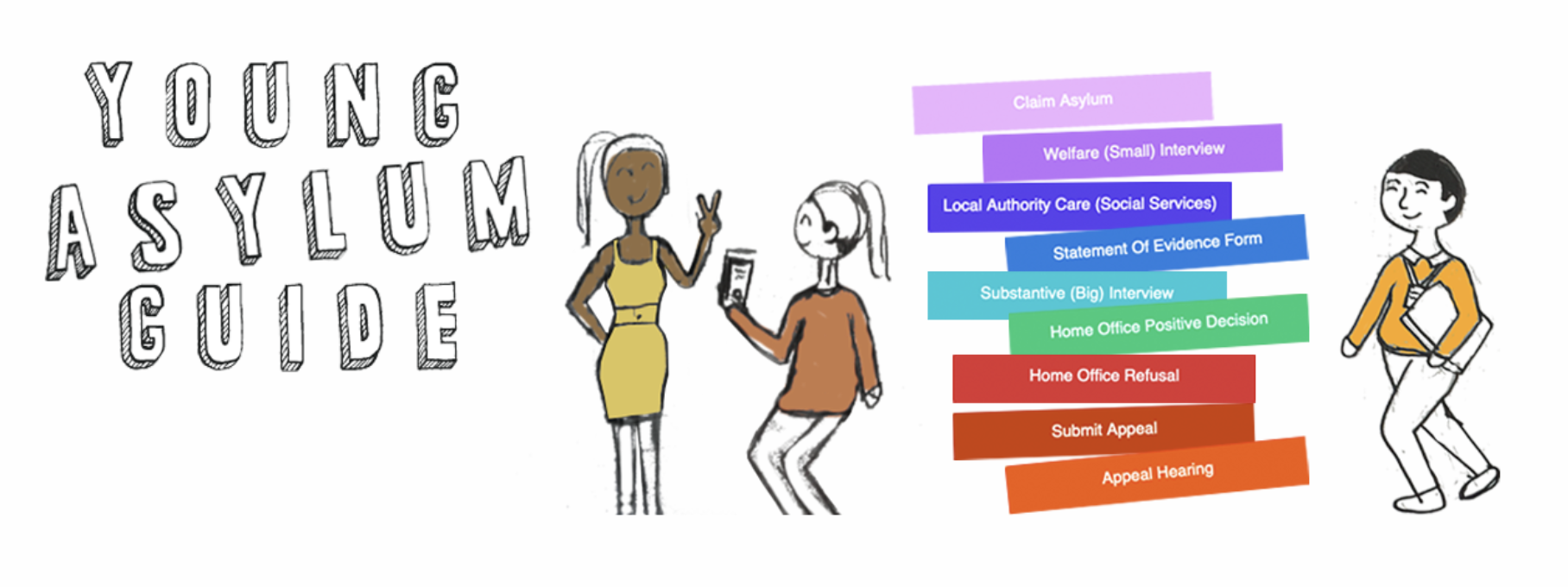
The Young Asylum Guide (YAG) was first created in March 2021 by Young Roots and Croydon Council, led by Lisa Matthews former Co-ordinator at Right to Remain and is now at Young Roots. It was a thoughtful and important piece of work, created to help young people understand the asylum process more clearly and feel less alone in it.
Like the Asylum Navigation Board, YAG helped young people see the asylum process as a system by showing that many of the difficulties they faced were not personal failures, but the result of a hostile and confusing system. In this way, YAG offered more than information but also clarity, dignity, and reassurance.
One of the most powerful parts of YAG was its creative and participatory approach. The guide was brought to life through illustrations made by young people in the asylum process during a workshop led by artist Tim Sanders. These images captured both the hardship of the system and the strength, insight, and resilience of the young people moving through it and made the guide feel human, honest, and grounded in lived experience.
The original YAG has been hugely valuable. It created a strong foundation that has helped many young people better understand their situation and their rights, and its principles continue to shape this next stage of the work.
We are now updating and refreshing the guide for both practical and wider reasons. The original YAG sits on a separate platform from the main Right to Remain platform. It is more difficult to update and, critically, does not include a translation function unlike our Toolkit. This makes it harder to keep the information accessible, accurate, and up to date.
Since 2021, the situation for young people in the asylum system has also changed in important ways. In particular, there has been a rise in age disputes, with more children being treated as adults or going through difficult age assessment processes. We now would like to fill these new gaps in information and support, reflecting the realities of the difficulties the young people face.
We know that the Young Asylum Guide was also used by professionals and organisations working with young people, and we understand that some were sorry to see the standalone site taken down: we have already been contacted by some people expressing their disappointment. YAG was never intended primarily as a resource for institutions. Its main purpose was always to help young people themselves and their families and friends understand the asylum system and their rights. That has remained our starting point as we think about what comes next.
Our decisions about the next phase of the guide have therefore been shaped first and foremost by what will make the information most accurate, accessible, translatable, and sustainable for young people. As a small team, we also have to be realistic about how we maintain the resource. Bringing the guide into the Right to Remain Toolkit gives us a more workable and sustainable way to keep information reliable and up to date, instead of stretching limited capacity across a separate platform.

What next? The Young Person’s Key Guide
The updated version will be called the Young Person’s Key Guide and will sit within the Right to Remain Toolkit. This will make it easier to update, easier to translate, and easier for young people to find information in one place. It also means that information about young people’s rights will sit alongside wider information about the asylum and immigration process, showing that young people are not separate from the wider system of rights and justice.
We know this approach has some limits, and we have thought carefully about them. But bringing the guide into the Toolkit allows us to focus on what matters most: accuracy, accessibility, translation, and keeping information up to date: building our community’s knowledge to democratise access to justice.
We want to clearly recognise and celebrate the work that went into the original Young Asylum Guide. Its ideas, design, and participatory spirit remain deeply important. The Young Person’s Key Guide builds on that strong foundation and continues its work in a new form. The new guide is being developed in conversation with Social Workers Without Borders, youth-led organisations, and others who work closely with young people in the asylum system. Their feedback is helping to shape both the content and the approach. We want the guide to reflect real experiences, real gaps in information, and the questions young people actually have.









Discussion: