
Last updated: 30 September 2026
Immigration Enforcement (IE) is the part of the Home Office that carries out immigration control. It says its job is to “protect” the public and economy, but in practice this means surveillance, control, and removal through reporting, raids, detention, and deportation that often target people already facing hardship and discrimination.
These teams are part of the UK’s wider Hostile Environment, which pushes border checks into everyday life: into homes, workplaces, hospitals, schools, and banks. It forces landlords, employers, and public services to carry out immigration checks and turns spaces that should offer care and safety into places of control.
This guide focuses on the enforcement carried out directly by the state, especially reporting and immigration raids; two of the most common ways people are controlled and detained. We know from our communities the fear, uncertainty, and disruption these cause, but also the strength and solidarity that we can grow in response.
Within the guide, you’ll find clear, practical information about what these enforcement practices are, who they affect, and how to be prepared – including your rights, risks, and steps you can take to stay safe, supported, and informed.
- Who works in Immigration Enforcement?
- What is immigration bail?
- What is reporting?
- Challenges of in-person reporting
- Immigration Enforcement
- The police and Immigration Enforcement
- Immigration Enforcement visits to homes and workplaces
- How can Immigration Officers enter?
- If officers ask for your permission to enter
- If officers have a warrant including if there is a warrant for a specific person
- AD letters for businesses
- Businesses selling alcohol or late-night hot food
- What can Immigration Officers do after they enter the property?
- After a raid has happened
- The Anti-Raids Network
Who works in Immigration Enforcement?
The Home Office uses several different teams for enforcement. Some plan raids, some carry them out, some run reporting centres, and others make decisions on detention and removal. Understanding who does what helps communities protect themselves.
- Immigration Enforcement (IE) – frontline teams who carry out raids on homes and workplaces, ask questions, check documents, and detain people.
- Reporting and Offender Management (ROM) – the staff who run reporting centres, monitor people on immigration bail, and decide if someone should be detained at reporting.
- Casework Teams – Home Office staff who make decisions on people’s immigration cases, including detention, removal and deportation.
- Criminal and Financial Investigation (CFI) – officers who investigate organised immigration-related crime such as trafficking, smuggling or document fraud.
- Intelligence Units – teams who collect and share information about people, workplaces or networks to plan enforcement operations.
- International Intelligence Network – staff based outside the UK who work with other countries to stop people travelling to the UK.
- Detention and Escort Services (DES) – teams who run immigration detention centres and organise transport for removals, including charter flights.
What is immigration bail?
Being on immigration bail means you are not in detention, but you are still under Home Office control and must follow strict conditions.
Immigration bail is permission to be in the UK under certain conditions while your immigration case is being decided, or after you leave detention. You are still “liable to detention”, which means you could be detained again if the Home Office decides to take further action on your case.
Common bail conditions include:
- living at a specified address
- reporting regularly to the Home Office or police
- restrictions on work, study, or travel
- sometimes wearing an electronic tag (GPS monitor)
You’ll receive these conditions in writing on your Bail 201 form. This is a formal letter from the Home Office that clearly shows your details and bail conditions, includes your Home Office reference number, and is headed “Bail 201”.
You should take your Bail 201 form with you to reporting appointments.The Home Office calls these appointments “reporting events”.
What is reporting?
Reporting is an immigration bail condition. It means keeping in contact with the Home Office while your immigration case is still being decided. Reporting is managed by the Reporting and Offender Management (ROM) teams within Immigration Enforcement (IE).
Many people call reporting “signing” because, for many years, people had to sign their name in a book or on a form each time they reported. Even though many centres now use computers or phone check-ins, the word “signing” is still widely used in communities. In this Key Guide, we will use the term reporting.
You may be asked to report in person, by telephone, or through digital reporting (usually email or via an app). The purpose of reporting is to show that the Home Office can contact you and that you are following your bail conditions.
As of 4 March 2026, the Home Office ask for people to complete this online form before their first reporting event. The form asks for information about your address, medication, GP details, living situation, ID documents, banking and solicitor details. The new GOV.UK page says people should complete a “first reporting event” form before attending their reporting appointment, and says the BAIL 201 form tells them which reporting centre to go to. But the public guidance does not clearly explain how people are told that they need to complete this form, or what steps are taken to make sure they know about it.
Full details can be found in the Home Office Policy on Reporting and Offender Management v.8 (October 2025). This guidance explains how staff manage reporting, how they decide reporting conditions, and how they keep in contact with people on immigration bail.
Where do people report?
People required to report in person must attend the nearest Home Office reporting centre or another location specified on their Bail 201 form, or sometimes a police station.
There is no maximum distance set in law, but the Home Office should consider the impact of long travel times (over two hours each way) and take account of people who are young, elderly, vulnerable, or have medical issues.
If travel is difficult, staff can direct someone to report at a closer police station or by phone or digital reporting, though some events (for example, interviews) may still require travel to a main centre.
There are currently 13 dedicated reporting centres across the UK:
- London & South: West London, South London
- North, Midlands & Wales: Liverpool, Manchester, Leeds, Sheffield, Solihull, Loughborough, Cardiff, Swansea, Middlesbrough
- Scotland & Northern Ireland: Glasgow, Belfast
- Reporting also takes place in some police stations, including areas such as Hampshire, Thames Valley, Devon and Cornwall, the South West, and the East of England. A ROM manager may also require someone to report at a police station instead of a Home Office centre. For example, if there has been a problem with aggressive behaviour, a criminal offence, or where the case is being prioritised for removal or enforcement.
These centres are also where you may go for other interviews about your case such as your screening interview in order to claim asylum, your substantive asylum interview, or for documentation or emergency travel document interviews.
You can find updated contact details of all the reporting centres on the UK Government website here.
Different ways to report
In-person reporting
If you have to report in person, you will be told to go to a Home Office reporting centre (or sometimes a police station) at a specific time and date. You will receive the appointment by text, email, or letter. The Home Office calls these appointments “reporting events.”
You should only attend if you have an appointment. When you arrive, you may have to queue at the entrance. You will show your text message and/or Bail 201 form to the security staff at the door. You will then go through security checks, where your bag is put through an X-ray machine and you walk through a metal detector. Inside, staff will check your identity, and you may be asked a few short questions about your current circumstances.
Sometimes reporting is quick. Other times, you may be asked to stay longer for an interview. You may be at risk of detention when you report in some situations.
It is important that you bring your Bail 201 form and the SMS text message or email confirming your appointment each time you go to report. Read more about the challenges you might face with in-person reporting here.
Telephone reporting
Telephone reporting is when the Home Office calls you at a certain date and time. You will have details of when you are expected to receive a telephone call on your Bail 201 form. You will get a text message to remind you of your next reporting time.
You will usually receive a call from this phone number: 0300 1050321. You must answer the phone yourself. No one else is allowed to answer for you – not a friend, family member, legal adviser or solicitor. When you answer the call, the Home Office staff member will ask you some questions to check your identity. The call may also include personal questions, so try to be somewhere private, and somewhere you are able to access any important information or paperwork about your case.
If you do not answer the planned phone calls, and the Home Office cannot reach you after trying again, they will say you have not followed your immigration bail rules. The Home Office will try to contact you (or your legal representative) within 72 hours after the missed call. If you still do not answer after these attempts, the Home Office may take further action. For example, they will tell you to start going to the reporting centre in person.
Immigration Bail Digital reporting (IBDR)
Immigration Bail Digital Reporting (IBDR) is a digital way of checking in with the Home Office while you are on immigration bail. Instead of travelling to a reporting centre, you confirm your compliance by replying to a message sent to your phone or email. This can either replace your usual reporting condition or be added alongside it.
If you are given an IBDR condition, the Home Office will contact you directly by email or text message with instructions. You must reply yourself by following the link or prompt in that message. You should reply to IBDR messages yourself using your own phone or email (unless you’ve been told to report as part of a family group). You can still speak to your lawyer, caseworker or community for advice, but they cannot reply to the Home Office on your behalf for digital reporting. Sometimes the Home Office will ask you to share your location when you report digitally. This just means letting your phone show where you are at that moment so they can confirm you’ve reported.
If you don’t reply to a digital reporting message (and any of their follow-up reminders), the Home Office may count it as a missed check-in (“breaching your bail conditions”) and ask you to start reporting in person again.
When you report online through IBDR, the system uses small files called cookies. These help the Home Office link your digital reporting to your own phone or device and check that the same phone isn’t being used to report for someone else. Simply, it’s a way for the system to confirm who’s reporting and from which device. You don’t need to do anything about it, but it’s important to use your own phone or email for reporting and not share it with anyone else.
If you lose access to your phone or email (for example if it’s lost, broken, or stolen) contact your reporting centre straight away to explain. They can record it and tell you how to report until you get access again. You can find the most recent contact details and information here.
Electronic Monitoring (tagging)
From 15 June 2022 to 31 December 2023, the Home Office ran a pilot using GPS electronic monitoring tags for certain people on immigration bail. This began under the Electronic Monitoring (EM) Expansion Pilot, using powers in Schedule 10 of the Immigration Act 2016, which allow the Secretary of State to make tagging a condition of bail for anyone who is “liable to detention.”
There is currently no clear public evidence that GPS tagging improves compliance compared to traditional reporting methods.
However, as of October 2025, Immigration Enforcement still have the power to use electronic monitoring tags and the Reporting and Offender Management (ROM) Guidance v8.0 still lists it as an option that can be used instead of, or in addition to, in-person reporting.
In practice, EM tags are GPS ankle devices supplied and managed by Mitie Care & Custody on behalf of the Home Office. They record a person’s movements 24 hours a day and send data securely to Home Office systems. People must charge the tag daily and report faults immediately. Failing to keep the tag charged or tampering with it can be treated as a breach of bail conditions, which may lead to detention.
Only GPS ankle tags are used in immigration cases. Other tag types used in the criminal justice system (for example, radio-frequency or alcohol-monitoring tags) are not used for immigration bail. The Home Office’s EM scheme is separate from the Ministry of Justice tagging system.
Action Section: Be prepared for telephone or digital reporting
- If you don’t have your own phone or email, tell the Home Office or your legal adviser as soon as possible so your bail conditions can be changed. For example, you may be allowed to report by phone from a caseworker’s device, or by going to a reporting centre instead.
- Don’t use someone else’s phone or email to report. The system is usually linked to one device, and using another person’s phone can look like you did not report.
- If your phone is lost, stolen, or broken, contact your reporting centre quickly so they can update your record.
- Make sure you keep your phone charged and it has enough battery at the time you are meant to report.
- Make sure you can hear notifications like the phone ringing or that you have received an email or text message.
- Save the Home Office numbers so you recognise the call and don’t miss it.
- Check your voicemail and SMS (text messages). Sometimes the Home Office leaves messages or sends reminders.
- Stay in a place with good signal or Wi-Fi when you are due to report. Poor signal can make you miss the call or fail digital reporting.
- Have your documents ready as you may need to provide reference numbers or information
- Tell the Home Office immediately about any changes, including a new phone number, new email or new address (even if you have moved between different accommodation provided by the Home Office).
- Set reminders: Use your phone alarm, calendar, or ask someone you trust to remind you of reporting times.
How often do I have to report?
The Home Office decides how often and in what way someone must report, based on their case type and personal situation. Reporting type and frequency are always decided on a case-by-case basis by Immigration Enforcement staff, taking into account a person’s health, family circumstances, case progress, and risk assessment.
If you’re unsure why you’ve been asked to report in a certain way or think it’s too frequent, you may be able to ask for your reporting conditions to be changed.
You can read the current suggested patterns about ways and how often someone should report in Reporting and Offender Management (ROM) Guidance v8.0 (2025). These categories reflect the latest suggested Home Office guidance and are not fixed rules.
We have also summarised the list in table below:
| Personal circumstances | Type of reporting | Suggested guidance on how often you should report |
| Adults (over 18 years old) with an ongoing asylum claim | Decision is made on each individual case | Decision is made on each individual case |
| Adults with an ongoing appeal or judicial review | Telephone with attendance in person every 3 months | Decision is made on each individual case |
| Adults with an outstanding immigration application | In-person or telephone | Every month or every 2 weeks |
| Adults with no active applications and/or barriers to removal which means the Home Office believes there is nothing stopping them from removing someone from the UK. For example, you have no ongoing applications or appeals and there are no problems getting travel documents or a passport. | In-person | Every 2 weeks |
| Adults with no ongoing applications but with “no prospect of removal”. This means adults who the Home Office cannot practically remove from the UK at the moment. | Telephone with attendance in person every 3 months | Decision is made on each individual case |
| Families with children under 18 years old | Digital | Decision is made on each individual case |
| Pregnancy | Telephone may continue | Reporting should be stopped 6 weeks before the expected week of child birth (you need to send a MATB1 form to the Home Office). |
| Foreign National Offender (FNO) – someone who is not a British Citizen and has a criminal conviction that is considered serious enough for deportation. This does not mean any criminal conviction. | In-person (even if you have an active asylum claim) | Decision is made on each individual case |
| Unaccompanied minor (under 18 years old with no guardian) | No reporting until 18th birthday | May report between 17th and 18th birthday and this will be organised with social services |
| Elderly adult The Home Office does not define this in the reporting rules. Other services in the UK define “elderly” as aged over 65 years. The Home Office Adults at Risk policy about who should not be detained refers to people over 70 years old. | Digital only unless FNO | Decision is made on each individual case |
| Adults who are “vulnerable”. This could mean that you have medical or mental health conditions that make it hard to travel to the reporting centre or make reporting unsafe. You will need to provide medical evidence. | Digital only unless FNO | Decision is made on each individual case |
Challenges of in-person reporting
Reporting in-person can be extremely difficult. It can be hard practically, but also emotionally and physically. Many people describe reporting as humiliating, traumatising, or frightening. Reporting centres are also the places where people may be detained, so it is normal to feel anxious, scared, or unsure before an appointment. You can read the experiences of others here.
There are also real barriers: long journeys, health problems, childcare, costs, or being treated unfairly at reporting centres. This section goes through some of the key practical issues and risks including travel, missed appointments, and risk of detention, and explains what steps you can take to prepare, protect yourself, and get support.
Travel assistance
If you are on immigration bail and must attend regular reporting appointments, you may be able to get help with travel costs in exceptional circumstances. You must apply directly to your reporting centre (listed on your Bail 201 form).
You can only apply for travel assistance in certain circumstances:
- If you live more than 3 miles from your reporting centre
- If you live within 3 miles, you’ll only get help in exceptional cases, such as:
serious health problems, mobility issues or mental-health conditions that make travel unsafe, or urgent childcare or caring responsibilities. You will need to provide evidence of this.
If your application for travel assistance is refused you have the right to ask for the decision to be reviewed by the ROM manager. If they refuse again, they must give their reasons in writing.
If your application is approved, the Home Office might put additional money on your ASPEN card to cover the cost of the return journey, or they might send you return travel tickets (usually bus) by post or email, or give you tickets at your reporting appointment.
If your ticket is lost or stolen it will only be replaced in “exceptional circumstances”. If the Home Office thinks you are using tickets for other reasons except attending your reporting appointments then they may stop providing you with travel assistance.
What if I cannot attend a reporting appointment?
If you cannot go to a reporting appointment, try to tell the Home Office before the appointment time. Missing a reporting event without telling them may be treated as breaking your immigration bail conditions, which can increase the risk of detention. The important thing is to make contact with them and explain what has happened.
You can ask to change or delay an appointment if you are unwell, have a medical appointment, a childcare emergency, travel problems (such as cost, distance, or disruption), an important legal appointment, or a serious personal crisis like a bereavement or a mental health emergency. Sometimes things happen on the day, and you can explain this afterwards.
Send evidence if you can, such as a doctor’s note, hospital letter, travel-delay screenshot, childcare proof, or a letter from your lawyer. Keep copies of anything you send and any correspondence from the Home Office. You can find all the contact details for reporting centres here.
The Home Office expects solicitor appointments to be arranged around reporting times, but if the appointment is essential (for example, an appeal hearing, asylum interview, trafficking/modern slavery interview, or an important legal deadline) they should offer flexibility. They do not have to change a reporting appointment for religious reasons, but may be flexible about the time.
If you cannot attend your reporting time, contact the Home Office using the phone number, email, or SMS details they have given you. Explain clearly why you cannot come, send evidence if possible, and save the new appointment time. Tell your lawyer or caseworker so they know what is happening.
If you miss an appointment without telling the Home Office, they may contact you to ask what happened. Reply quickly and provide any evidence you have.
Asking to change your reporting conditions
If you are on immigration bail, the Home Office decides how you must report, whether that is in person, by phone, or through digital reporting (IBDR) and how often you must report.
If you are experiencing serious difficulties with attending your reporting appointments or you think that it is not appropriate for your situation, you can ask for the Home Office to “vary” your reporting condition, which means changing the way you report. For example:
- You have to travel more than 1 hour (each way) by public transport to the reporting centre
- You have a physical health condition that makes it difficult to travel to the reporting centre and/or puts your health at risk
- You have a mental health condition that makes it difficult to go to reporting and/or is worsened by the reporting appointments.
- You have to use your asylum support payments to travel to reporting
- You are recognised as a victim of trafficking or modern slavery (you have a positive NRM decision).
- You have to bring children with you to the reporting centre
- You have an ongoing asylum claim or another type of ongoing immigration case then you may be able to change to telephone or digital reporting
However, the Home Office is unlikely to change your conditions from in-person reporting if they believe that:
- You are considered to be a Foreign National Offender (usually a criminal conviction with a sentence of 12 months or more)
- You are taking steps to return to your home country
- You refused or did not take up the Voluntary Return programme
- You have been identified for removal
- You missed phone or digital reporting and the Home Office lost contact with you
To make a request, you will have to provide evidence. For example: if you have to travel over 1 hour then you could provide a screenshot of the distance between your home address and the reporting centre from Google Maps. If you are making a request based on a physical health condition then you will need to provide evidence from your GP or healthcare professional.
If you have a legal representative it is a good idea to speak to them about your reporting conditions to make sure that all information sent to the Home Office is accurate and consistent.
Risk of detention when reporting in-person
There is always some risk of detention at a reporting appointment, but it is higher in certain situations. People are more likely to be detained if:
- Your immigration case has been refused or closed and you have no ongoing appeal or legal claim.
- You do not currently have an active application or legal case with the Home Office.
- The Home Office believes removal is possible soon (for example, if travel documents have been issued).
- You have been categorised as a “returns priority,” including people the Home Office says can be removed soon or people with criminal convictions.
- Your bail or reporting conditions have recently changed which may indicate that the Home Office is re-assessing your case.
- People with pending asylum claims or active judicial reviews are generally at lower risk, but detention can still happen.
The Home Office must complete a mitigating circumstances interview before they can decide to detain you. This decision must then be approved by a senior Home Office official.
A mitigating circumstances interview is when a Home Office officer asks you about anything that could affect the decision to detain you. They may ask about your family, partner, or children; any medical conditions, disabilities, or medication you need; and any mental health conditions or impairments (for example learning difficulties, psychiatric illness, or clinical depression). They may also ask if you want to leave the UK voluntarily.
If you have a mitigating circumstance interview, it is important to tell the Immigration Officer anything about your physical or mental health, and to give evidence if you can.
If you are detained at a reporting centre
If you are detained when you go to report, you will be kept in a holding room inside the reporting centre while the Home Office arranges transport to take you to immigration detention. You may be taken first to a Short-Term Holding Facility, or you may be taken directly to an Immigration Removal Centre.
The rules say you cannot be held in a holding room at a reporting centre for more than 24 hours. Your legal adviser is allowed to visit you while you are there.
A Home Office officer who is not trained to make arrests is not allowed to use force on you, unless it is needed to protect themselves or other people. In this context, “force” means any physical action used to make you move or do something, for example holding your arms, guiding you, pulling or pushing you, or using restraints like handcuffs. This includes moving you from the reporting area into an interview room or a holding room.
If you refuse to move or do not cooperate, the officer must call arrest-trained officers. These officers are allowed to physically escort you, which means holding or guiding you to another area. They may use reasonable force if they have to. This means they can use only the smallest amount of force needed to carry out the action. Officers should not use force to punish you or use more force than is necessary.
If the Home Office planned to detain you at a reporting appointment and you do not go, they may set a new time to detain you or they may send immigration officers to your home to carry out the detention.
Reporting Solidarity
In some areas, community groups have signing support systems to help people who report. Before someone goes to report, they “check-in” with the group, who keep their contact details and simple instructions on what to do if they do not come out. This helps people feel safer and means supporters can act quickly if detention happens.
A signing support system can reduce stress because the person knows someone is looking out for them and there is a plan in place.
How groups can set up a basic signing support system:
- Keep a list of when and where each member reports.
- Know where they might be held locally before being moved to a detention centre.
- Collect simple information (with consent): name, date of birth, Home Office reference, lawyer’s contact, health needs, family responsibilities, and emergency contacts.
- Ask members to sign a consent form allowing the group (or a named person) to speak to their lawyer or support them if detained.
- Decide how the group will know if someone is detained. For example, a buddy system, WhatsApp check-in, phone tree, or group email.
- Follow a clear, agreed action plan. For example, contact their lawyer, find out where they’ve been taken, support them with legal advice or bail if needed, and make sure their family, health needs, and urgent responsibilities are looked after.
Action Section: Tips for supporting someone who is reporting in-person
Reporting can be stressful and frightening. It can interrupt someone’s daily life – their education, hobbies, volunteering, work, confidence, and sense of belonging.
There are practical things you can do to support someone who is reporting; to help them feel less alone, keep them safe and prepared, and help them continue with the rest of their life alongside reporting. These are only suggestions, and it is important to ask for permission, respect boundaries, and let the person lead the way in what support feels right for them.
Below are practical steps you can take to support someone before, during, and after reporting.
- Talk about reporting. Gently starting a conversation about reporting (e.g. how often they go, when and where they report, how it makes them feel, and whether they want help with travel or reminders) can help create a safer space where they feel seen, supported, and not alone. This can make it easier for them to share worries, ask for help, or prepare for their appointment without feeling overwhelmed. These conversations can also be a stepping stone towards creating safety plans, talking about risks calmly, and helping the person feel more in control on reporting days.
- Help to recognise times of increased risk of detention: Talking about reporting regularly and building trust can help people feel more comfortable to share any changes in their immigration situation. This makes it easier to spot moments when risk might increase – for example, a recent decision on their case, a mitigating circumstances interview at their last reporting event, changes to how often or how they report (such as being moved from phone to in-person reporting), or if they have missed previous reporting appointments. These are the times to review any safety plans together and make sure everything is up-to-date and in place.
- Reporting solidarity: You can support someone by helping them set up a small check-in routine for reporting days. For example, add their reporting dates to your calendar so you can check in with them before they go in and after they come out. This can help them feel less alone.With their consent, you can also hold emergency contact details or instructions about who to call if they do not check in after their appointment. This kind of “signing support” can make reporting feel safer and more manageable.
- Communication with the reporting centre: You can help someone write a simple message or email to the Reporting and Offender Management (ROM) team if they need to change, delay, or explain a missed appointment. This can include helping them read letters or texts, draft a short explanation, or send evidence. However, asking to vary or change their reporting conditions (for example, asking to switch from in-person reporting to phone reporting) is part of their immigration case. It is safest if this request is led by a lawyer or regulated immigration adviser. Supporters can help with practical tasks like writing, sending, or understanding messages, but should not give immigration advice or decide what to ask for.
- Help with communication to others (e.g. school, college, work, volunteering) Reporting can make it hard for someone to keep up with classes, work, or volunteering. You can support them by helping write short messages or emails to explain why they need to miss or be late for something. This can stop them losing their place in college, missing important classes, or getting into trouble for reasons outside their control.
For example, you can help them send a simple message like: “I have a legal reporting appointment with the Home Office. I must attend at this time and cannot change it. I will come back as soon as I can.”
You can also help them read replies, plan their timetable, or talk to a tutor or manager with their consent.
Immigration Enforcement
Immigration Enforcement is part of the Home Office. Its officers carry out immigration enforcement work across the UK, including:
- visits to homes and workplaces
- immigration checks
- arrests and detention
- operations in public places
The formal name for many of the local teams carrying out this work is Immigration Compliance and Enforcement (ICE). However, officers, vehicles and Home Office information commonly use Immigration Enforcement or IE.
You may also hear ICE used when people are talking about immigration enforcement in the United States. In the US, ICE means Immigration and Customs Enforcement. It is a different organisation with different legal powers. The comparison is also becoming part of UK politics. Reform UK has proposed creating an ICE-style deportation agency, and the Conservatives have proposed a removals force explicitly modelled on US ICE. This sits within a wider political shift towards more immigration enforcement, detention and deportation, while the current UK government has also significantly increased enforcement visits and arrests. The information on this page is about Immigration Enforcement in the UK.
In the next part of this guide, we explain some of the different ways Immigration Enforcement operates in the UK. We know that immigration enforcement can be frightening, and that as enforcement increases, more people and communities are experiencing the fear, disruption and violence that can come with it.
There is no simple way to make these situations safe. But throughout this guide, we have included phrases you can use, practical information about your rights, and things that may help you respond in the moment. You can also find a short summary of what you can say and do in the Action Section here.
Words we use in the next sections of this guide
The Home Office uses different terms for different kinds of enforcement activity.
Public operation
Immigration Enforcement can carry out planned activity in streets, town centres and other public places. The Home Office calls some of these Street Operations (STOPS). On this page, we usually call them public operations.
Enforcement visit
This is the Home Office term for Immigration Enforcement going to a home, workplace or other premises.
Immigration raid or raid
This is a term commonly used by communities, campaigners and the media for enforcement visits, particularly when officers arrive suddenly at a home or workplace. We sometimes use raid on this page because it may better reflect how these visits are experienced.
Immigration Officer
This means an officer working for Immigration Enforcement who is using immigration enforcement powers.
Warrant card
This is an Immigration Officer’s official identification. It is not the same as a warrant.
Warrant
A warrant is a legal document giving officers a particular legal power, for example to enter an address and search for a person or evidence.
Formal immigration examination
This is when an Immigration Officer formally checks someone’s immigration position using a legal power. It is different from voluntary questions an officer may ask when they first approach someone.
Where the Home Office uses a technical term that is important to understand, we explain it in plain language the first time it appears.
Immigration Enforcement in public spaces
Immigration Enforcement can carry out planned operations in public places. The Home Office calls these Street Operations (STOPS).
Immigration Officers do not have a general power to stop people at random in public just to check their immigration status. A public operation must have a reason and be based on information connected to a person, place or possible problem with someone’s immigration status or conditions. For example, the Home Office may have information that a person they are looking for is likely to be in a particular area, or that there may be an immigration issue connected to a particular location.
The information behind an operation can come from different places. It might come from a member of the public, the police, a local council, HMRC or another organisation, previous Immigration Enforcement operations, surveillance, or Home Office information and analysis.
Public operations must be authorised by a senior Home Office officer. For most operations, the Home Office must also record the reasons for the operation. This should include the information being relied on, why the operation is needed, why that location has been chosen, whether the operation is lawful, necessary and proportionate, and possible risks to the community.
When an Immigration Officer approaches you in public
During a public operation, an Immigration Officer may approach you because they think you could be connected to the reason for the operation. For example, they may think:
- you are a person they are looking for
- you are connected to a person they are looking for
- you match information they already have
- something else connects you to the place or reason for the operation
Officers should not simply choose people at random. Home Office guidance also tells officers to look for information that helps them quickly rule out people who are not connected to their enquiry.
Immigration Officers must not make assumptions about someone’s immigration status because of their race or ethnic background.
Home Office guidance says:
“It is unlawful for an Immigration Officer (IO) carrying out their duties to do any act that constitutes direct discrimination based on a person’s colour. A person’s colour or perceived ethnic origin can never be the basis of your ‘reasonable suspicion’ that someone is an immigration offender.” – Home Office, Enforcement visits, version 6.0, published for Home Office staff 9 April 2026, updated on GOV.UK 20 August 2026, section “Reasonable suspicion: equality and discrimination”
This means that clearly a person’s skin colour or perceived ethnic origin can never be the reason for reasonable suspicion. Other information about the situation may sometimes be relevant, but it must be connected to the reason for the operation rather than assumptions about someone’s race or background.
An Immigration Officer may first ask some simple questions to find out whether you are connected to the reason for the operation. The Home Office calls these “exploratory questions”.
For example, they might ask:
- “What is your name?”
- “Do you live around here?”
- “Do you know this person?”
- “Where have you just come from?”
These questions are voluntary. This means you can choose whether to stop and answer them.
You do not have to answer exploratory questions just because an Immigration Officer asks you. You also do not have to show proof of your immigration status during voluntary exploratory questioning.
If you do not want to answer, the officer cannot keep you there just because you refused to answer. Refusing to answer questions or show documents does not, by itself, give the officer reasonable grounds to formally examine or arrest you.
Immigration Enforcement operations can be frightening. You may feel nervous or confused, find it difficult to answer questions, avoid officers or try to leave. This does not automatically mean that there is a problem with your immigration status.
Home Office guidance also says:
“If a person displays evasive behaviour it should always be remembered that there may be a good reason for this.”
It also says: “A person’s unusual behaviour in isolation of other factors is particularly difficult to assess quickly.”
This means that being nervous, avoiding officers or trying to leave should not be enough on its own to justify a formal immigration examination. Officers should consider whether they have other information that gives them reasonable grounds to examine you.
When questioning is no longer voluntary
A formal immigration examination is different from voluntary exploratory questions. Before an officer can formally examine your immigration status, they must have a real reason to suspect that there may be a problem with your immigration status or conditions. This is called having reasonable grounds.
For example, they may have information that suggests you:
- do not have permission to be in the UK
- stayed in the UK after your immigration permission ended
- are working when your immigration permission does not allow you to work
- are not following another condition of your immigration permission
The officer cannot formally examine you based only on a guess or assumption. They may use different pieces of information together. For example, this could include information they already have about you, something that connects you to the reason for the operation, what is happening at the location, or your behaviour together with other information. The officer must be able to explain and record why they had reasonable grounds to formally examine you.
Once a formal immigration examination has started, the situation is different from voluntary questioning and you may no longer be free to leave.
Example of when an officer may move from voluntary questions to a formal examination
Immigration Enforcement is carrying out a planned STOPS operation in a town centre. Officers have information that a person they are looking for often visits that area.
An officer sees someone who they think may match the information they have. The officer approaches them and asks: “What is your name?” This may be a voluntary exploratory question to find out whether they are the person the officer is looking for. The person does not have to stop and answer voluntary exploratory questions. If they do not answer and walk away, this alone is not enough to give the officer reasonable grounds to formally examine them.
However, if the officer already has other information, or gets more information, which gives them reasonable grounds to suspect there may be a problem with the person’s immigration status, the officer may then be able to start a formal immigration examination.
Action section: What to do if an Immigration Enforcement Officer approaches you in public
If an Immigration Officer approaches you, try to work out why they have stopped you and whether they are asking for your cooperation or using a legal power.
You can ask questions to understand what is happening. If you do not understand, ask the officer to explain in simple language or ask for an interpreter.
| What is happening? | What you can do | What you can say or ask |
|---|---|---|
| An Immigration Officer approaches you | Ask why they have approached you and whether you are free to leave. You can also ask to see their identification. If an Immigration Officer is not in uniform, they must identify themselves and show their warrant card when they speak to you as an officer | “Why have you approached me?” “Are these questions voluntary?” “Am I free to go?” “Can I see your identification?” |
| They are asking voluntary questions | You can choose whether to answer. You do not have to show proof of your immigration status just because an officer asks during voluntary questioning. | “Do I have to answer this?” “I do not want to answer voluntary questions. Am I free to go?” |
| They say you are not free to go | Ask why you cannot leave and whether they are formally examining you under immigration law. | “Why am I not free to go?” “Am I being formally examined under immigration law?” “What allows you to stop me leaving?” |
| They say you are being formally examined | Ask why. You can also ask what information or circumstances have made them think they can examine you. | “Why am I being examined?” “What makes you think you can examine me?” |
| They tell you that you must answer a question | Ask what allows them to make you answer. Different rules can apply depending on what they are asking. | “What allows you to make me answer this?” |
| They tell you that you must give information or show a document | Ask what allows them to require the information or document. The rules for answering questions, giving information and showing documents are not always the same. | “What allows you to make me give you this information?” “What allows you to make me show you this document?” |
| You do not understand what is happening | Tell the officer. Ask them to explain more simply. Ask for an interpreter if you need one. You can also ask about getting legal advice. | “I do not understand. Please explain this in simple language.” “I need an interpreter.” “Can I speak to a lawyer or legal adviser?” |
| They arrest you | Ask why you are being arrested. You can also ask what information or circumstances led them to arrest you. | “Why am I being arrested?” “What makes you think you can arrest me?” |
The police and Immigration Enforcement
Police officers and Immigration Officers have different legal powers.
Police officers can speak to people in public and ask questions. For example, they may ask your name, what you are doing or where you are going.
In most situations where a police officer is simply asking questions, you do not have to stop or answer. If there is no other reason to suspect you, refusing to answer cannot by itself be used as a reason to search or arrest you.
Police also have separate legal powers to stop and search or arrest people. These powers have their own rules. For example, many stop and search powers require the officer to have reasonable grounds to suspect that you are carrying something they have a legal power to search for, such as drugs, a weapon or stolen property.
If a police officer is not in uniform, they must show you their warrant card, which is their police identification.
Police must not base reasonable suspicion on stereotypes or general assumptions about someone’s race or background.
The rules about police powers are different in Scotland and Northern Ireland.
When police and Immigration Enforcement work together
Police sometimes work with Immigration Enforcement during enforcement operations.
Police and Immigration Enforcement have different legal powers. If they are working together, each officer can only use the powers that apply to their own role. For example, police may stop someone using a police power and then speak to an Immigration Officer who is also present. The Immigration Officer must still have their own legal reason to formally examine the person’s immigration status.
They may first ask voluntary exploratory questions. To move to a formal immigration examination, they must have reasonable grounds to suspect that there may be a problem with the person’s immigration status or conditions, as explained above.
Action Section: What to do if police and Immigration Enforcement approach you together
Police officers and Immigration Officers have different legal powers. If they are both there, first try to find out who is speaking to you and why they have approached you.
Do not rely only on uniforms. Police and Immigration Officers may wear different uniforms or plain clothes. If you do not understand what is happening, ask them to explain.
| What is happening? | What you can do | What you can say or ask |
|---|---|---|
| Police and Immigration Enforcement are both there | First find out who is speaking to you. You can ask to see identification. | “Are you police or Immigration Enforcement?” “Can I see your identification?” |
| You are not sure why they have approached you | Ask why they have stopped or approached you and what allows them to do this. | “Why have you approached or stopped me?” “What allows you to do this?” |
| An Immigration Officer is asking you questions | Find out whether the questions are voluntary. If they are voluntary, you can choose whether to answer. | “Are these questions voluntary?” “Am I free to go?” |
| Immigration Enforcement says you cannot leave | Ask whether they are formally examining you under immigration law and why. | “Am I being formally examined under immigration law?” “Why am I being examined?” “What makes you think you can formally examine me?” |
| A police officer is asking you questions | Find out whether they are simply asking questions or using a police power. If they are only asking questions and are not using another legal power, you will usually be free to leave. | “Do I have to stop and answer?” “Am I being stopped and searched?” “Am I under arrest?” “What allows you to stop me?” |
| Police stop you and then involve Immigration Enforcement | A police stop does not automatically mean Immigration Enforcement can formally examine your immigration status. The Immigration Officer must still have their own legal reason for doing this. | “Are these questions voluntary?” “Am I free to go?” “Why are you formally examining me?” “What makes you think you can formally examine me?” |
| You do not understand what is happening | Tell them you do not understand. Ask them to explain more simply or ask for an interpreter. | “I do not understand. Please explain this in simple language.” “I need an interpreter.” “Please tell me which organisation you are from and what allows you to do this.” |
E-bikes and delivery riders
Delivery riders have been a particular focus of Immigration Enforcement activity in recent years.
Between January and June 2026, Immigration Enforcement carried out 635 visits and made 635 arrests across the wider warehousing, distribution and delivery services sector. Since July 2024, the Home Office says it has carried out more than 1,500 visits in this sector.
The Home Office has also carried out operations specifically targeting delivery riders. During one week of operations in July 2025, officers stopped and spoke to 1,780 people and made 280 arrests.
Immigration checks by delivery companies
Deliveroo, Uber Eats and Just Eat have also increased checks on people using their platforms.
These include right-to-work checks for account holders and registered substitute riders, as well as stronger identity checks designed to identify people using someone else’s account.
The Home Office also has an agreement with these companies to share information about the locations of hotels used for asylum accommodation. The companies can use this information as part of their checks for possible illegal working.
These company checks are separate from the legal powers used by police or Immigration Enforcement if they approach someone in public.
If you are seeking asylum and the Home Office gave you permission to work while your asylum claim is still being decided, there may be limits on the jobs you are allowed to do. Having permission to work does not always mean you can take any job, including delivery work.
Working outside the conditions of your permission can affect your immigration position and may also put your asylum support at risk. Read more about permission to work and asylum support here.
If police stop you while you are riding an e-bike
Police may stop you because they think there may be a problem with your bike or the way it is being used.
For example, they may think that an e-bike has been changed so that it no longer meets the legal rules for an electrically assisted pedal cycle (EAPC).
To be treated like an ordinary bicycle under these rules, an e-bike must:
- have pedals that can be used to move the bike
- have a motor with a continuous power of no more than 250 watts
- stop providing motor assistance when the bike reaches 15.5 mph
If an e-bike does not meet these rules, it may legally be treated as a motorbike or moped. Different rules can then apply, including rules about a driving licence, insurance, registration and where the bike can be ridden.
Police may also use other legal powers to stop, search or arrest someone if the requirements for those powers are met.
A police stop about an e-bike does not automatically become an immigration examination.
If Immigration Officers are also present, they must still follow the rules explained earlier on this page. They may first ask voluntary exploratory questions. Before formally examining someone’s immigration status, they need reasonable grounds to suspect there may be a problem with that person’s immigration status or conditions.
Being a delivery rider, riding an e-bike or being stopped by police does not by itself give Immigration Enforcement reasonable grounds to formally examine you.
Immigration Enforcement visits to homes and workplaces
The Home Office calls immigration raids “enforcement visits”. We call them raids because they are often sudden, frightening and happen without warning.
Immigration Enforcement may visit a home or workplace to:
- look for someone they want to arrest
- investigate suspected illegal working
- investigate a suspected immigration offence
- look for particular documents or evidence
Different legal powers apply to different actions. A power to enter a home or workplace does not automatically give Immigration Officers permission to search everyone, question everyone about their immigration status, search phones or take property.
If you are unsure what officers are doing, you can ask: “What legal power are you using?”
Immigration Officers must identify themselves
Immigration Officers have official Home Office identification called a warrant card. This is different from a warrant that gives officers a legal power to enter a building.
If an Immigration Officer is not in uniform, they must identify themselves and show their warrant card when they speak to you as an officer. Immigration Officers in uniform should also identify themselves if you ask.
You can always ask:
“Can I see your ID?”
How can Immigration Officers enter?
The legal power Immigration Officers need depends on where they want to enter and why.
They may be able to enter because:
- they have a warrant
- they have an Assistant Director letter, usually called an AD letter, to enter a business
- they are using a specific legal power for some businesses selling alcohol or providing late-night hot food
- the person who controls the property gives informed consent
- another specific legal power applies
You can ask:
“What legal power are you using to enter?”
If officers ask for your permission to enter
Immigration Officers may ask the person who lives in the home, or the person responsible for the workplace, to let them in. This is called informed consent.
Before you agree, officers should explain clearly:
- who they are
- why they want to enter
- what they want to do inside
- that they are asking for your permission
- that you do not have to agree
- that you can change your mind
You can ask:
“Do I have to let you in, or are you asking for my permission?”
If they are asking for permission, you can say:
“I do not consent to you entering.”
For a private home, permission must normally come from an adult who lives there. A landlord cannot give Immigration Officers permission to enter a tenant’s private home.
A person under 18 should not be asked to give permission for officers to enter.
In shared accommodation, permission to enter one person’s room does not automatically give officers permission to enter another person’s private room. They must get permission from the person who lives in that room.
At a workplace, officers may ask the owner, manager or another person who appears to be responsible for the premises for permission to enter.
If officers entered because you gave permission, you can change your mind. You can say:
“I am withdrawing my consent. I no longer agree to you being here.”
If officers do not have another legal power allowing them to stay, they should stop relying on your permission.
If you physically block or obstruct Immigration Officers while they are lawfully using their powers, you could be arrested for obstruction. Obstructing an Immigration Officer acting lawfully is a criminal offence. You can still ask what legal power they are using, ask to see any document that gives them that power, and record what happens if it is safe.
If officers have a warrant
A warrant is a legal document from a court that gives Immigration Officers permission to do particular things, such as enter and search a place.
Different warrants allow officers to do different things. For example, a warrant may allow officers to:
- enter a particular address to find and arrest someone
- search for particular documents
- search for evidence of an offence
A warrant does not automatically allow officers to search for anything they want. Ask to see the warrant as soon as possible. You can check the information on the warrant is correct including:
- the address
- the date it was issued
- the legal power written on it
- who or what officers are looking for
- what officers are allowed to search for
Immigration warrants are normally valid for 3 months from the date they are issued. Where possible, officers should show the occupier the warrant and a document called a Notice to Occupier, and give them copies.
You can ask:
“Please show me the warrant so I can read it.”
“Who or what does this warrant allow you to search for?”
If the warrant is to find a particular person
A Schedule 2 paragraph 17(2) warrant allows Immigration Officers to enter the address on the warrant to look for and arrest a particular person.
It does not automatically give them power to investigate everyone else who happens to be there.
If the person named in the warrant is not there, you can say:
“The person named in the warrant is not here.”
If it is clear that the person is not there, Home Office guidance says the warrant must not be used to search for them. This is different from a warrant to search for evidence or documents, which may still allow officers to search the premises even if the person is not there.
Officers may have another legal power. If they say they do, ask:
“What other legal power are you using?”

AD letters for businesses
An Assistant Director letter, usually called an AD letter, is not a court warrant. It is Home Office authority that can allow Immigration Officers to enter and search business premises without a warrant to arrest a person.
Officers must have reasonable grounds to believe the person they are looking for is at the business. They must also have grounds to arrest that person.
An AD letter:
- only covers business premises, not separate residential accommodation
- should not be used instead of a warrant where there is time and grounds to apply for one
- cannot be used as an alternative if a court has refused a warrant on the same information
- cannot be used simply because a business has refused to let officers enter voluntarily
The officer entering must show their warrant card. They should give the person in charge the AD letter and a Notice to Occupier, which explains the power they are using.
In urgent cases, authority can be given by telephone and the AD letter may be provided afterwards, normally within 2 working days.
You can ask:
“Who are you looking for?”
“Why do you believe they are here?”
“Can I see the AD letter and Notice to Occupier?”

Businesses selling alcohol or late-night hot food
In England and Wales, Immigration Officers have a power under Section 179 of the Licensing Act 2003. This can allow them to enter some businesses without a warrant or permission where they have reason to believe the premises are being used to sell alcohol or provide hot food or drinks to the public between 11pm and 5am. The premises do not have to actually hold a licence.
They can only use this power to investigate whether an immigration offence is being committed in connection with that activity. For example, this could include suspected illegal working connected to the sale of alcohol or late-night food or drink.
This is not a general power to enter a business for any immigration purpose. Home Office guidance says officers must not use Section 179 simply to:
- arrest a named person where the information they have means a warrant should be used;
- use it as an alternative where an AD letter cannot be obtained;
- carry out general right-to-work compliance checks where there is no information suggesting illegal working connected to the relevant activity; or
- enter separate private living accommodation, unless there is a separate reason to believe that alcohol sales or late-night food or drink are also taking place there.
Once officers have lawfully entered under Section 179, they can take immigration enforcement action if they identify immigration offences.
You can ask:
“What legal power are you using to enter?”
“What immigration offence are you investigating?”
“How is it connected to the sale of alcohol or late-night food or drink?”
What can Immigration Officers do after they enter the property?
What an Immigration Officer can lawfully do after entering the business or property depends on the legal power they are using.
For example, a warrant allowing officers to search for one person does not automatically allow them to:
- formally examine everyone else’s immigration status
- search everyone
- search for unrelated documents
- take someone’s possessions
Sometimes, what officers see or learn during a visit can change what they are allowed to do. For example, officers may come to a workplace looking for one person. While there, they might ask other people voluntary questions such as whether they work there or live there. What someone tells them, together with other information the officers already have, may lead them to formally question or arrest that person. If this happens, officers should still be able to explain what allows them to do this, and why.
The same rules about voluntary exploratory questions and formal immigration examinations explained in the public spaces section also apply during home and workplace visits. In short: officers can ask you voluntary questions, but you do not have to answer them. If they formally examine you using immigration powers, they should make this clear and different rules apply. You can ask: “Are these questions voluntary?” or “Am I free to go?”.
Being nervous, confused or not wanting to answer questions does not, by itself, mean there is a problem with your immigration status. You do not have to answer voluntary exploratory questions, and choosing not to answer does not by itself give officers a reason to think you are breaking immigration law.
If an officer says that you must answer questions, you can ask:
“Am I being formally examined under immigration law?”
“Why am I being examined?”
“What legal power requires me to answer?”
If a formal immigration examination has started, you may no longer be free to leave. You can ask for an interpreter if you do not understand what is happening. You can also ask to speak to a lawyer.
Searches during a raid
What officers are allowed to search depends on why they are searching and what law they are using. They should only search for the person or thing that the law allows them to look for.
For example, if officers have a warrant to search for a person, they should look in places where that person could be. If they want to search for something else, such as documents, they may need a different legal power.
You can ask: “What are you looking for?” or “What allows you to search for this?”
If you think officers are searching somewhere they are not allowed to, it is usually safer not to physically try to stop them. If it is safe, record or write down what happens and try get legal advice afterwards.
Can Immigration Officers search your phone?
Immigration Officers cannot simply take your phone and look through your messages, photos, calls or apps whenever they want. But in some situations, the law may allow them to ask for information stored on your phone or another electronic device, or to take the device.
What they are allowed to do depends on why they want the information and what legal power they are using. If officers ask for your phone, you can ask: “What legal power are you using?” or “What information or document are you looking for?”
In some situations, Immigration Officers may have a legal power to ask you for a specific document that is saved on your phone or another device. This could be an identity document, immigration document or something connected to your work.
If they have this power, you should be the person who opens the device and finds the document. Home Office guidance says the officer should not do this for you.
You might be able to:
- show the document on your screen
- send them a copy
- print the document
If officers are legally allowed to ask for a document and you cannot or do not provide it, there are some situations where they may then be allowed to take the device.
This is different from an officer taking your unlocked phone and looking through your messages, photos, calls or apps.
You can ask:
“What document are you asking for?”
“What allows you to ask me for this?”
“Can I find the document and show it to you myself?”
The Border Security, Asylum and Immigration Act 2025 gives Immigration Officers new powers to search, take and look at phones and other devices in some situations. These powers do not apply to everyone. They only apply to some people who came to the UK without the permission they needed and where officers think the device may contain information about helping people enter the UK unlawfully.
These powers do not mean Immigration Officers can search everyone’s phone. An officer may ask for your PIN or password. You do not have to give it under this power, and refusing is not itself a criminal offence.
If an officer says you must give it, you can ask: “What allows you to make me give you my PIN or password?”
Action Section: What to do if Immigration Enforcement come to your home or workplace
An Immigration Enforcement raid can be frightening and confusing. There may be several officers and things can happen quickly. You do not need to remember every legal power or know immediately whether an officer is using a power correctly. The important first step is to find out what officers are doing, what power they say allows them to do it, and whether they are asking for your permission.
Asking about a legal power does not always stop what is happening. It can help you understand what officers say they are allowed to do, avoid giving permission when you do not have to, and make a record if you later need legal advice or want to challenge what happened.
If officers say they are asking for your permission → You can decide whether to agree. If you do not agree, say so clearly.
If officers say they already have a legal power → You can ask what the power is and what it allows them to do. You can ask to see the warrant, AD letter or other document.
If you do not understand the answer → you can ask them to explain it in simpler language or ask for an interpreter.
If you are still not sure whether they are allowed to do something → You do not have to work this out on the spot. It is usually safer not to physically stop officers who say they have a legal power. If it is safe, record what they say and do, keep any documents they give you, and get legal advice and support afterwards.
| What is happening? | What can you do? | What can you say? |
|---|---|---|
| They ask to come inside | Ask if they are asking for your permission. If they need your permission, you do not have to let them in. | “Are you asking for my permission to come in?” “I do not agree to you coming in.” “What allows you to come in?” |
| They say they are allowed to enter | Ask why they are allowed to enter. Ask to see any document that gives them permission. If you do not understand, ask them to explain. | “What allows you to enter?” “Can I see the document?” “What are you allowed to do?” |
| They have a warrant | Ask to see it and read it if you can. Check the address and date. Check who or what they are looking for. Ask what the warrant allows them to do. | “Please show me the warrant.” “Can I have a copy?” “What does this warrant allow you to do?” |
| They ask you questions | Ask if you have to answer. You do not have to answer questions that are voluntary. | “Do I have to answer this?” “Am I free to leave?” |
| They say you have to answer questions | Ask why. Ask what law allows them to make you stay or answer. Ask for an interpreter if you need one. Ask to speak to a lawyer. | “Why do I have to answer?” “Am I free to leave?” “I need an interpreter.” “I want to speak to a lawyer.” |
| They want to search your home or workplace | Ask what they are looking for. Ask what allows them to search for it. If it is safe, make a note of where they search and what they do. | “What are you looking for?” “What allows you to search for this?” “Where are you allowed to search?” |
| They want to search you | Ask why they want to search you and what allows them to do it. | “Why do you want to search me?” “What allows you to search me?” “Am I under arrest?” |
| They ask for a document on your phone | Ask what document they want. Ask why they are allowed to ask for it. If you have to show a document, you can open your phone and find it yourself. | “What document do you want?” “What allows you to ask for this?” “I will find the document and show it to you.” |
| They ask for your PIN or password | Do not assume you have to give it. Ask if you have to give it and why. | “Do I have to give you my PIN?” “What allows you to ask for my PIN?” |
| They take your phone, documents or other things | Ask why they are taking them. Ask for something in writing that says what they took. If you can, write down what happened. | “Why are you taking this?” “What allows you to take it?” “Please give me a written record of what you have taken.” |
| They arrest you | Ask why you are being arrested and where they are taking you. Ask for an interpreter or medical help if you need it. Ask to speak to a lawyer. | “Why am I being arrested?” “Where are you taking me?” “I need an interpreter.” “I want to speak to a lawyer.” |
Having someone there to support you during a raid
If Immigration Officers are searching your home or workplace, you can ask to have someone there with you.
Home Office guidance says that if the occupier asks for a friend, neighbour or another person to witness the search, they must be allowed to do so, as long as that person does not interfere with or obstruct the search.
A supporter can help to:
- read the warrant or other documents
- make notes
- keep track of which legal powers officers say they are using
- record important times and events
- help you understand what is happening
Support does not always mean lots of people arriving at the premises. One calm person who can read documents, ask questions and record what happens may sometimes be the most useful support.
Download a copy of our POCKET GUIDE FOR PROTECTING OUR COMMUNITIES AGAINST IMMIGRATION ENFORCEMENT made with Leeds Anti-Raids Action.
After a raid has happened
Once officers have left, there may still be important things to deal with. Try to record what happened, check whether anyone needs urgent immigration or legal support, and think about what could happen next. It is also important to look after yourself and other people who were affected.
Record important information
As soon as you can, write down what happened. It may be useful to record:
- when officers arrived and left
- how many officers were there
- officers’ names or warrant numbers, if you know them
- what legal power they said they were using
- what documents they showed or gave you
- who or what any warrant was for
- who officers questioned
- whether anyone was searched
- whether officers looked at any phones or other devices
- anything officers photographed, copied or took
- who was arrested or detained
- anything important officers said about why they were taking an action
Keep any documents the officers gave you. If you have photographs or videos, keep the original files if you can, rather than only keeping copies that have been sent through WhatsApp or another messaging app. If you think Immigration Officers may have acted unlawfully, you can try to get legal advice about what happened.
Think about what might happen next
After an Immigration Enforcement visit, check whether anyone needs help with their immigration situation.
This might include:
- Reporting: Check when everyone next has to report to the Home Office. If someone has missed a reporting appointment, they should get advice and contact the reporting centre as soon as possible.
- Letters and documents: Check anything officers gave you. Has anyone been given a new appointment, reporting condition or other Home Office document?
- Risk of detention: If someone may be at risk of detention, make or update a safety plan. Think about who they would contact, their lawyer’s details, important documents, medication, children or other people they care for, and who could help if they were detained.
- Officers may come back: If officers were looking for someone and did not find them, they may try to find that person again. If officers return, you can still ask “What allows you to come in?” Do not assume that a previous visit automatically means they can enter again.
If someone has been detained
Try to find out where they have been taken and make sure people they trust know what has happened.
As soon as possible:
- contact their immigration lawyer, if they have one
- collect copies of important immigration and legal documents
- tell their lawyer about anything urgent, such as a removal date, court deadline, health needs or medication
- make sure the detained person has important phone numbers and knows who is supporting them
- if they do not have a lawyer, ask about legal advice available in the detention centre, including the Detained Duty Advice Scheme
- get advice about immigration bail and whether they can apply
Look after yourself and each other
Raids can be extremely frightening and stressful, even if nobody is taken away. After officers leave, give yourself and other people time and get support if you need it.
You may find it helpful to:
- contact someone you trust and tell them what happened
- check that everyone is safe and has what they need
- check in with people who were questioned, searched or particularly affected
- help anyone who has been arrested or detained to contact a lawyer or support organisation
- talk through what happened with other people who were there
- share practical tasks so that one person does not have to deal with everything
- take a break before trying to sort everything out at once
You do not have to deal with what happened on your own. Friends, family, community groups and support organisations may be able to help with both practical things and how people are feeling.
Find out more about what happened
You can make a Freedom of Information request (FOI) to the Home Office to ask for information they have recorded about an Immigration Enforcement visit or operation.
For example, you could ask whether they produced:
- an operational plan
- an operational booklet
- an equality assessment
- other records about how the operation was planned or carried out
You can send an FOI request directly to the Home Office. You can also use WhatDoTheyKnow, a website that helps you make FOI requests. Remember: requests made through WhatDoTheyKnow are published online. Do not include private or personal information that you do not want to be public. Make an FOI request using WhatDoTheyKnow here If you have not made an FOI request before, the Information Commissioner’s Office (ICO) has guidance on how to make one. You can read this guidance here.
The Home Office may not give you everything you ask for. The law allows them to keep some information private, including some information about immigration enforcement or law enforcement. If they refuse to give you information, they should tell you why. If you disagree with their decision, you can ask them to look at it again. This is called an internal review. An FOI request is usually used to ask for information about policies, decisions or operations.
If you want information the Home Office holds about you personally, you would normally make a Subject Access Request (SAR) instead. For example, a SAR can be used to ask for information about you held on Home Office immigration records.
The Anti-Raids Network
The Anti Raids Network (ARN) is a loose, volunteer-led network of groups and individuals who share information and resources to help communities resist immigration raids. It is not one organisation and has no leaders. Instead, people work together to spread practical knowledge about people’s rights, support neighbours during enforcement visits, and challenge immigration controls on the street. ARN focuses on mutual aid, direct action, and solidarity, helping communities stay safe, informed and connected.
There are anti-raids groups across the country, and each uses different methods to support their communities. It’s important to remember that this work is not only about blocking a van. It’s also about preparing people long before a raid happens: building local solidarity, strengthening neighbourhood networks, and making sure everyone knows their rights. When communities are informed and connected, we are far less likely to reach crisis moments in the first place.
Learn more about the Anti-Raids Network
Download Anti-Raids flyers in different languages
Find your local Anti-Raids Group
Action section: Supporting someone during Immigration Enforcement activity
If Immigration Enforcement is targeting someone in your community, there may be things you can do to support them. You do not have to confront officers or put yourself at risk. Support can mean staying nearby, helping someone understand what is happening, sharing rights information, recording what happens or contacting someone who can help.
The aim is to reduce harm and help people understand and use their rights. Think about what will actually help the person affected. Sometimes a small, calm response may be safer and more useful than lots of people arriving.
| What is happening? | What you can do | What you can say or ask |
|---|---|---|
| You are not sure if they are Immigration Enforcement | If it is safe, ask who they are. Officers may be in plain clothes or use unmarked vehicles. An Immigration Officer who is not in uniform should identify themselves and show their warrant card when speaking to someone as an officer. | “Are you Immigration Enforcement?” “Can I see your identification?” |
| You are not sure what is happening | Ask officers what they are doing. They may not be able to give you private information about another person, but they should give basic information where they can. | “What is happening?” “What allows you to do this?” |
| You are thinking about calling more people | First think about what support is actually needed. More people do not always mean more protection. Ask whether the person wants support, whether someone is already helping, and whether more people could bring more police attention or create other risks. | “What support does this person need right now?” |
| You send an alert or ask people to come | Share only the information people need. Say where Immigration Enforcement has been seen, roughly how many officers are there, whether police are there and what help is needed. Avoid publicly sharing someone’s name, immigration situation, face or home address. | Be clear about the request, for example: “We need one person to come and support.” |
| Someone is being stopped and questioned | If your own situation is safe and they want support, stay calm and help them work out what kind of questioning is happening. Do not pressure them to accept your help. | “Why have you approached me?” “Are these questions voluntary?” “Am I free to go?” “Am I being formally examined?” |
| The questions are voluntary | The person does not have to stop and answer. If officers say they are free to go and they choose to leave, you can offer to walk with them. | “Are these questions voluntary?” “Am I free to go?” |
| Officers say the person cannot leave | Do not tell the person to walk away if officers say a formal examination or arrest has started. Help them ask why they cannot leave. | “Why am I not free to leave?” “What allows you to stop me leaving?” |
| Workers or residents nearby may need to know | Calmly tell people nearby that Immigration Enforcement is there and share rights information. This does not always mean calling a large group to the scene. | “Immigration Enforcement is here. Do you know your rights?” |
| You want to film | In a public place, you can normally film Immigration Officers and police. Try to stand somewhere that does not physically get in their way. Filming by itself is not obstruction. | “Do I legally have to stop filming?” “What allows you to make me stop?” |
| An officer says you are obstructing them | Do not physically block officers, grab officers or equipment, or block vehicles. Keep enough distance for officers to carry out what they are doing. | “Can you explain what I am doing that you say is obstructing you?” “Are you asking me to do this, or do I legally have to do it?” |
| You are recording someone who is being questioned or arrested | Think about their privacy. Focus on officers where possible. Avoid filming documents, phone screens, children or other people who are not involved. Ask before posting footage that identifies the person. Keep the original recording. | “Is it okay for me to share what I have filmed?” |
| You are inside a home or workplace during a visit | Being there does not automatically mean you are detained or being formally examined. If officers ask you to stay somewhere, check whether this is a request or whether you legally have to stay. | “Am I being detained or examined, or am I free to go?” “Are you asking me to stay here, or do I legally have to stay here?” |
| Officers start asking about your immigration situation | Check whether the questions are voluntary or whether officers say a formal immigration examination has started. | “Are these questions voluntary?” “Am I being formally examined?” “What allows you to do this?” |
| The Immigration Enforcement activity has finished | As soon as you can, write down what happened. Record the time and place, officers and vehicles, what officers said and asked, whether anyone was searched or stopped from leaving, whether phones were looked at or taken, and whether anyone was arrested. Keep original photos, videos and audio recordings. | You do not need to ask anything at this stage. Write down what you remember while it is still fresh. |
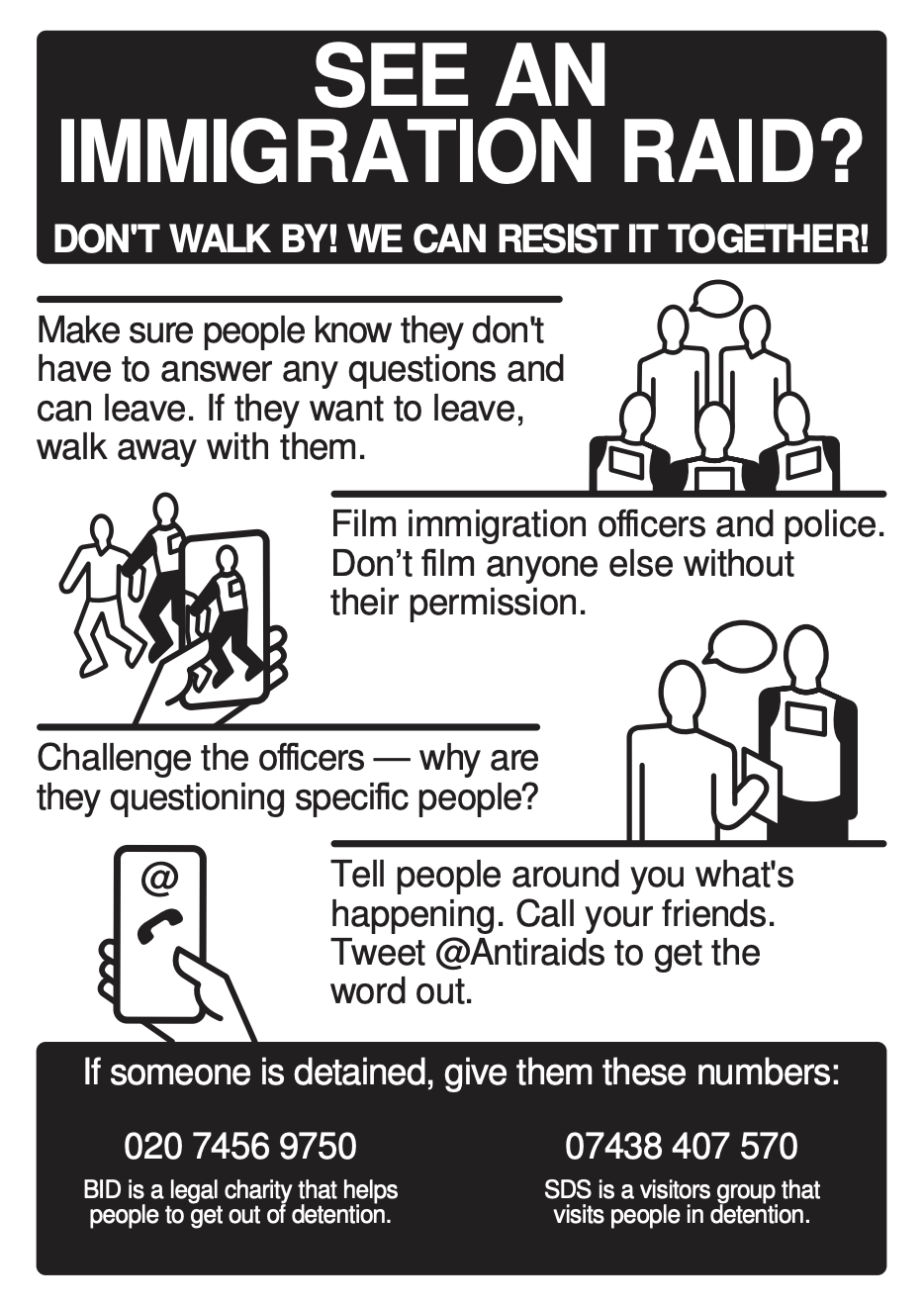
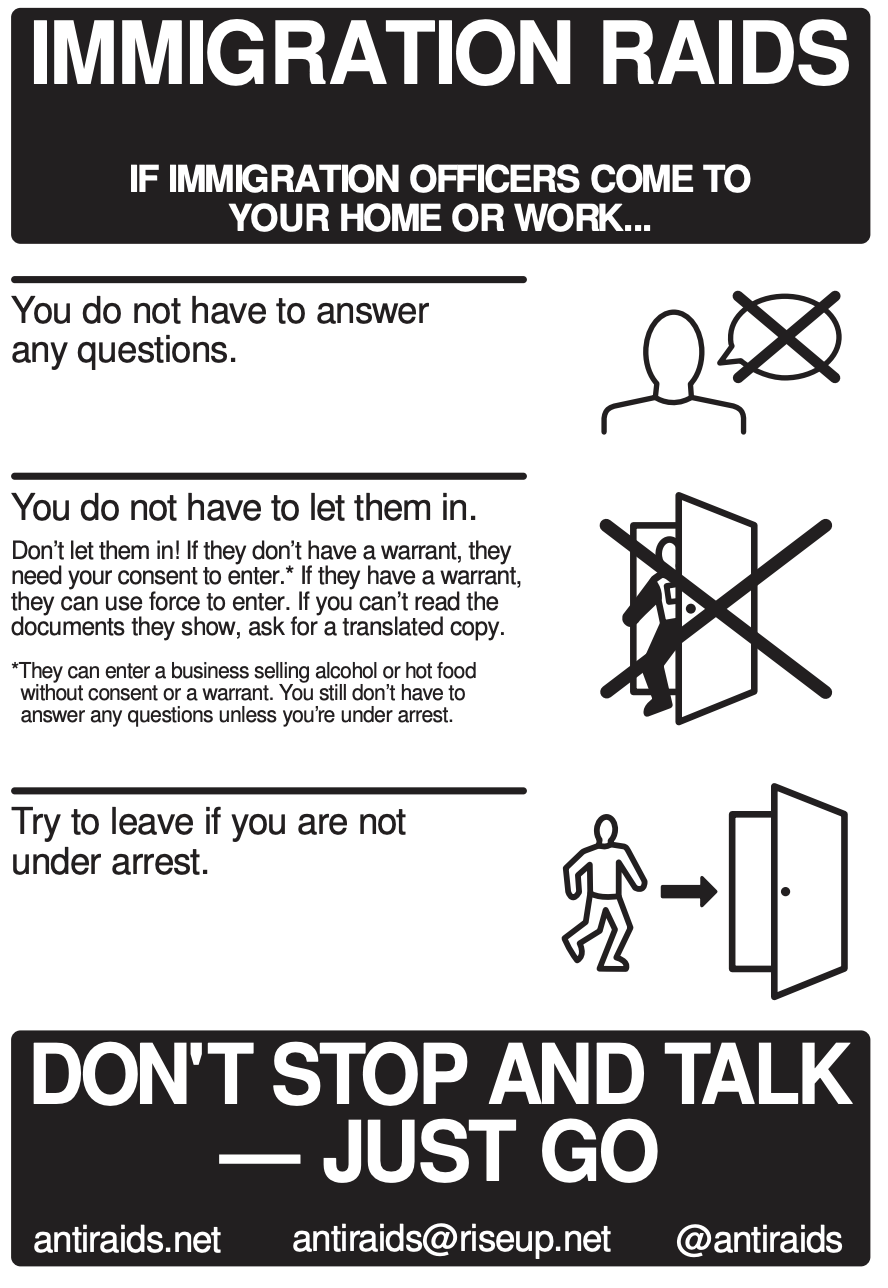
Video: Fighting back against immigration raids as a community
Leeds Anti-Raids Action have created a video of their training designed to help people feel more confident about the basics of immigration raids: what they are, how to spot them, what your rights are, and the wide range of ways communities can resist and keep each other safe.