Last updated: 3 August 2026
This Guide explains how the asylum process works for children and young people who come to the UK without an adult to look after them. If you are in the UK with your family, you may still find some parts helpful, but this guide is mainly for children and young people who are here without a parent or carer.
The guide focuses mainly on the asylum process and other issues, including age disputes, living in care, legal help and your rights as a child or young person living in the UK.
Asylum is also not the only immigration route. The guide includes some information about other types of applications that may matter for young people, for example if someone has lived in the UK for a long time, has family or private life in the UK, has serious health needs, or may be able to apply for settlement or British citizenship. These parts are not the main focus of the guide, but they are included so young people and the people supporting them know what questions to ask and where to get advice.
This Key Guide has been developed from the groundbreaking Young Asylum Guide and has been written in collaboration with Social Workers Without Borders. This guide links to the main Right To Remain Toolkit. We also are grateful for the contribution of all the organisations, individuals and young people who have given their time, expertise, energy and thoughts in creating this guide, including: PAFRAS, CARAS, Shadows and The Refugee Council.
There is a lot of information on this page. Take your time to read the different sections. Don’t worry if you feel confused or overwhelmed – this is normal. The system is very confusing and many people find it hard to understand what is happening. This is why the Right to Remain Toolkit exists. You are in the right place!
It is important to try to understand what is happening and what to expect. You will meet many different people with different jobs. Some are there to help you. This is your life and your case. Other people can support you, but it can also help if you understand what is happening, ask questions, keep your papers safe, and tell someone quickly if something is wrong.
At the same time, you are still young. You deserve safety, care, and the chance to enjoy life as a young person. Sadly, not everyone in the system will see this, or treat you fairly. That is not your fault.
You are not alone. Many others have been through the same process and found ways to keep going. Stay strong, ask for support, and remember your voice matters.
On this page, you will find the following information.
- Before you start: what other young people want you to know
- What is asylum?
- Who is an “unaccompanied asylum seeking child”?
- Some important words you need to know
- Organisations you might hear about
- People you may meet; including people who are part of the government and people who are not part of the government.
- When Children’s Services look after you
- Legal help: what should your lawyer do?
- What happens when you first claim asylum?
- Trafficking and modern slavery
- What if you age is not believed?; including: different types of age assessment
- How to Home Office looks at your asylum claim
- Getting your decision; including: eVisa, Travel documents, Refugee Family Reunion
- What if you are refused by the Home Office?
- Your rights in the UK; including: work, volunteering, education, bank accounts, health, police and immigration officers, reporting and detention.
- Housing, care and support if you are on your own
- What happens when you are living in care and turn 18?
- What to do if you are unhappy with your care or support
- Immigration status, staying longer, settlement and citizenship
- Voluntary return
Before you start: what other young people want you to know
This section is based on what other young people told us about the asylum process in the UK.
They shared what was difficult, what they wish they had known earlier, and what advice they would give to another young person who has just arrived.
The advice below comes from their experiences. Some of the wording has been made shorter or made simpler, but the meaning comes from what young people shared. Thank you to the young people and PAFRAS for what they have shared.
💜 You are not alone
Many young people said the asylum process can feel confusing, stressful and lonely. Waiting for decisions, being away from family, learning a new language, and trying to understand a new country can all be very hard.
“The waiting, uncertainty, loneliness, and adapting to a new culture have been difficult.”
If you feel worried, tired, angry, sad, confused or scared, this does not mean you are weak. It does not mean you have done something wrong. Many young people feel this way because the system is difficult and the waiting can be very hard.
💜 Waiting can be difficult
A lot of young people said waiting was one of the hardest parts of the asylum process. Waiting for letters. Waiting for appointments. Waiting for interviews. Waiting for decisions. Waiting without knowing what will happen next.
“The hardest part for me was waiting for a long time without clear information.”
You may not always get clear answers about how long things will take. This can be frustrating and upsetting. Try to keep going to your appointments, keep your papers safe, and ask someone you trust to explain anything you do not understand.
💜 It is okay to ask questions
The asylum system uses many difficult words. Letters from the Home Office, lawyers, courts or Children’s services can be hard to understand. This is normal. You are allowed to ask people to explain things again. Some letters also need urgent replies – it is important to keep all your letters and emails and show someone you trust.
You can ask:
- What does this letter mean?
- What do I need to do next?
- Is there a deadline?
- Can you explain this in simpler words?
- Can I have an interpreter?
- Can I speak to a lawyer or support worker?
“I wanted to know what each step really means, and what my rights are while waiting.”
You do not need to pretend you understand. It is better to ask.
💜 If you do not understand your interpreter, say so
Language can be harder than people expect. Even if you speak some English, it can still be difficult to understand legal words, official letters, different accents, or an interpreter who does not speak your exact language or dialect.
“If you do not understand your interpreter because of the language, dialect or accent, say this.”
You can say: “I do not understand this interpreter properly. Please write this down. I need an interpreter I can understand.” This can be important in interviews, meetings, legal appointments and age assessments. You are not being rude. It matters that you understand what is happening and that your words are interpreted correctly.
💜 Learning English helps but it takes time
Many young people said learning English helped them feel more confident and understand more about life in the UK. But learning a new language is not easy, especially if you are stressed, tired, missing your family, or dealing with difficult memories.
Try to go to school, college, ESOL classes or community groups if you can. Start small. Practise little by little. You do not need perfect English to ask for help or to have rights.
💜 Life in the UK can be safe and still be hard
Some young people said they felt safer in the UK and had more opportunities. But many also said life in the UK was harder than they expected.
“Some people think life becomes easy as soon as you arrive in the UK, but that is not true.”
You may miss your family. You may feel lonely. You may find it hard to understand the culture, the weather, the food, transport, school, college, housing, money or appointments. You may feel pressure to be okay because people think the UK is easy.
It is okay if life here does not feel how you expected. Starting again in a new country is a big thing.
💜 Ask for help when you need it
Young people said they were helped by social workers, personal advisers, support workers, doctors, charities, friends and community groups.
You do not have to deal with everything by yourself. If you are worried, confused, unsafe, or do not understand something, try to speak to someone you trust.
This could be:
- a social worker
- a personal adviser
- a support worker
- a teacher or college worker
- a doctor
- a lawyer
- a charity or youth organisation
- a trusted friend or community member
“There are people who can help you, and you should not be afraid to ask for support.”
Asking for help is not a weakness – it is one way to protect yourself.
💜 It is not your fault
Some young people feel they have done something wrong when they do not understand the process, miss a deadline, feel too stressed, or struggle to explain what happened to them.
But the asylum process is difficult. Many people find it confusing and frightening. You may also be dealing with painful memories, trauma, loss, separation from family, or worries about the future.
If things feel hard, it does not mean you are failing. You deserve clear information. You deserve support. You deserve to be treated with care.
💜 A message from other young people
“You are not alone.”
Be patient with yourself. Ask for help when you need it. Try to learn English little by little. Keep your documents safe. Go to your appointments. Ask for things to be explained. Tell someone if you feel unsafe. Try to find people you trust.
You may not be able to control how long the process takes, but you can still get support, learn your rights, and take things one step at a time.

What is asylum?
Asylum means asking for safety in another country. You ask for asylum when it is not safe for you to live in your own country anymore.
People ask for asylum when they are in danger. This danger is called persecution. Persecution means people treat you badly, or you are not safe, because of who you are or what you believe.
When you ask for asylum, you are asking the government to say: “You are a refugee. You can stay here safely.”
Who is a refugee?
A refugee is a person who cannot go back to their country. This is because they are scared. They are scared that people will hurt them because of:
- Their race – for example, their skin colour or ethnic group
- Their religion – what they believe in, or how they pray
- Their nationality – the country they are from, or their group inside that country
- Their political opinion – what they think about their government, or things they have said or done
- The group they belong to – this means people who share something important about who they are, or how other people see them. For example: being LGBTQ+, being a woman or girl in a country where women are not safe, or belonging to a minority community
This fear must be real and serious. We call this a “well-founded fear of persecution.” That means: the danger is real, and it would be very hard or unsafe to stop it.
Could the police protect you instead?
The Home Office will ask: could you be safe in your own country? This is called protection.
For example: could you ask the police or the courts in your country for help? Would they really be able and willing to protect you?
If the danger comes from the government itself, this kind of protection is usually not possible.
Could you live somewhere else in your country?
The Home Office may also ask: could you live safely in a different part of your own country? This is called internal relocation.
The Home Office can only say this if all of these things are true:
- There is somewhere else where you would not be in danger
- You could travel there safely
- It would be fair to expect you to live there, without serious hardship
What does “serious hardship” mean?
Serious hardship does not just mean life would be difficult. It means life would be so hard that it would not be fair to expect you to live there. For example:
- You would not be safe there
- You could not get food, water, or shelter
- You could not travel there safely
- You could not get help when you are sick
- You would be completely alone, with no one to support you
What is humanitarian protection?
Sometimes the Home Office decides that you do not meet the rules to be a refugee, because the danger you face is not because of one of the refugee law reasons, such as your race, religion, nationality, political opinion, or belonging to a particular social group.
But the Home Office may still agree that you would face very serious harm if you went back. This is called humanitarian protection.
Table to show how protection law works
| What does being a refugee mean in the law? | What this means |
| 1. You are outside your own country | You have to be in another country to ask for asylum. |
| 2.You have a real fear (“well-founded fear”) | Is your story believed? Is the danger real? |
| 3. You face serious harm (“persecution”) | Examples include violence, threats, abuse, or detention. |
| 4. The harm is because of who you are or what you believe | The harm must be due to one of these five reasons: your race, your religion, your nationality, your political opinion, or a particular social group you belong to. |
| 5. Your country cannot, or will not, keep you safe (“no protection”) | Can the police or authorities in your country keep you safe? |
| 6. Can you live in another part of your country? | Would you still be at risk? Could you access housing, support and health care? |
| – For humanitarian protection: the reason can be anything | For example, you could be facing serious danger because of war and it does not have to be because of who you are or what you believe. |
Who decides if I am a refugee and I can stay in the UK?
The Government (the people voted in to run the country) makes the laws about who can and cannot stay in the UK.
The Home Office is the part of the government that looks at what has happened to you and decides whether it is safe for you to go back.
If the Home Office agrees you cannot go home safely, they can give you permission to stay in the UK. This is sometimes called “leave to remain” or “immigration leave.”
Keep reading to find out more about the asylum process – this is how the Home Office decides if you can stay safely in the UK.
How does the Home Office decide if I am allowed to stay?
When the Home Office looks at your case, they will look at what you say in your interviews, what is written down in forms or statements, and other evidence about your life and what happened to you.
The Home Office also looks at country information about what is happening in your country. These reports are called Country Policy and Information Notes (CPINs), and they are used in asylum and human rights decisions. You can read about these more here.
The law can sound complicated. The table below gives some simple, real-life questions to help you understand what the Home Office should be thinking about when looking at your case, and how this connects to the law. It is based on the guidance Home Office caseworkers use when deciding children’s asylum claims. This guidance says they should think about danger if you return, why you are at risk, whether your own country could protect you, whether you could live somewhere else in your country, whether you might still need humanitarian protection, and what is safest and best for you as a child. They should also use country information about what is happening in your country.
If you want to learn more, you can read the Home Office guidance for children’s asylum cases on the official UK Government website here.
| ❓The Home Office may ask you… | 🧠Why they are asking this |
| Why are you scared to go back? | They are trying to understand what danger you are afraid of. |
| Who are you scared of? | They are trying to understand who might hurt you. For example, your family, other people in your community, the police, the government, or someone else. |
| What do you think would happen if you went back? | They are trying to understand how serious the danger is. |
| Has this happened before? | They may ask what has already happened to you, or what happened to people like you. |
| Why do you think this is happening to you? | They are trying to understand if the danger is because of who you are, what you believe, or how other people see you. |
| Did you ask the police or anyone else for help? | They want to know if you tried to get protection in your own country. |
| If you asked for help, what happened? | They want to know whether the police, courts or other authorities actually helped you, ignored you, or were part of the danger. |
| If you did not ask for help, why not? | They should think about whether it would have been dangerous, pointless, or impossible to ask for help. |
| Could you live in another part of your country? | They may ask if there is another place where you could live in your country and not be in danger. |
| If you moved there, where would you live? | They should think about if you could move to a different place then whether you would actually have somewhere safe to stay. |
| Who would look after you there? | If you are under 18 years old, they should think about whether there would be a suitable adult to care for and support you. |
| Would you be able to go to school, get medical help, and get basic things like food and water? | They should think about whether you could actually live there safely and cope there. |
| Could you travel there safely? | They should think about whether you could even get to that place without danger. |
| What is safest and best for you as a child? | If you are under 18, they should think about your age, your needs, and your best interests. “Best interests” means what is safest and best for you as a child, including your safety, care, support, health, and wellbeing. |
| Even if you do not fit the refugee rules, would you still be in very serious danger if you went back? | Sometimes you may still need protection because of the level of danger you would face even if it is not specifically because of who you are or what you believe. For example, there is war in your country. |
If you are interested in learning more about this, you can look at the guidance the Home Office uses to make decisions about children’s cases on the official UK Government website here.
Who is an “unaccompanied asylum seeking child”?
If you are under 18 and arrive in the UK without a parent or other adult who is responsible for you.
You may hear professionals use the term “unaccompanied asylum-seeking child” or “UASC”. This is the official term used by the Home Office, but it can feel dehumanising because it describes a young person mainly through their immigration status. In this guide, we usually use “separated child” or “young person seeking asylum” because this better describes a young person’s situation and keeps the focus on them as a young person with a full life, history and future, not only as someone with an immigration status.
Who is an “accompanied child”
If you arrive with a parent or another adult who looks after you, you are an “accompanied child”. An asylum claim can still be made by or for you in your own right, but in many cases children who arrive with family are dealt with as part of the family’s asylum claim rather than as a separate case. This often means the Home Office makes a decision about the family together.
If your parent or guardian is granted refugee status, you will often be granted status too. If the family claim is refused, your case may also be refused, unless the Home Office accepts that you have your own protection needs. This guide mainly focuses on separated children, but some of the information may still be useful for accompanied children too.
There is also an important change from 2 March 2026. Some people who claim asylum or make further submissions on or after this date and are granted refugee status or humanitarian protection will usually be given 30 months’ permission to stay at first.
This does not usually apply in the same way to separated children. If you are accepted as a UASC and your asylum claim succeeds, you should usually get 5 years’ permission to stay, even if you have turned 18 by the time the decision is made.
The rules for children who are part of a family claim can be more complicated (accompanied children). If you are granted status as part of a family claim, ask your lawyer, social worker or another trusted adult to help you check what type of permission you have and how long it lasts.
This Key Guide focuses on separated children but you might still find some of the information useful if you are a child or young person who are part of a family claim for asylum.
Who is a “young person”?
In the UK, you are legally defined as a child if you are under 18. This means you are treated as a child in the asylum system if you are under 18. When you turn 18, the asylum system will treat you as an adult. Local Authorities (see below) also have certain responsibilities to support, protect and care for under 18s in their area.
However many organisations in the UK see young people as anyone aged 16–25. This means you may still be able to:
- Join youth groups and activities
- Use special youth mental health services
- Access housing projects for young people
- Access Local Authority care leaver support if you were looked after by the Local Authority before you turned 18
There may also be special services for young people seeking asylum that you can still access up to age 25.
This age (16–25) is often called a transition to adulthood. It is a time when you are still learning, building independence, andwill need additional support.
So even if the asylum system calls you an “adult” at 18, remember you are still a young person and support is out there for you.
If you were over 18 when you claimed asylum, you should look at the main Toolkit pages, as you will be in the adult process. The Toolkit is written in a way that is easy for everyone to understand and use.
Your rights as a child living in the UK
While you are under 18, the people and organisations making important decisions about you must think about what is in your best interests. This includes the Home Office (Section 55 of the Borders, Citizenship and Immigration Act 2009) and Children’s Services (Children Act 1989). Best interests means making decisions that keep you safe, supported, and able to build your life. “Best interests” means what keeps you safe, healthy, and supported. Your feelings, identity, and views should always be listened to when deciding what is best for you.
The rest of this guide explains who is involved, what kinds of meetings may happen, and what support you should get as a child in the asylum process

Some important words you need to know
You will hear many words again and again during the process. These are words and roles that will come up in many parts of your asylum journey. Understanding them now will help you later in the guide.
Don’t be afraid to ask people to explain what these words mean. It is important that you understand.
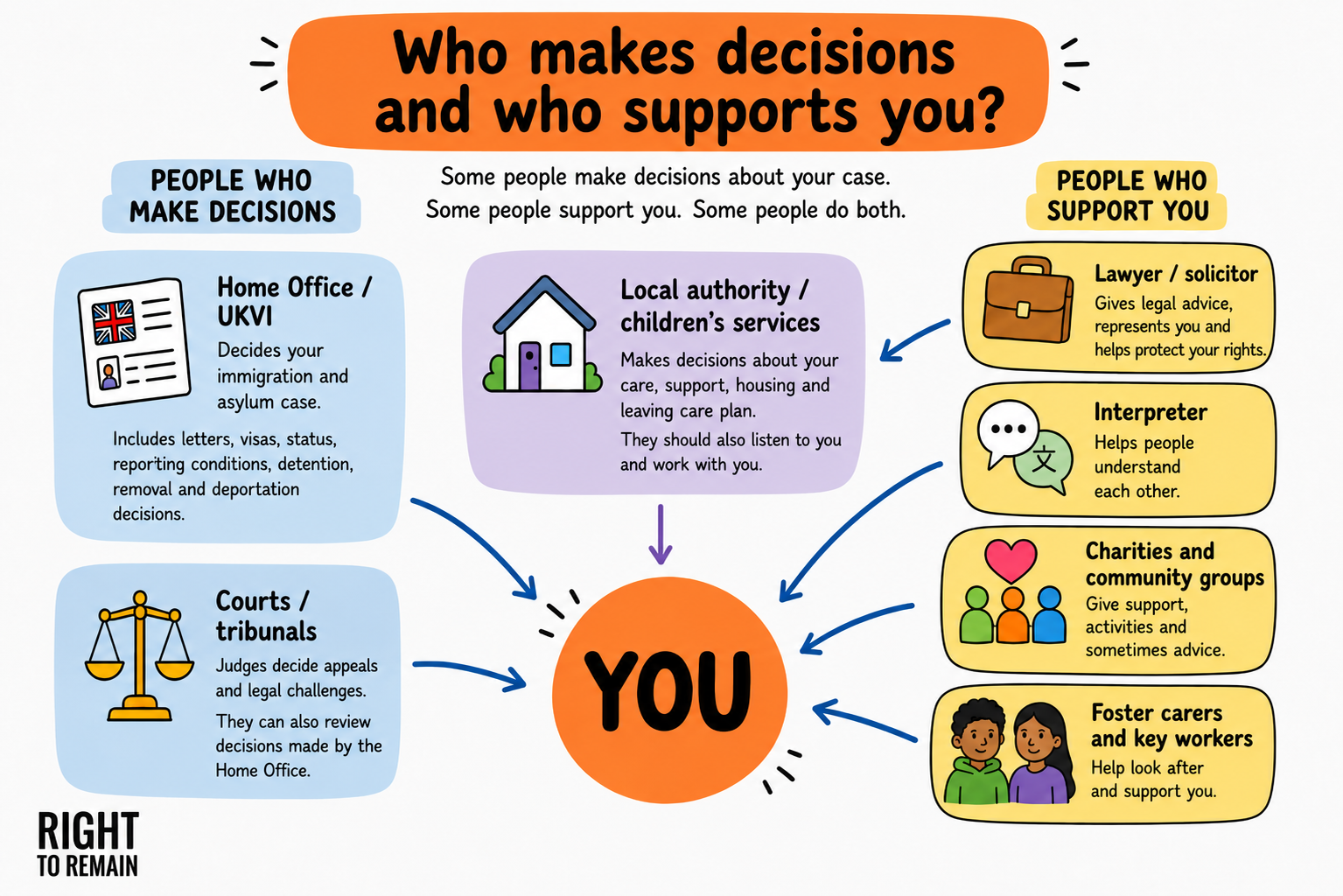
It is also important to know who is who. Different people have different jobs. Some people make decisions about your case. Some people support you. Some people do both. This can help you understand who can make decisions, who can help you, and who you can ask questions.
But remember: this is your life and your case. You also have power: to speak up, to ask questions, to get support, and to challenge decisions.
As you read the list below, you will see different colours. These colours are there to help you understand the different roles people and organisations may have in your journey to stay in the UK.
🔵 Blue = government, courts or police
These people or organisations may make decisions, enforce rules, or be involved if there is a legal problem.
🟣 Purple = Children’s Services
Children’s Services may make decisions about your care and support. They should also help keep you safe, support you, and make plans with you.
🟡 Yellow = people who are not part of the government
These people do not decide your asylum or care case. They may support you, advise you, explain things, or help you speak up.
The colours are a guide. Some people’s roles can be confusing, so you can always ask: “Who do you work for, and what is your job?”
Organisations you might hear about:
🔵 The Government ➜ The government is the group of people and organisations with the power to make rules and decisions for the country. There is the national government and the local government.
🔵 National Government ➜ This is the government for the whole country. The Home Office is part of the national government.
🔵 The Home Office ➜ The Home Office is part of the UK Government. It controls borders, decides asylum claims, and may question your age.
🔵 National Referral Mechanism (NRM) → This is a system run by the Home Office that is supposed to help find people who may be victims of modern slavery and help them to get the right support.
🔵 The Local Authority (or Local Council) ➜ “Local” means your town, city, or area. For example, if you live in Leeds, your Local Authority is Leeds City Council. Local Authorities run services such as schools, housing and Children’s Services.
🟣 Social Services or Children’s Services ➜ This is part of your Local Authority. Their job is to keep children safe and supported, including children in care. They are part of the government, but they are not the same as the Home Office. They may share some information with the Home Office, but they do not decide your asylum claim. We will use the term Children’s Services in this guide.
🔵 The Legal Aid Agency (Legal Aid) ➜ Legal Aid is a system that uses government money to pay for a lawyer if you cannot afford one. It is funded by the government, but it is not the Home Office.
🔵 The Tribunal or the Court ➜ This is where judges make legal decisions, for example if you appeal. Courts and tribunals are independent. This means they are not part of the Home Office or the Council.
🟡 A charity ➜ A charity is an independent organisation. This means it is not part of the government. A charity may give you advice, support or activities.
People you may meet:
People who are part of the government
🔵 Home Office caseworker ➜ This is the person at the Home Office who works on your asylum case. They may look at your forms, interviews and evidence.
🔵 Immigration officer ➜ An immigration officer works for the Home Office. You may meet immigration officers at a border, airport, port, reporting centre, Home Office building, or during immigration enforcement.
🟣 Social worker ➜ A social worker works for Children’s Services. Their job is to help keep you safe, support you, and make plans with you.
🟣 Independent Reviewing Officer, or IRO ➜ An IRO checks whether the local authority is making proper plans for you and listening to you. They should help make sure your care plan is being followed.
🟣 Personal Adviser ➜ If you are leaving care or have left care, you may have a Personal Adviser. They can help with things like housing, education, money, appointments and planning for the future.
🔵 Police ➜ The police deal with crime and public safety. For example, they may become involved if someone is hurt, threatened, unsafe, arrested, or accused of a crime. Some people feel scared of the police. This may be because of past experiences, racism, trauma, immigration worries, or fear of not being believed. If you feel scared, this is understandable.
People who are NOT part of the government
🟡 Lawyer ➜ A lawyer is someone who gives legal advice and helps with your case. You may hear different words for a lawyer like “solicitor” or “legal representative” or “immigration advisor”. You may also have different types of lawyers for different legal problems. An immigration lawyer helps with your asylum claim, immigration status and appeals. A community care lawyer helps with problems with Children’s Services or the Local Authority, for example support, housing, age disputes and care leaver support. A public law lawyer helps challenge decisions made by the government or another public body, often through a court process. A barrister mostly works in courts to present legal arguments for appeals or hearings. They are normally given instructions by a solicitor and you might not meet them until the day of an appeal.
🟡 Judge ➜ A judge makes legal decisions in court or in the tribunal. Judges are independent. This means they are not part of the Home Office or the Local Authority.
🟡 Interpreter ➜ An interpreter helps people understand each other if they do not speak the same language.
🟡 Foster carer or caregiver ➜ This is the adult who looks after you day to day if you are living in foster care or another care placement.
🟡 Responsible adult ➜ If you are under 18, there should usually be an adult with you at important meetings and interviews to support you and help make sure you are treated fairly. This might be your social worker, foster carer, key worker or another adult who is responsible for your care. You may hear different words for this, such as “responsible adult” or “appropriate adult”.
🟡 Key worker or support worker ➜ This is someone who helps you with practical things, appointments and support.
🟡 Charity worker or volunteer ➜ This is someone from an independent organisation who may support you with advice, activities or emotional support.
🟡 GP/Doctor ➜ A GP is normally the first person you would see or speak to if you have a medical problem. You might talk to them on the phone or go to a GP surgery which is the building where they work. If the GP decides that you need to see someone else about a specific medical issue, then you might be sent to a specialist doctor or be seen by a nurse or another medical professional like a surgeon or a psychiatrist (someone who deals with mental health).
When Children’s Services look after you
If Children’s Services are looking after you and giving you somewhere to live, you may hear adults say you are a looked-after child or a child in care. These words mean that the local authority has legal duties to care for and support you. In this guide, we usually say child in care because it is shorter and easier to understand.
When you turn 18, you may become a care leaver. This means you were in care before you became an adult. The local authority may still have duties to support you after 18. We explain more about what to expect and your rights later in this guide.
A simple way to think about it is:
Before 18: Children’s Services may look after you as a child in care.
Around 18: Children’s Services should plan what support you need as you become an adult.
After 18: You may get care leaver support from the local authority.
After 21: You can still ask for support from a Personal Adviser until you are 25.
Legal help: what should your lawyer do?
A lawyer should help you understand your case and speak up for you. They should explain things clearly, answer your questions, and help you know what is happening and what the next steps are. They should not expect you to understand legal words on your own.
You may need different types of lawyers for different problems. For example, an immigration lawyer can help with your asylum claim, immigration status or appeal. A public law or community care lawyer can help with problems involving children’s services, support, housing, age disputes or care leaving support.
A good lawyer should usually:
✅ Explain their role and how you can contact them
✅ Keep in touch with you and tell you about important updates or delays
✅ Speak to you in a way you can understand
✅ Check that you have understood what they are telling you
✅ Listen to you and give you space to ask questions
✅ Help prepare your case, including forms, statements and evidence
✅ Help check for mistakes in things that have been written down about you
✅ Come to important meetings, interviews or hearings when they can
✅ Make sure your needs as a child or young person are taken into account
✅ Explain decisions and next steps if something changes in your case
Your lawyer should speak to you, not only to the adults around you. They should treat you with respect, use simple language, and explain things again if needed. It is okay if you need things repeated, explained more slowly, or written down in a clearer way.
If you cannot find a lawyer straight away
We know it can be hard to find a lawyer. Many people are told they need legal advice, but then struggle to find someone who can take their case. This is not your fault.
This guide and the main Right to Remain Toolkit can help you understand the system, prepare questions, keep track of what is happening, and know when something may need urgent help. But they are not a replacement for legal advice.
If you cannot find a lawyer straight away, speak to a trusted adult. This could be your social worker, personal adviser, foster carer, support worker, teacher, youth worker, charity worker or someone else you trust. They may be able to help you look for, contact organisations, understand letters, or work out what needs to happen next. Your social worker, personal adviser, or a specialist charity may also be able to help you find a suitable immigration lawyer.
If there is a deadline, for example for an appeal or a legal challenge, tell someone quickly. Do not wait.
If you are worried about your lawyer
Some signs that something may be wrong are if your lawyer:
⚠️ Does not reply for a long time
⚠️ Does not explain what is happening
⚠️ Uses words you cannot understand without explaining them
⚠️ Mostly speaks only to your social worker or carer instead of you
⚠️ Does not tell you about important deadlines
⚠️ Stops acting for you without clearly explaining what has happened and what your options are
If you are worried about your lawyer, speak to a trusted adult about your concerns. You can ask for help to understand what is happening and what your options are.
What happens when you first claim asylum
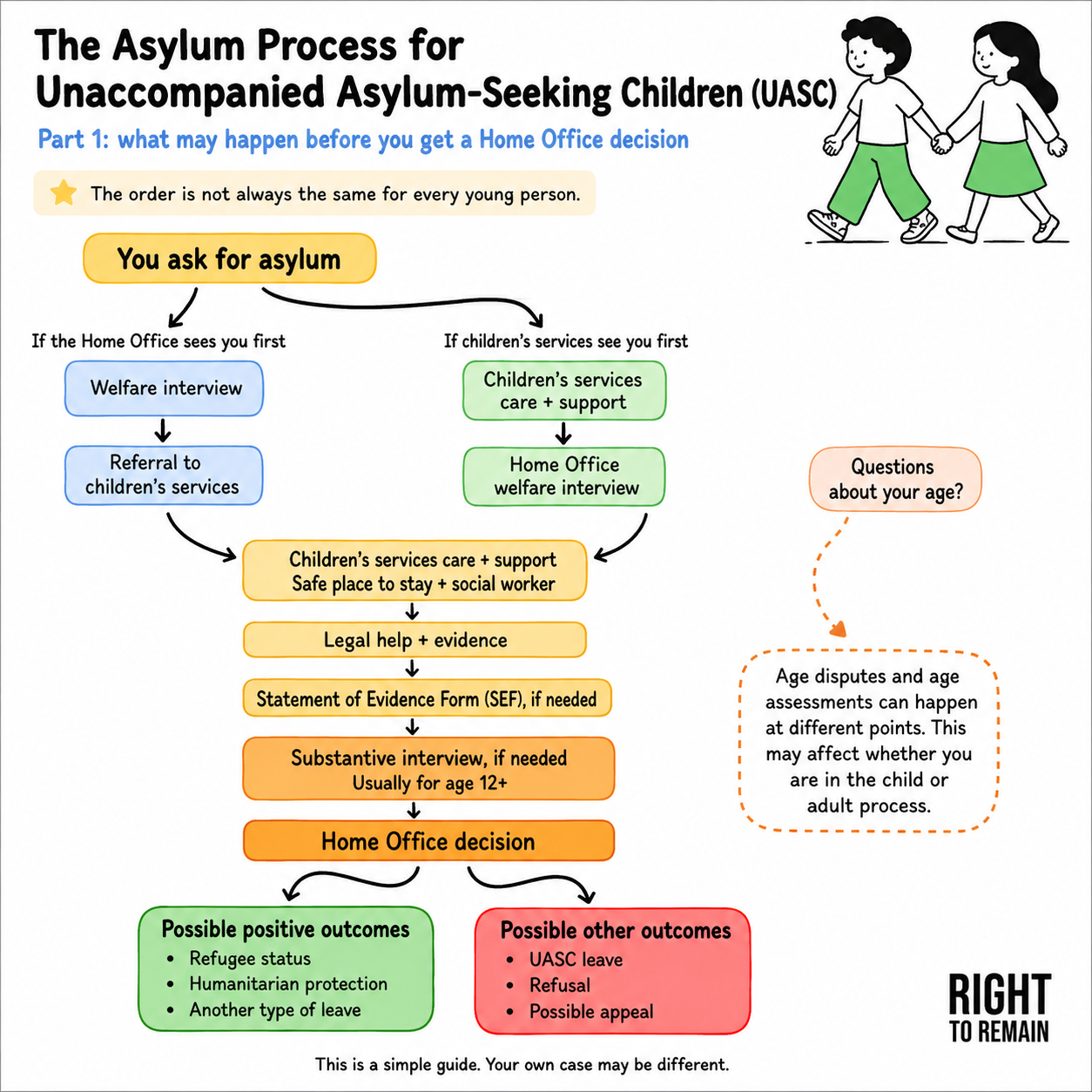
The asylum process for young people is similar to the one for adults, but there are some important differences.
In this guide we will explain the steps that are different for children and what your rights are if you are under 18.
We also know that many young people have their age questioned or not accepted and will be in the adult process. Later in this guide, we will explain what happens in those situations and what support you can get.
Asking for asylum
If you want to ask for asylum, you tell the Home Office. Some people ask for asylum when they first arrive in the UK, for example at an airport or port. Some people ask later at a Home Office building.
The first meeting is to register your claim. What happens next can be different for adults and children.
Welfare interview (If you are a separated child)
If you are under 18 (and the Home Office accepts you are under 18) and you are not with a parent or another adult who looks after you, you should usually have a welfare interview instead of an adult screening interview. This is a short first meeting with the Home Office. You can read about what happens if the Home Office do not accept you are under 18 here.
A welfare interview is mainly to check:
- who you are
- where you are staying
- whether you are safe
- whether you need help, support or medical care.
The welfare interview is not the full interview about why you need asylum. The Home Office should not ask you to explain in detail why you are scared to go back to your country at this stage. This first interview should only be used for basic information about you, to check if you are safe and need help, and to check if anyone may have harmed you, controlled you or forced you to travel or do things against your will. This is called trafficking and modern slavery
You should be given a copy of the welfare interview form. Your social worker should also get a copy, and your lawyer should get one too if you have one.
It is important to read the welfare interview form carefully if you can. It is normal for there to be mistakes in the welfare interview form. Mistakes can happen if you are tired, upset or unwell, if there are problems with interpreting, or if the questions are confusing or not asked clearly. If something on the form is wrong, don’t panic but make sure that you tell your social worker, foster carer, lawyer or another trusted adult as soon as you can, so the mistake can be explained to the Home Office later. The Home Office says information from this first interview should not be used to decide your asylum claim unless it is properly discussed again later with a responsible adult or lawyer present.
If you are with your parent or family (accompanied child)
If you are with a parent or your family, the family may go through the normal screening and registration process together. The Home Office should still ask about your welfare and your protection needs.
The Home Office should check whether:
- your reasons for needing protection are the same as your parent’s
- your reasons are different or extra
- or you do not have your own protection needs
If your protection needs are different from your parent’s, your claim should be looked at separately as a child’s claim.
Screening interview
Adults (over 18s) usually have a screening interview. This is a short first interview. It is used to register the asylum claim and collect basic information, such as identity, family details, and a short summary of why the person is asking for asylum. It is not the full asylum interview.
We know that the Home Office often does not believe a young person’s age. This means that even if you say you are under 18, you may still be treated as an adult at first and asked to go through the adult screening process.
Trafficking and modern slavery
Sometimes young people are brought to the UK by other people who make promises, threaten them, or force them to do things. This is called trafficking and modern slavery.
This can look like:
- Someone promising you a job, money, or school, but then controlling you, not letting you leave, not paying you or making you do things against your will.
- Someone threatening you or your family if you don’t do what they say.
- Being made to work, have sex, or do things you didn’t choose.
- Being moved from place to place without being asked.
If any of this has happened to you, or someone has tried to make it happen, it is important you tell the Home Office, your lawyer, or social worker as soon as possible. You still have the right to claim asylum, and you may also get extra protection as a victim of trafficking or modern slavery.
What if your age is not believed?
When you arrive in the UK and say you are under 18, sometimes the government does not believe you. This is called an age dispute. The government has also started calling this an age concern.
Sadly, this happens to many young people. A recent study by the Helen Bamber Foundation and Refugee Council found that many young people who were first treated as adults were later found to be children.
An age assessment is the process used to decide whether you will be treated as a child or an adult. This decision can have serious effects. It can affect where you live, what support you get, your asylum case, your education, and whether you are treated as a child or an adult.
If people are not sure how old you are, they should usually give you the benefit of the doubt. This means you should normally be treated as a child for now, unless they are very sure that you are an adult.
There are three main ways your age may be looked at.
1. A first decision by the Home Office
When you first arrive, the Home Office may make a first decision about your age based on how you look and seem.
The Home Office’s own guidance says this should only happen where two officers separately decide that your physical appearance and behaviour very strongly suggest you are significantly over 18, and there is little or no evidence supporting the age you have given.
You should be asked if you have any documents or other evidence about your age. Many young people do not have documents, or lost them during their journey but anything you do have should be considered.
Many young people are wrongly treated as adults in this way. Age can be very hard to judge from appearance alone, especially when someone is tired, frightened or has just arrived after a difficult journey.
If the Home Office is not sure, you should usually be treated as a child while your age is looked at more carefully.
2. An age assessment by local authority children’s services
The local authority where you live, or the local authority responsible for your care, may accept the age you have given. If the Home Office has disputed your age, the local authority may need to write to the Home Office to confirm this.
The local authority may also decide to do its own age assessment. This is a formal process carried out by social workers.
Unless the social workers think you look a lot older than 18, the decision should not just be about your physical appearance. It is usually a longer process where they ask questions about your life to try to work out your age.
For example, they may ask about your family, school, where you have lived, your journey to the UK, and any documents or other evidence about your age. They may also ask to look at your social media accounts, if you have any.
A local authority age assessment can have serious consequences. If the local authority decides you are an adult, this may affect your care, housing, support and how the Home Office treats you in your immigration case.
If you disagree with a local authority age assessment, try to get legal advice quickly. You can ask for the decision in writing and ask for a copy of the age assessment. A lawyer may be able to help you challenge the decision in court. This is called judicial review.
3. An age assessment by the National Age Assessment Board
The National Age Assessment Board, or NAAB, is part of the Home Office. It employs social workers who can carry out age assessments in some cases.
This usually happens after a referral from a local authority. In some situations, the Home Office can also ask the NAAB to assess a person’s age.
A NAAB age assessment can also have serious consequences. If the NAAB makes a decision about your age for immigration purposes, the Home Office will usually rely on this in your immigration case.
If you disagree with a NAAB age assessment, try to get legal advice quickly. You can ask for the decision in writing and ask for a copy of the age assessment. A lawyer may be able to help you challenge the decision in court. Significant new evidence may also mean your age needs to be looked at again.
The whole process of age disputes and age assessments can be complicated and confusing. Different people may use words like Home Office, local authority, children’s services or NAAB. They are talking about different parts of the system that may decide whether you are treated as a child or an adult.
Some organisations that work with children and young people have also made a guide which explains the process. It was written with the help of young people who have experienced an age dispute.
I have heard about the government using X-rays, MRI scans, AI and face photos. What does this mean?
You may hear about X-rays or MRI scans being used to guess someone’s age. These are scans that take pictures inside your body, for example of your bones or teeth.
You may also hear about the Home Office using AI to guess someone’s age from a photo of their face. This is sometimes called Facial Age Estimation, or FAE. None of these methods can prove your exact age. The Home Office says Facial Age Estimation should only give extra information to officers. It should not make the decision by itself. It should not replace a full age assessment by social workers.
The Home Office says it is not using X-rays or MRI scans in age assessments at the moment. The Home Office also says Facial Age Estimation is not being used in age decisions yet but it is testing this technology in 2026 and may start using it at the border in 2027.
Many organisations are worried about this technology because it can make mistakes. People may look older or younger for many reasons, including stress, trauma, illness, hunger, lack of sleep, or a difficult journey.
Action section: What to do if you are under 18 and in a hotel for adults
Tell the accommodation provider or Migrant Help straight away that you are under 18. Ask them to write this down. Tell them your age and your date of birth (if you know this) and explain that you are a child.
Give them any information or evidence you have about your age. This could include documents, photos, school records, medical papers, messages from family, or letters from people who know you. You should also tell them if the Home Office has already spoken to you about your age or made an age decision.
Ask the accommodation provider to follow the Home Office age concern referral process. Home Office guidance says that where someone in adult asylum accommodation says they are a child, the provider or Migrant Help should collect information about their age, consider any risks, and send an Age Assessment Information Form to the Home Office Age Dispute Team.
Tell staff if you feel unsafe. For example, tell them if you are sharing a room with adults, feel frightened, have health problems, or are at risk of harm. The guidance says providers should consider risks, including room sharing, and raise harm or vulnerability concerns with the Asylum Safeguarding Hub.
Ask what response has come back from the Home Office Age Dispute Team. The guidance says the Home Office Age Dispute Team should respond within 24 hours, not including weekends.
If no initial age decision has been made, the provider should refer you to the local authority children’s services and ask them to assess your age.
If an age decision has already been made but there is new evidence, or the provider still has concerns that you may be a child, the provider should send the Age Assessment Information Form to both the local authority and the Home Office Age Dispute Team.
If an age decision has already been made and the provider says they have no further concerns, ask them for contact details for local children’s services. You can ask the local authority directly for an age assessment. You should also try to get legal advice urgently.
Try to get legal help quickly. Do not wait. A public law solicitor can advise you about challenging an age decision or age assessment.
If staff tell you to contact Migrant Help
If you are in adult Home Office asylum accommodation and you tell staff that you are under 18, they should not just tell you to contact Migrant Help and leave it there.
Home Office guidance says the accommodation provider or Migrant Help should take information about your age, look at any risks to your safety, and contact the Home Office Age Dispute Team. They may also need to contact the local authority children’s services.
You can say:
“I am telling you that I am under 18. Please follow the Home Office age concern referral process. Please write down that I have said I am a child. Please tell me what you are doing to keep me safe while my age is being looked at.”
If staff do not help, or only tell you to call Migrant Help, try to speak to a trusted adult, support organisation or lawyer as soon as possible. They may be able to help you contact children’s services directly, ask the accommodation provider to follow the correct process, or make a complaint.
Making a complaint about your accommodation should not affect your asylum claim or your asylum support.
You can also contact Humans For Rights Network – message or call +447506663089 or find a local organisation.
Challenging an age assessment
If social workers or the Home Office say you are an adult and you do not agree, you can challenge this. You will have to see a special type of lawyer called a “public law” solicitor. They are different from an immigration solicitor. Their job is to challenge unlawful decisions made by public bodies, such as a local authority, the Home Office or the NAAB. You should not have to pay for this, it is covered by Legal Aid.
The process of a challenge is:
- The solicitor writes to the public body responsible for the decision. This may be the local authority, the Home Office, the NAAB, or more than one of them. – this is the first step, called a “letter before action.” They usually have to wait 14 days for the LA to respond.
- Court case – if the local authority still refuses, your solicitor can ask the court to decide. A judge will then make a final decision.
- Outcome – the judge might accept your age, order a new assessment, or say you are an adult.
You can find much more detail about this legal process in the Age Assessment Toolkit.
If you reach the end of the process and the court says you are an adult then you will be treated as an adult in the asylum system. You should follow the main Right to Remain Toolkit pages for adults, which you can find here.
If you later get new evidence (like original papers, school or medical records, or strong letters of support), speak to a lawyer again. Sometimes it may be possible to ask for your age to be looked at again.
Finding a way forward if you are being treated as an adult after an age assessment
If you have been told you are an adult and your challenge has been unsuccessful, it can feel very unfair. It is normal to feel angry, upset, or hopeless. This reaction makes sense – it is not easy to accept. Many other young people have also been through this situation. Knowing that doesn’t take away your feelings, but it shows you are not alone. There are people and organisations who understand what you are facing.
This is a hard place to be. Your feelings are real, and they matter. At the same time, you do have choices and support. Many others have found a way forward and you can too, in your own time. Some things you can do:
🩵 Focus on your asylum claim: Go to your interviews and appointments, keep your papers somewhere safe, and stay in touch with your lawyer if you have one. If you do not go to an interview or appointment, it will not change the age the Home Office has given you. It may also cause more problems in your case. For example, the Home Office may say you have not stayed in contact or not followed the process, and it may treat your asylum claim as withdrawn unless you had a good reason that was outside your control
🩵 Look for support: Even if things feel confusing or unfair, you do not have to deal with everything on your own. Charities, youth groups, community organisations may still be able to help you with things like housing, health care, education, daily support and activities. Being around supportive people can also help you feel less alone.
🩵 Take care of yourself: Try, as much as you can, to eat regularly, rest, drink water and move your body in ways that feel okay for you. This will not fix everything, but it can help you keep your strength for appointments, decisions and whatever comes next.
🩵 Stay open to new evidence: Sometimes new information can help later, even if it is not available straight away. This could include school records, identity documents, medical papers, photos, or letters from people who know you well and can support what you have said about your age. If new evidence becomes available, keep it safe and show it to your lawyer (if you have one) or another trusted adult supporting you, because it may help if your case is looked at again.

How the Home Office looks at your asylum claim
After you ask for asylum, the Home Office has to decide whether you need protection. The way it looks at your claim can be different depending on things like what country you are from, whether the Home Office agrees that you are under 18, and whether your case is in the usual process or a faster process for some children.
This part of the process can feel confusing, and sometimes it can change depending on your situation. But you should not have to deal with it on your own. There should be adults supporting you through it, such as a social worker, carer or lawyer if you have one. It is still important to understand what is happening and what to expect, so things feel a bit less unknown.
Statement of Evidence Form (SEF)
In many children’s cases, the Home Office will ask for a Statement of Evidence Form (SEF).
The SEF is a form about why you are asking for asylum. It asks about your life, your family, your journey, your health, and why you are scared to go back to your country.
The SEF can be very important. The Home Office may use it to understand your case and decide whether you need a full asylum interview.
A SEF should usually be completed with help from a legal representative. Your social worker, foster carer, support worker or another trusted adult can support you, but they should not be expected to complete the SEF for you or give you immigration advice.
This is because the SEF is part of your asylum case. What is written in it may affect what happens later. If something is unclear, missing, or different from something you say later, the Home Office may ask you questions about it.
If you have a lawyer, ask them about the SEF. They should explain what it is, help you understand the questions, and help prepare your answers.
If you do not have a lawyer yet, tell your social worker or another trusted adult as soon as possible. Ask them to help you find legal advice. You can also ask them to help you tell the Home Office that you do not have a lawyer yet and need help to find one.
If the Home Office is asking for the SEF and you do not have a lawyer, ask a trusted adult to help you tell the Home Office that you do not have legal representation and need time and support to find advice.
You can read the official UK Government guidance about the SEF here.
SEF opt-out pilot
You may hear about something called the SEF opt-out pilot.
This pilot is for some young people aged 16 or 17. It may mean their asylum case can move to an asylum interview without completing the SEF first.
This does not apply to everyone. The Home Office guidance says the pilot is only for young people who already have legal representation and who agree to take part.
You should not be pushed into this. If this pilot is mentioned in your case, ask your lawyer to explain:
- what the pilot means
- whether it applies to you
- what could happen if you agree
- what could happen if you do not agree
- whether going to an interview without a SEF is in your best interests
If you do not understand, ask for more time and ask for things to be explained in simpler words.
Streamlined process for some children
Some children may go through a different process called streamlined asylum processing. This means the Home Office may deal with your claim in a quicker way. As of May 2026, this may apply to some children’s cases from Eritrea and Sudan. The Home Office says this is because children from these countries are often granted protection. This may change, so check the latest guidance or ask a lawyer or trusted adult.
Preliminary Information Meeting (PIM)
If your case is in the streamlined process, you may be invited to a Preliminary Information Meeting (PIM). The Home Office calls this a meeting, not a full asylum interview. But it may still feel like an interview, because you will be asked questions about your case. The Home Office uses this meeting to decide what should happen next.
A responsible adult must be with you at the PIM. This is usually your social worker, carer or another adult who supports you. If you need an interpreter, the Home Office should provide one. A lawyer can attend too, but the meeting will not usually be delayed if they cannot come.
The PIM is often by video call, but it can sometimes be in person if needed. It should not usually happen in your first two weeks in care.
The Home Office will write down what is said and should give you, or the adult supporting you, a copy afterwards. The meeting should not be audio recorded
After the PIM, the Home Office may:
- give you refugee status
- ask for more information in writing
- invite you to an asylum interview. This could be a shorter interview, a more focused interview, or a full asylum interview.
The Home Office should not refuse your claim only because of what was said in the PIM. If the Home Office cannot decide to give you protection after the PIM, you should usually be given an asylum interview.
What is the substantive (big) interview?
Sometimes you may be invited to a longer interview. This is often called a substantive interview. This is the main interview about why you need protection.
Not every child will have one. Before deciding to interview you, adults should think about whether an interview is in your best interests, which means whether it is the right and fair thing for you. In many cases, children over 12 are usually interviewed, but not always. If there is already enough information, or if an interview would be too harmful or upsetting, there may not need to be one.
The interview is usually by video call, but sometimes it can happen in person if needed. These interviews are often around 2 to 4 hours.
If you are under 18 at the time of your interview, a responsible adult must be there with you. This is usually your social worker, carer or another adult who supports you. They are there to support you, help make sure you are treated fairly, and speak up if you are too tired, upset or confused, but they are not there to answer questions for you. If you have a lawyer, they should usually be there as well. An interpreter should also be provided if you need one by the Home Office, and sometimes your lawyer may arrange an interpreter too.
You may be asked questions about things like:
- your family
- where you are from
- your health
- your journey
- why you are scared to go back
The interview can feel stressful and tiring. You do not need to get everything perfect. If you do not understand a question, do not know an answer, cannot remember exactly, or need a break, it is okay to say so.
Getting your decision
After the Home Office has looked at your case, it will send a decision. This is usually in a letter. The letter should explain what the Home Office has decided and why. If you have a lawyer, the letter should usually be sent to them too.
Table showing the different types of decision you can get
| 📝 Type of decision | 💡 What this means | ➡️ What happens next? |
| Refugee status | The Home Office accepts that you need protection in the UK because it is not safe for you to return to your country. | If you were under 18 when you claimed asylum you should get 5 years leave to remain. You may need help to: set up your eVisa, apply for a travel document. If you are 18 or over, you may need help to apply for benefits. Benefits are money from the government to help people pay for things like food, rent, and living costs. |
| Humanitarian Protection | The Home Office may not accept that you are a refugee, but agrees that it is not safe for you to return to your country because you could face serious harm | If you were under 18 when you claimed asylum you should get 5 years leave to remain. You may need help to: set up your eVisa, apply for a travel document. |
| UASC Leave | The Home Office does not accept your asylum claim, but gives you permission to stay because you are a separated child and there are no safe care arrangements for you in your country. This leave usually lasts until you are 17 and a half years old. | This is still a refusal of your asylum claim. You may need legal advice about an appeal, your eVisa, and what to do before your leave ends |
| Another type of leave | The Home Office does not accept your asylum claim, but gives you permission to stay for another reason, such as family life, private life, health, or other circumstances. Your decision letter will explain the reasons why. | You may need legal advice about your decision. You may also need help with your eVisa, your rights, and when to apply again. |
| Refusal | The Home Office does not accept your asylum claim and does not give you permission to stay. This does not always mean your case is finished. | Check if you have the right to appeal. Speak to a lawyer or trusted adult quickly because there may be a short deadline to appeal. |
eVisas
An eVisa is an online record of your immigration status. It is not a card or a paper document.
Your eVisa should show what permission you have to stay in the UK. It may also show things like whether you can work, study, rent, or claim benefits.
To see your eVisa, you need a UKVI account. UKVI means UK Visas and Immigration. This is part of the Home Office.
You may need your eVisa to prove your immigration status. For example, you may need it for work, renting, education, benefits, travel, or other services.
You can use your UKVI account to get a share code. A share code lets another person or organisation check your immigration status online. For example, an employer, landlord, college or benefits office may ask for one. A share code only lasts for a limited time.
It is important to check that the information on your eVisa is correct. Check things like:
- your name
- your date of birth
- your photo
- your immigration status
- the date your permission ends
- what rights or conditions are shown
If something is wrong, ask for help as soon as you can. You can speak to a lawyer, social worker, personal adviser, support worker, charity worker, teacher or another trusted adult.
Keep your UKVI account details safe. If you change your phone number, email address, passport or travel document, you may need to update your UKVI account.
If you cannot access your eVisa, or you think your eVisa is wrong, ask for help. Do not ignore it. Problems with an eVisa can make it harder to prove your rights.
Travel documents
If you want to travel outside the UK, you may need a travel document. A travel document is not the same as your immigration status. It is a document that may let you travel to other countries if you cannot use or get a passport from your country.
The type of travel document you can apply for depends on your immigration status. For example:
- if you have refugee status, you may be able to apply for a refugee travel document
- if you do not have refugee status but cannot get a passport from your country, you may be able to apply for a certificate of travel
- if you have been recognised as stateless, you may be able to apply for a stateless person’s travel document
The rules are different for each type of travel document. You should check before applying.
If you have refugee status, you should not travel to the country you claimed asylum from or even contact that country’s embassy to request a passport. This could cause serious problems for your immigration status.
If you want to travel, ask for advice first if you can. You can speak to a lawyer, social worker, personal adviser, support worker, charity worker or another trusted adult.
Before you travel, check:
- whether your immigration status allows you to come back to the UK
- whether your eVisa details are correct
- whether you need a visa to enter the country you want to visit
- whether travelling could affect your benefits, housing, education, immigration status or future applications
Keep it safe! If you lose your travel document while outside the UK, it may be difficult and expensive to return.
If you have less than 6 months left on your permission to stay, you may need to extend your permission before applying for a travel document.


Refugee Family Reunion
Family reunion means applying for close family members to come to the UK to live with you once you have Refugee Status. It is different from family tracing, which means trying to find family members you have lost contact with.
As of June 2026, the UK refugee family reunion route is paused. This means new applications cannot be made under that route. Applications made before 3pm on 4 September 2025 should still be looked at under the old rules.
This is a difficult and changing area of law. If you want to bring family members to the UK, speak to a lawyer, social worker, personal adviser, support worker or another trusted adult before making any application. Some families may need to look at other visa routes, but these can be stricter, more expensive, and harder to use
What if you are refused by the Home Office?
The Home Office will send you a decision letter. This letter should explain why your asylum claim has been refused.
Getting a refusal can feel shocking, scary, or upsetting. But a refusal does not always mean your case is over.
Some people can make a legal challenge. This is called an appeal. An appeal means asking a judge to look at the Home Office decision.
If you get a refusal, show the letter to your lawyer, social worker, personal adviser, foster carer, key worker, or another trusted adult immediately. There may be a short deadline to appeal.
What happens if you appeal?
If the Home Office refuses your application, you may have the right to appeal the decision. An appeal means you ask an Immigration Tribunal (a type of court) to review your case.
At the Tribunal, an independent judge looks at the Home Office decision and the evidence in your case. You (or your representative) can explain what you think the Home Office got wrong, and you can send evidence to support what you say. The Home Office can also send its reasons and evidence.
An appeal is not just “checking the paperwork”. It is a chance to challenge the Home Office refusal and ask a judge to decide your case fairly, based on the evidence.
If you win, the judge may allow your appeal (meaning the Home Office decision is not accepted). If you lose, the judge may dismiss your appeal (meaning the refusal decision stays in place). Sometimes, the Tribunal may send the case back to the Home Office to make a new decision.
What happens if you can’t appeal?
Sometimes the Home Office refuses a case and says there is no right of appeal. Sometimes a person does appeal, but the judge does not agree with them.
This can feel very frightening, but it does not always mean there is nothing else you can do. You should try to get legal advice quickly if you can, because there may be short deadlines.
If you are not given a right of appeal, a lawyer may be able to look at whether the decision can be challenged in another way. This might be through a legal challenge called judicial review.
Judicial review is not the same as an appeal. It usually asks whether the Home Office, a tribunal, a local authority, or another public body made an unlawful decision or acted unfairly.
What happens if you lose your appeal in court?
If your appeal is not successful in the First-tier Tribunal, you may be able to ask for permission to appeal to the Upper Tribunal. This is usually only possible if there may have been a legal mistake in the judge’s decision. It is not just a chance to tell the same story again.
If you cannot find a lawyer straight away, speak to a trusted adult as soon as possible. This could be your social worker, personal adviser, foster carer, support worker, teacher, youth worker, charity worker or someone else you trust. Show them the decision letter and any tribunal documents.
Keep all your papers safe. Ask someone to help you check:
- what the decision says
- whether there is a deadline
- whether you still have a right to appeal
- whether you can ask for permission to appeal
- whether there is new evidence that may help
- whether you need advice about fresh claims or further submissions
If the Home Office says you are “appeal rights exhausted”, this means they think you have no more appeal steps left in your current asylum claim. This can affect your support and you may be at risk of being made to leave the UK (the Home Office calls this ‘removal‘), so it is important to get help quickly

Your rights in the UK
Different types of immigration status carry different rights, for example the right to work, study or claim benefits. People seeking asylum and separated young people have rights in the UK. You will also have some restrictions because of your immigration status. These usually change if your claim is accepted and you are given status by the Home Office.
For example, most people seeking asylum are not allowed to work. In some situations, you may be able to ask the Home Office for permission to work, but you should get advice before doing this.
You may also see the words No Recourse to Public Funds, or NRPF. This means you cannot claim some kinds of benefits or housing help from the government. Benefits are money from the government to help people pay for things like rent, food and living costs. Remember NRPF does not mean you have no rights or no support at all.
If you are under 18, you have rights as a child, whatever your immigration status. This means you should be safe, cared for, and able to go to school or college and to access whatever healthcare that you need. If you are a separated child, the Local Authority/Children’s Services should assess what support you need and make sure you are getting it. We explain this more later in this guide here. Your immigration status should not stop you from getting help if you are a child in need. There are also some situations where the local authority have a duty to support people considered to be adults.
Application Registration Card (ARC card)
An ARC card means Application Registration Card. It is a card from the Home Office that shows you have claimed asylum in the UK, or that you are part of someone else’s asylum claim.
Your ARC card may show your name, date of birth, nationality, photo and other information the Home Office has recorded about you. It may also say if your age is disputed, or if you have permission to work.
An ARC card is not proof of identity. It is also not the same as asylum support. Asylum support means help from the Home Office with housing or money if you need it (for over 18s or children living with their family).
You do not need an ARC card to register with a GP, dentist or optician, or to get emergency hospital treatment.
If your ARC card is lost, damaged, expired, has the wrong information, or you have not received it, you can use the online ARC enquiry form.


This image of an ARC card has been taken from UK Gov website and is an example of what an ARC card looks like. The image has been enhanced using AI to enhance quality.
Work and volunteering
Most people seeking asylum are NOT allowed to work while they wait for a decision.
In some situations, you can ask the Home Office for permission to work. You can usually only ask if you have been waiting for a decision on your asylum claim for more than 12 months, and the delay is not your fault.
If you are under 18, Home Office guidance says children should not be given permission to work. You may still be able to do work experience or training if it is part of your education.
If the Home Office gives you permission to work, this does not mean you can work in any job.
You can only work in jobs allowed under the Permission to Work rules. Since 26 March 2026, this usually means jobs listed in Appendix Skilled Occupations at RQF level 6 or above. These are usually higher-skilled jobs, such as some jobs in health, teaching, social work, engineering, architecture, science, law, accounting or IT.
This means you would usually not be allowed to work in many everyday jobs, such as in a takeaway, restaurant, shop, warehouse, cleaning job, delivery job, or most casual work.
Permission to work also does not usually allow you to be self-employed, start your own business, or do paid work outside the jobs allowed by the rules.
If you work when you do not have permission, or you work in a job that is not allowed by your permission to work, this may be treated as illegal working.
Illegal working is a criminal offence. It can also cause serious problems for your asylum support if you are getting housing or money from the Home Office. It may also affect future immigration applications or a future application for British citizenship.
Before starting any paid work, check what your Home Office letter says. Ask someone like your laywer or social worker to help you understand it if you are not sure.
If you think you may have worked when you were not allowed to, or you are worried about a job, try to get advice quickly. Do not ignore it.
You can usually volunteer while your asylum claim is being looked at. Volunteering means giving your time for free to help a charity, public organisation, community group, people, animals, or the environment.
Education
If you are under 16, you should usually go to school. In England, children aged about 5 to 16 must get full-time education. The government says asylum-seeking children do not need to prove their asylum status to apply for a school place, and schools must not refuse a child because of their nationality or immigration status.
If English is not your first language, your school should help you learn English. This is sometimes called EAL, which means English as an Additional Language.
If you are 16 or over, you may go to school, sixth form, college, or an ESOL course. ESOL means English for Speakers of Other Languages. ESOL classes help you learn English for everyday life, study, work, and appointments.
Some colleges have specialist courses for young people who are new to the UK. These may include ESOL, maths, digital skills, life skills, and support to prepare for other courses.
If you are 18 or older, you may still be able to study at college, including ESOL and other courses. Many young people continue in education after they turn 18, even if their immigration status is not yet resolved. The courses available to you, and whether they are free, can depend on your age, immigration status, where you live, and your local college’s admission and funding rules. Speak to your social worker, personal adviser, or the college if you are unsure what support is available.
University and higher education
Higher education means study after school or college, like university or other higher-level courses.
Your options can depend on your immigration status. If you are still waiting for an asylum decision, you usually cannot get government loans or money to help pay for university (this is called Student Finance). You may also be charged international student fees, which are much more expensive.
Some universities offer scholarships for people seeking asylum, refugees, or people with other types of leave. A scholarship is money or support to help you study. You usually do not have to pay it back. You can read more about scholarships here.
If you are a care leaver, Children’s Services should help you think about university as part of your pathway plan. You may also be able to get a higher education bursary from your local council. A bursary is money you do not have to pay back.

Bank accounts
A bank account is a safe place to keep your money. You may need a bank account to receive college bursary payments, travel money, benefits, wages if you are allowed to work, or other support.
People seeking asylum can sometimes open a bank account, but it can be difficult. Banks have their own rules about what documents they accept. They may ask for documents to show who you are, where you live, and your immigration situation.
Your ARC card is not an official form of ID. You may also need other letters or documents. For example, a bank might accept a letter from a school, college, local authority, foster care service, accommodation provider, or social worker.
If you need a bank account for a college bursary, tell the college if you are having problems opening one. Ask if they can help with letters, alternative payment options, or extra support while you are trying to open an account.
Health
If you are a separated child and in the care of Children’s Services, there are certain things they must do to understand and meet your health needs. These include:
🔎 Arranging an Initial Health Assessment (IHA) with a specialist doctor for children in care within 20 working days of you becoming looked after. This is a chance to talk about your physical and mental health and make a plan for any support you might need. Your social worker, foster carer or key worker should help you attend the appointment. If there is anything you want to discuss privately, you can ask to speak to the doctor on your own. You should then have a Review Health Assessment every year until you turn 18. This may be carried out by a specialist nurse or a doctor.
🏥 Arranging any health screening you may need. This depends on your age, where you have lived or travelled, and any symptoms you have. It may include tests for tuberculosis (TB), blood-borne infections such as hepatitis or HIV, or sexually transmitted infections (STIs). Your doctor or nurse should explain any tests and ask for your consent before they are carried out.
💉 Make sure your vaccinations are up to date. If you have missed any childhood vaccinations or there is no clear record of them, you should be offered the vaccines you need. Your doctor or nurse should explain these to you and ask for your consent before they are given.
🩺 Registering you with a GP (doctor) and making sure someone supports you to book and attend appointments, especially while you are under 18.
🦷 Registering you with a dentist and an optician (eye care professional) and helping you attend regular check-ups.
🧠 Checking in with you about your health. Your social worker should speak with you regularly about your physical and mental health and make sure you are getting the care and support you need.
In the UK Everyone can register with a GP (General Practitioner) in the UK. A GP is a local doctor. It is free to register and free to see a GP. You do not need proof of address, ID, an NHS number, or proof of immigration status to register. GP services are part of what is called ‘primary care’. Primary care is free for everyone, regardless of immigration status.
In England, under-18s, and under-19s in full-time education, can usually get free prescriptions, dental treatment and sight tests. The rules are different in Scotland, Wales and Northern Ireland, where some NHS charges are different.
Adults who are seeking asylum or who have very low income can apply for a HC2 certificate which allows them to access free prescriptions, dental treatment and sight tests.
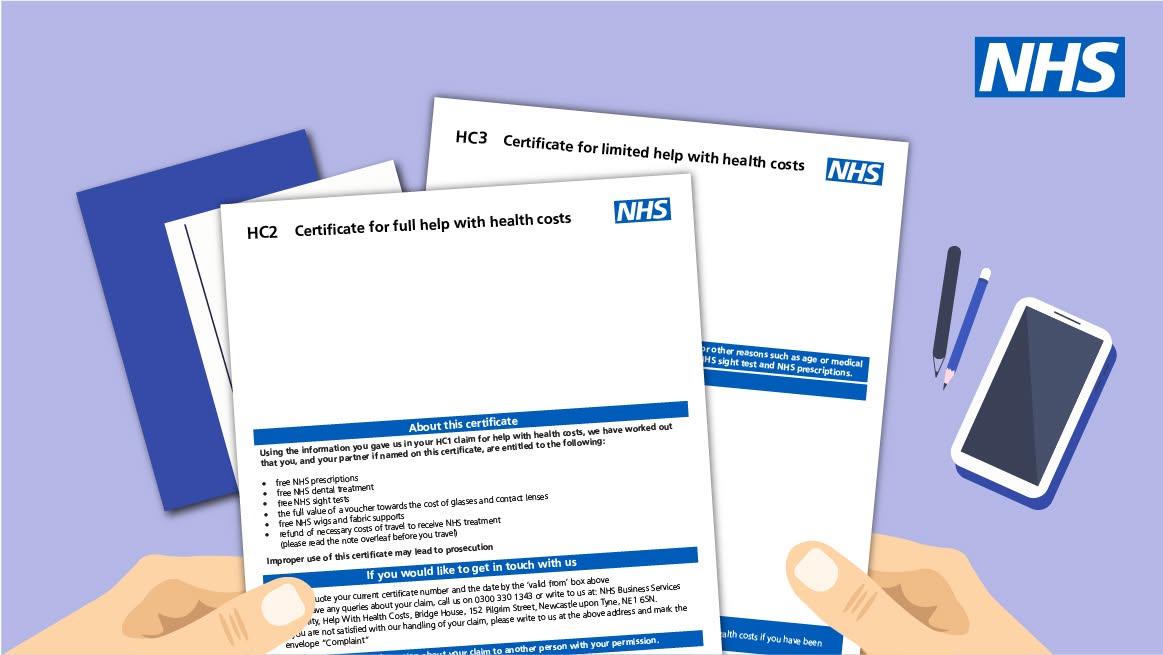
Secondary health care means urgent and emergency care, planned care (some operations or treatment plans), and mental health care. Secondary care is free of charge for asylum seekers who are waiting for a decision on their claim. In Scotland and Wales, asylum seekers who have been refused are entitled to free secondary care. In England, they will only be entitled in certain circumstances, for example if they receive section 4(2) support from the Home Office.
There are some situations where people without immigration status or who have been refused asylum can still access secondary care. This includes:
- When their treatment had already started before the refusal
- If treatment is urgent or immediately necessary
- Maternity care
- Diagnosis and treatment of infectious diseases
- Care for survivors of violence,such as sexual violence or torture or female genital mutilation (FGM) or domestic abuse, where the treatement is directly related to the violence.
Sometimes, you may receive this treatment straight away even though you cannot pay or your immigration status is unclear. However, the NHS could send a bill for some types of treatment. If this happens, you should seek advice on whether the bill can be reduced or cancelled, or paid back slowly. It is important to know if you have been charged for NHS treatment because the charges can impact future immigration applications.
If you are a professional and are unsure whether a child or young person is being treated correctly under the NHS, you can read the Royal College of Paediatrics and Child Health’s Guidance on Rights to access healthcare. They have also produced a helpful flowchart.
Family tracing
Family tracing means trying to find your family members if you are separated from them.
If you are a child in the UK without your parent or carer, and you claim asylum, the Home Office should think about whether it is possible and safe to help find your family.
This should only happen in a way that is safe for you and your family. It should not put anyone in danger.
The Home Office may ask you questions about your family, where they might be, and whether you are still in contact with them. You should be given a chance to say what you think and how you feel about family tracing.
Family tracing does not always mean your family will be found.
Police, racism and hate crime
You have the right to be safe in the UK. If someone hurts you, threatens you, follows you, damages your things, abuses you, or targets you because of who you are, this may be a hate crime.
A hate crime is when someone commits a crime against you because of who you are, or who they think you are. This may be because of your:
- race or ethnicity
- religion or belief
- disability
- sexual orientation
- transgender identity
For example, it may be a hate crime if someone attacks you, threatens you, spits at you, damages your things, or shouts racist, Islamophobic, antisemitic, homophobic, transphobic or disability-related abuse at you. What happened is not your fault. Report a hate crime here.
If you or someone else is in immediate danger, call 999.
If it is not an emergency, you can report it by calling 101, contacting your local police, or reporting online.
You can ask for an interpreter. You can also ask for a trusted adult, support worker, social worker, Personal Adviser, charity worker or friend to help you report what happened.
If you report something to the police, you can ask for:
- a crime reference number
- the name or number of the officer you spoke to
- what will happen next
- support as a victim of crime
If it is safe to do so, keep evidence. This could include screenshots, photos, videos, messages, names of witnesses, dates, times and locations.
Some people feel scared about speaking to the police. This may be because of their immigration status, past experiences with police or authorities, racism, trauma, or fear of not being believed.
If you feel scared, this is understandable. You can speak to a trusted adult or support organisation before reporting. They may be able to help you think about your options and support you to report safely.
It is important to know that there is not always a complete separation between the police and the Home Office. In some situations, police may share information with the Home Office. This is one reason it can help to get support before reporting, especially if you are worried about your immigration status.
You can still get support even if you do not report to the police.
If the police stop you or arrest you
The police can stop and search you in some situations. This means they can ask you to stop and look for things like drugs, weapons, stolen items, or other things connected to a crime.
In most cases, the police must have a real reason to search you. This is called reasonable grounds. They cannot search you only because of your race, religion, nationality, immigration status, language, or the way you look.
Before searching you, the police should explain who they are, why they are searching you, what they are looking for, what law they are using, and how you can get a record of the search.
If you are under 18, tell the police your age. Ask for a record of the search and keep it safe. If you feel unsafe, confused, or upset afterwards, speak to a trusted adult, support worker, social worker, Personal Adviser, charity worker or lawyer.If the police stop you, question you, or arrest you, try to stay calm if you can. Ask what is happening and why.
If you are arrested, remember you have rights. You can ask for:
- free legal advice from a lawyer
- an interpreter if you do not understand English well
- medical help if you feel ill, injured or unsafe
- someone to be told where you are
If you are under 18, the police should contact an appropriate adult. This is an adult whose job is to help you understand what is happening and make sure you are treated fairly. This might be a parent, carer, social worker, foster carer, or another responsible adult.
If you are under 18, you should not be interviewed without an appropriate adult, except in very limited situations. You should not be put in a cell with an adult.
You can ask to speak to a lawyer before answering questions. Asking for a solicitor does not mean you have done something wrong.
If you do not understand what the police are saying, say: “I need an interpreter.”
If you are under 18, you can say: “I am under 18. I need an appropriate adult.”
If you want legal advice, you can say: “I want to speak to a lawyer before I answer questions.”
If you are worried about your immigration status, tell your solicitor. Try to speak to the solicitor before answering questions about things you do not understand or that make you feel worried.
If you are released from the police station, ask for any papers you are given to be explained to you. Keep them safe and show them to your lawyer, social worker, Personal Adviser, support worker or another trusted adult.

Immigration Officers
Immigration officers are not the same as police officers. The police deal with crime and public safety. Immigration officers deal with immigration matters.
Immigration officers may wear uniforms that look similar to police uniforms. Their uniform may say “Immigration Enforcement”. They work for the Home Office. You can ask them who they are, what their job is, and why they want to speak to you. You can also ask to see their ID.
Immigration officers can still have legal powers in some situations. For example, they may be able to ask questions, check someone’s immigration status, arrest or detain someone, search someone, or take documents or other items.
If you do not understand what is happening, you can ask:
“I do not understand. Can you explain what is happening?”
“Are you an immigration officer or a police officer?”
“Can I have an interpreter?”
“Can I speak to a lawyer?”
If you are under 18, tell them your age.
What is reporting?
Some people have to report to the Home Office. This means you must go to appointments with immigration officers, or report in another way, such as by phone or online.
Reporting is usually part of immigration bail. Immigration bail does not always mean you have been in detention. It can also mean the Home Office has given you rules to follow while your immigration case is still happening.
Children under 18 should not usually have to report to the Home Office.
But some separated children may be asked to report between their 17th and 18th birthdays. This should usually be a one-off appointment to explain reporting before you become an adult. If this happens, Children’s Services should know, and an appropriate adult should go with you.
If you are under 18 and you are told to report, tell your social worker and lawyer as soon as possible.
If you are 18 or over, you may be told to report to the Home Office. This can happen if your asylum or immigration case is still going on, if you are appealing, or if the Home Office says you do not have permission to stay.
Your reporting paper may be called a Bail 201. This paper should say where you must report, when you must go, and how often you must go.


This image was created with AI assistance, based on a real Bail 201 form. The final version was checked and edited by Right to Remain.
Reporting can happen in different ways. You may have to:
- go to a reporting centre
- go to a police station
- report by phone
- report online or by text message
Reporting can feel frightening. Some people are detained when they go to report. This does not happen to everyone, but it is important to be prepared.
Before you report, you can:
- tell your lawyer, social worker, Personal Adviser or support worker
- take your Bail 201 and any important Home Office letters
- make sure someone you trust knows where you are going
- plan how you will travel there and back
- ask what to do if you cannot go because you are ill or have another serious reason
If you cannot go to a reporting appointment, do not ignore it. Contact the reporting centre as soon as possible. Explain why you cannot go. If you can, keep evidence, such as a medical letter, appointment letter, or message showing what happened.
If reporting is too difficult because of your health, disability, travel distance, money, college, caring responsibilities or safety, ask for help. A lawyer or trusted adult may be able to help you ask the Home Office to change your reporting conditions.
If you are scared about reporting, speak to someone quickly. You do not have to deal with it alone.
What is immigration detention?
Immigration detention means the Home Office holds someone because of their immigration case.
A person may be held in an Immigration Removal Centre, a short-term holding facility, or sometimes in a prison. Detention is not the same as prison. But it can feel similar because you are not free to leave.
Talking about detention can feel scary. But talking about it does not mean it will happen. It can help you and the people supporting you make a plan and be more prepared.
Children under 18 should not usually be held in immigration detention.
But if the Home Office or local authority is treating you as an adult, or if your age is disputed, you may be at risk of being detained as an adult.
Some people are detained when they go to report to the Home Office. Some people are detained after a refusal, after losing an appeal, or when the Home Office says it may remove them from the UK. This does not happen to everyone, but it is important to be prepared.
If you are worried about detention, speak to your lawyer, social worker, Personal Adviser, support worker or another trusted adult.
You can make a safety plan. A safety plan can include:
- keeping important papers safe
- making sure someone you trust has your Home Office reference number
- saving important phone numbers
- telling your lawyer or trusted adult before you go to report
- planning what should happen with your college, housing, medication or appointments if you are detained
- knowing who should be contacted if you are detained
If you are detained, ask to speak to a lawyer as soon as possible.
You can also ask about immigration bail. Immigration bail means asking to be released from detention. If you are released on bail, you may have rules to follow. These are called bail conditions.
If you are detained and you do not have a lawyer, ask staff how you can get legal advice. You can also ask a trusted person outside detention to help you contact a lawyer or support organisation.
If you are under 18, or you think the Home Office has your age wrong, tell staff, your lawyer, your social worker, or another trusted adult straight away.

Housing, care and support if you are on your own
If you are under 18 and you are in the UK without a parent or another adult who can properly look after you, children’s services in your area should help keep you safe and support you. Children’s services are part of the government, but they are not the same as the Home Office. They may share some information with the Home Office but generally speaking this should be with your consent and with your best interests in mind. They do not decide your asylum claim. The Home Office says separated children should be referred to children’s services as soon as possible and should get care and support while their asylum claim is going on.
What does this mean in different parts of the UK?
The UK means the United Kingdom. It is made up of 4 parts: England, Scotland, Wales and Northern Ireland. The Home Office makes asylum decisions for the whole UK, but the laws about children’s care and support are a bit different in each part of the UK.
You do not need to remember these legal names. But it may still help to recognise them, because you might see them in letters or hear adults use them.
- In England, children are often accommodated under section 20 of the Children Act 1989. If this lasts more than 24 hours, you will usually become a looked-after child (or a ‘child in care’).
- In Wales, the law is a bit different. One of the main laws is the Social Services and Well-being (Wales) Act 2014, including section 76, which is about accommodation for children without parents or who are lost or abandoned.
- In Scotland, separated children are the responsibility of the local authority where they are found and should be accommodated and supported under section 25 of the Children (Scotland) Act 1995.
- In Northern Ireland, similar support is provided by Health and Social Care Trusts under the Children (Northern Ireland) Order 1995, including article 21 on accommodation for children in need.
This section mainly uses the words used in England, like “section 20” and “local authority”, because these are the terms many people will hear most often. If you are in Wales, Scotland or Northern Ireland, the law may have a different name, but you should still get care and support as a child.
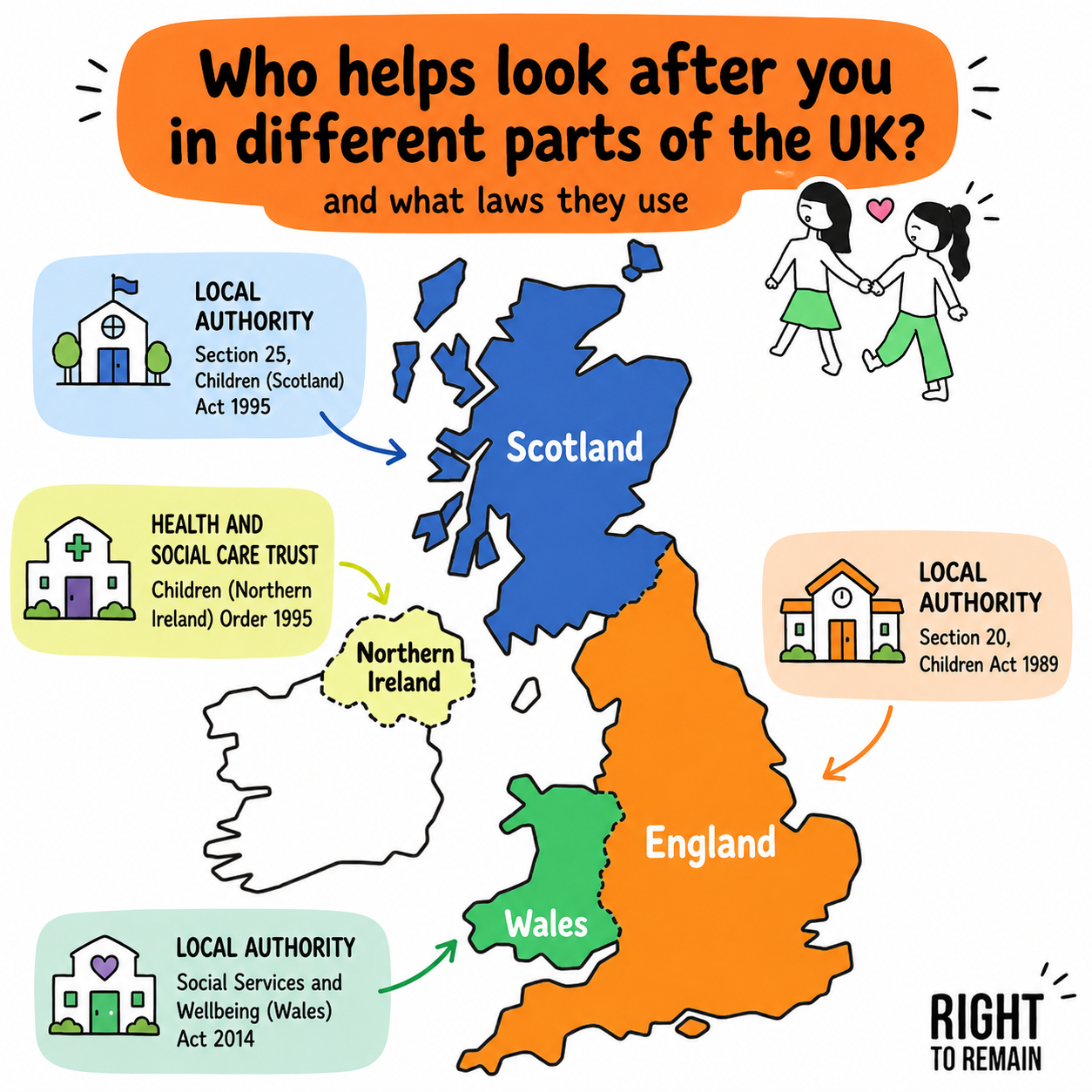
What support should you get?
If children’s services are looking after you, you should usually have:
- a safe place to live
- a social worker
- help with your health and education
- help to get legal advice
- regular reviews of your care
- a chance to say what you want and how you feel
How does your social worker help you and what should they do?
If children’s services are looking after you, you will be given a social worker who works for the Local Authority. Your social worker’s job is to help make sure you are safe, supported, and listened to and make plans with you. Their job is not only to do paperwork. The official guidance for separated children says support should begin as soon as you are referred to the local authority, and it works best when there is a stable, ongoing relationship with your social worker.
This section is based on Department for Education statutory guidance for local authorities in England called Care of unaccompanied migrant children and child victims of modern slavery, published in November 2017. Statutory guidance means official government guidance that professionals are expected to follow. Social Workers who work for the Local Authority should follow it unless there are exceptional reasons not to. It helps explain what local authorities, social workers, personal advisers and their managers should do when supporting young migrants who have been separated from their family.
Your social worker is not your lawyer, but they should understand the basics of the asylum process and help you get proper legal advice. They should think about your whole life, including your safety, health, education, care plan, wellbeing, immigration situation, and plans for becoming an adult. They should also understand that you may have had difficult or traumatic experiences before coming to the UK, during your journey, or after arriving here.
Your social worker should help you with things like:
🏠 Helping make sure you have somewhere safe to live. This means checking that where you are living is safe, suitable for your age, and meeting your individual needs.
📚 Helping with your health and education.
For example, helping you register with a doctor, dentist or mental health support, and helping you go to school, college or English classes.
🧠 Helping you get the right legal advice.
This means helping you find and stay in contact with a suitable lawyer who can advise you about your asylum or immigration case.
💡 Understanding the asylum process.
Your social worker should know the basics of the asylum process. This includes things like the Welfare Interview, Statement of Evidence Form, asylum case review, substantive asylum interview, possible decisions, and appeals. They should also understand how your asylum case may affect the plans for your support and development.
🗣️ Explaining what is happening.
This means helping you understand meetings, plans, decisions and what is happening in your case.
💕 Listening to what you want and how you feel.
Your social worker should take your views seriously and include them in planning. This does not always mean adults will agree to everything you ask for, but they should listen properly and explain their decisions.
🧭 Making sure plans are actually followed.
This means checking that the support you have been promised is really happening, and following up if it is not.
Your social worker should also be aware of trafficking and modern slavery. They should be able to recognise signs that a child may have been trafficked, exploited, forced to work, forced to do something, or controlled by another person. Sometimes a child’s experiences are not obvious straight away, so professionals should stay alert to this.
Your social worker may also be asked to complete a Current Circumstances Form. This is a form where your social worker can give information to the Home Office about your situation before a decision is made on your asylum claim. In some cases, if your asylum claim is refused and the Home Office is thinking about returning you to your country, your social worker may be asked to provide information about your circumstances and the proposed return.
If you need an interpreter
Your social worker should use a professional interpreter. They should not ask your friends, foster carers or keyworkers to interpret important information for you.
If English is not your first language, or you do not feel confident understanding or explaining things in English, you should be helped to get an interpreter when needed. It is okay to ask for one. What matters is that you understand what is happening and can say what you need to say.
You may need an interpreter even if you speak some English, especially in important, emotional or confusing meetings, or when talking about your asylum case, care plan, health, safety or future.
Your social worker should also try to book an interpreter who speaks the right language, dialect or regional variation for you. If you are worried about the interpreter, you should tell your social worker. For example, you might feel unsafe because of the interpreter’s background, especially if there is conflict between different groups, regions, religions or communities. Or you might worry that the interpreter is too close to your community and that your privacy may not be protected.
You can also tell your social worker if you would feel safer or more comfortable speaking through a woman or a man interpreter.
Professionals should check that you understand the interpreter and that the interpreter is interpreting properly. But this does not always happen, so it is important to say something if you do not understand, feel uncomfortable, or think the interpreter is not interpreting correctly. This can feel difficult, especially in a meeting with adults or professionals. But you are not being rude or causing a problem. It is important that you understand what is happening and that your words are interpreted accurately.
A good interpreter should interpret what you say as accurately as possible. They should not add things, remove things, advise you what to say, or speak for you.
If there is a problem, try to say something during the meeting. If you cannot say it in the meeting, tell your social worker as soon as possible afterwards. This could be because you did not understand the interpreter, felt unsafe or uncomfortable, or felt that the interpreter changed what you said.
If you have an interpreter you trust and understand well, tell your social worker. They may be able to book the same interpreter again. If you do not feel comfortable with an interpreter, tell your social worker so this can be recorded and a different interpreter can be used next time.
It can also help to speak in short sentences and pause often. This makes it easier for the interpreter to interpret accurately and for everyone to understand each other.
What meetings should you have?
If you are being looked after, you should have a care plan. This is a written plan about your needs and the support you should get. It should cover things like where you live, your health, education, emotional wellbeing, identity, family and social relationships, and any support you need as an separated child. Your care plan is not just one meeting. It should be kept up to date. The visits and meetings below should help check that your plan is right and that the support is really happening.
You should also have review meetings to check how things are going and whether anything needs to change. In England, the first review should happen within 20 working days (around 4 weeks) after you become looked after. The second review should happen within 3 months of the first review. After that, reviews should happen at least every 6 months.
These review meetings are chaired by an Independent Reviewing Officer (IRO). The IRO is not your social worker. Their job is to check whether Children’s Services is making proper plans for you, listening to you, and doing what it is supposed to do.
| Meeting or visit | When? | Who is there? | What should happen? |
| 🤝 Visit from your social worker | Usually within 1 week of moving somewhere new. It is often expected that you will be visited on the day you move. After that, usually at least every 6 weeks while you are under 18. | You and your social worker. | Your social worker should check that you are safe, see how things are going, and talk with you about any worries or support you need. |
| 🏠 Planning your new placement | Usually before you move. If this was not possible, it should usually happen within 5 working days after you move. Many local authorities arrange a Placement Planning Meeting to do this. | You, where appropriate, your social worker, your foster carer or residential key worker, and sometimes other professionals. | Adults should make sure your new home is safe and right for you. They should agree what support you need day to day. This should include things like food, money, health, education, travel, contact with important people, house rules, and what to do if there is a problem. |
| 1️⃣ First review meeting | Within 20 working days after you become looked after. | You, your social worker, and an Independent Reviewing Officer, or IRO. Other people supporting you may also be there. | Adults should check if your care plan is right and if the support is actually happening. The IRO should check that the local authority is listening to you and doing what it should. |
| 2️⃣ Second review meeting | Within 3 months of the first review. | Usually the same people. | Adults should check what has changed, what is working, and what still needs to happen. |
| 🗓️ Later review meetings | At least every 6 months after that. | Usually the same people. | Adults should keep checking that you are safe, supported, and getting the help you need. |
| 🌱 Pathway Plan review | If you are 16 or over, or if you are a care leaver, your Pathway Plan should be reviewed at least every 6 months. | You, your Personal Adviser and/or social worker, and other people who help support you. This might include a key worker, advocate, foster carer, college worker or someone else you trust. | Adults should review your plan for adult life. This can include where you will live, money, education or training, health, immigration issues, support, and your future goals. |
Action Section: Taking part in meetings and asking questions
Self-advocacy means learning how to speak up for yourself and take part in decisions about your life. It is an important skill for all aspects of life.It can include:
- asking questions when you do not understand
- saying what you think and feel
- speaking up for your rights and the things you believe in
- making choices about your life
- deciding what you want and planning how to get there
- making sure people listen to you and take you seriously
Self-advocacy does not mean doing everything by yourself. It means knowing that your voice matters, and that you have the right to understand what is happening and be involved in decisions about your future.
Questions you can ask in meetings
You do not need to ask all of these, but these are the kinds of questions that can help you to understand what is happening.
- What is this meeting about?
- Can you explain that in simpler words?
- What is the plan for me?
- What will happen next?
- Who is responsible for helping me with this?
- When will this happen?
- Do I have a choice?
- What are my options?
- Can I have time to think before I decide?
- Is there anything I need to do now?
- Are there any deadlines?
- Who can I contact if I have a problem?
- What should I do if I feel worried or unsafe?
- Can I have an interpreter or trusted adult with me?
- Can you write down what has been agreed?
- Can I have a copy of the notes or decisions?
Some useful sentences:
I do not fully understand. Please can you explain what is happening, what I need to do, and who is helping me?
I am finding this difficult, but I want to understand and be involved. Please can we go slowly?
I do not agree with this decision. Please can you explain why this has been decided?
I need help with this. Who is responsible for helping me?
If you feel upset or angry
These meetings can be difficult and upsetting. It is important to try to say clearly what you need and how you are feeling. It can also help to stay respectful. This means trying not to insult, threaten or blame people in the meeting, even if you are upset or disagree with what is happening.
If you feel too upset to speak, you can ask for a break, ask someone you trust to help you speak, or write down what you want to say.
Staying calm can help a meeting go better, but it is not your fault if the system is confusing or if adults do not listen properly. You still have the right to ask questions, disagree, and say what you need.

Where might you live?
If Children’s Services are looking after you, you may live in different kinds of accommodation. This should depend on your age, your needs, and what will help keep you safe and supported.
You might live:
- With a foster carer. This means you live with an adult, or a family, who looks after children in care in their home.
- In a children’s home. This is a home where children live together with staff there to care for them.
- In supported accommodation. You may also hear this called semi-independent living. This is usually for some older children aged 16 or 17 who are ready for more independence, but still need support. The government says supported accommodation is for young people aged 16 or 17 who need help to build independence and prepare for adult life while still being kept safe.
If you are under 16, you should not be placed in supported accommodation or semi-independent accommodation in England. The government banned this for looked-after children under 16.
If you are 16 or 17, supported accommodation may be used in some cases, but it is not right for everyone. The government says Children’s Services should think carefully about your individual needs and should only place you somewhere that is the most appropriate place for you and will keep you safe.
The rules about money, bills and daily living costs can be different in different placements. For example, in some accommodation, food, heating, electricity or other bills may be included. In other placements, especially supported accommodation, you may be expected to use some of your allowance to pay for things yourself. This should be explained to you and written down in your care plan, placement plan or pathway plan. You should not be left unsure about how you are meant to pay for food, travel, clothes, phone credit, toiletries, school or college costs, or other important things.
As an adult (and sometimes as a young person), you will need to be able to budget. This means you should be able to understand how much money you will get each month and what you will need to spend this on. To practice, it can be helpful to keep a record or plan for your monthly or weekly spending so that you know how much money you need for essentials like food or bills, and how much money is left for you to spend on other things.
What should matter when adults decide where you live?
Adults who work for Children’s Services should think about things like:
- how safe you will be
- how much support you need day to day
- your age and how independent you are
- whether the place can meet your needs
- whether you will have help with things like school, health and daily life.
Different Local Authorities may have different policies about money and allowances. This means that young people in similar situations, or even living in the same accommodation, may sometimes receive different amounts of financial support because they are looked after by different Local Authorities.
What if you are moved to another area?
Sometimes children’s services may decide that you should live outside the area where you first arrived or where your social worker’s office is. People sometimes call this an out of area placement. This just means you are living in a different town, city or area from the children’s services team that is looking after you. In England, the Government guidance says the Local Authority must place a child in the most appropriate place available to meet their needs, and special rules apply if the child is placed outside the council’s area.
If this happens, adults should not just move you somewhere and leave it at that. The Local Authority that is looking after you should think carefully about whether the place is right for you. For example, it should think about whether you will be able to get health care, school support, and other help you need in the new area. If the move is far away, the council should also speak to the local authority in the new area before the decision is made. Your Independent Reviewing Officer (IRO) should be asked about the move, and your wishes and feelings should be taken into account.
Even if you are living outside the area, you should still have your social worker, your care plan, and your review meetings. Your social worker should still visit you regularly. In England, visits should usually happen within 1 week of moving somewhere new and then usually at least every 6 weeks, unless one of the limited exceptions applies.
A simple way to think about it is:
- moving you far away should not happen without planning
- your views should still matter
- you should still get the same care and support.
What is the National Transfer Scheme?
The National Transfer Scheme (NTS) is a system for moving some separated children from one local authority to another. The idea is to share responsibility more fairly across the UK, so that one area does not have to support too many children on its own. The Home Office says the child’s best interests must always be a primary consideration in the scheme and transfer process.
If you first arrive in one area, that local authority may ask for you to be transferred to another area through the NTS. Since 15 February 2022, all local authorities in the UK with children’s services have been required to take part in the scheme. The current protocol (a set of guidelines and procedures to explain how something should be done) says only local authorities supporting 0.1% or more of separated children compared with their general child population can refer a child into the NTS, and authorities below that level can be directed to receive children.
Not every young person is eligible for the NTS. The current protocol says the scheme is for separated children who meet the Immigration Rules definition. It also says that separated children who have not claimed asylum in the UK are not eligible, and children who arrive within 13 weeks of their 18th birthday are also not normally eligible for referral into the scheme.
If a child is referred into the NTS, the transfer should usually be completed within 10 working days (2 weeks) from the date of referral. The Home Office says this is generally in children’s best interests, because transfers should happen as quickly as possible once the child has been referred into the scheme.
A simple way to think about the NTS is:
- you may first arrive in one area
- you may then be moved to a different area
- the idea is to share responsibility more fairly
- adults should still think about what is safest and best for you.

What happens when you are living in care and turn 18?
When you turn 18, Children’s Services should not suddenly stop helping you. You may be able to get care leaver support. This is support from the local authority after you turn 18 years old. Children’s Services is part of the local authority. Care leaver support also comes from the local authority.
You may get care leaver support if you were in care for 13 weeks or more before your 18th birthday.
This support can include:
- A Personal Adviser
- a Pathway Plan (a written plan about where you will live, money, education, health and your future))
- help with housing
- help with money
- help with education or training
- help to plan your future
The support is different for each young person. It can also be different in each local area.
Before you turn 18, your Social Worker is usually your main worker because you are still a child in care. After you turn 18, you will usually move to support from a Personal Adviser. A Personal Adviser is the worker who helps you plan adult life after care. They should help you with your Pathway Plan, housing, money, education, health, immigration issues and future plans.
You can read the official Home Office guidance here.
What happens when you are a care leaver and turn 21?
If you are a care leaver, turning 21 does not always mean support has to stop.
You can ask local authority for support from a Personal Adviser until your 25th birthday. If they refuse, ask for the decision in writing. A Personal Adviser can help you think about your future, your housing, money, education, health, immigration case and other support you may need.
This support does not always include housing or money. It depends on your situation. But your Personal Adviser can help you make a plan, ask questions, contact services, and understand what support may still be available.
If you are in education or training, tell the local authority. This can be important when they decide what support you should get. Tell the local authority what course you are doing, when it started, and when it will finish. This could include school, college, university, ESOL, an apprenticeship, or another training course.
You can give the local authority letters from your school, college, university, training provider, lawyer, doctor, support worker, or anyone else who can explain your situation.
If you are worried your support will stop, ask for the decision in writing. You can also ask for a copy of your pathway plan and any assessment the local authority has done.
What a is ‘human rights assessment‘?
If local authority says it may stop or refuse your support because of your immigration status, it may need to do a human rights assessment.
A human rights assessment is a formal process. The local authority looks at your situation before deciding whether support can stop.
The local authority should look at whether stopping support would break your human rights. Your human rights include your right to be safe from very serious harm. They also include your right to private and family life.
When doing a human rights assessment, the local authority should look at your full situation. This can include:
- your immigration case
- your health
- your safety
- where you will live
- how you will get money
- your family or support network
- your education or training
- whether there are legal, practical or medical reasons you cannot return to another country
Legal reasons could include waiting for a Home Office decision, an appeal, a court hearing, or legal advice about your case.
Practical reasons could include not having travel documents, not being able to travel safely, or not being able to get support in the country the local authority says you could go to.
Medical reasons could include serious physical or mental health problems, or medical evidence saying it is not safe for you to travel.
If you are in education or training, tell the local authority. Give them evidence if you can. This could be a letter from your school, college, university, apprenticeship provider, ESOL teacher, or training provider.
You should also tell the local authority about anything that makes you unsafe, unable to support yourself, or at risk of homelessness.
You can give them:
- Home Office letters
- court or tribunal letters
- letters from your lawyer
- medical evidence
- college or school letters
- letters from support workers or charities
- information about your family or support network
- anything else that helps explain your situation
Ask for the decision in writing. Ask for a copy of the human rights assessment. If you do not understand the decision, ask someone you trust to help you read it.
If your support is going to stop and you do not agree, try to get help quickly. Speak to a lawyer if you can. You can also speak to a social worker, Personal Adviser, support worker, charity worker, teacher, youth worker or another trusted adult.
What happens when you are a care leaver and turn 25?
If you are a care leaver, support from a Personal Adviser can continue until your 25th birthday if you ask for it.
When you turn 25, this type of care leaver support usually ends. This can feel worrying, especially if you still need help with housing, money, education, health or your immigration case.
Before you turn 25, ask your Personal Adviser to help you make a plan. This should include:
- where you will live
- how you will get money
- what will happen with education or training
- what health support you need
- what is happening in your immigration case
- who you can contact if you need help later
Ask for this plan in writing. You can also ask for copies of important documents before your leaving care support ends.
Turning 25 does not mean you can never get help again. Depending on your situation, you may be able to get help from other services. This could include housing services, adult social care, health services, education services, charities, community organisations, asylum support, or immigration advice.
If you are worried about what will happen when you turn 25, ask for help early. Do not wait until the last moment if you can avoid it.
Asylum support (money and housing from the Home Office for over 18s)
If you are over 18, or you are a child living with your family, and you have claimed asylum, you may be able to get asylum support from the Home Office.
Asylum support is for people who do not have anywhere to live, or who have somewhere to live but do not have enough money for food, travel, clothes and other basic needs.
Depending on your situation, asylum support can include:
- somewhere to live
- money for basic living costs
- both housing and money
Asylum support is usually provided while the Home Office is considering your asylum claim. This means while you are waiting for interviews, giving information to the Home Office, or waiting for a decision.
If you are a separated child and children’s services are looking after you, your support should usually come from the local authority, not from asylum support. The local authority is responsible for your care, accommodation and support while you are a looked-after child.
If there is a dispute about your age, things can become more complicated. For example, if the Home Office or local authority decides you are over 18, you may be told to apply for asylum support instead of getting support from children’s services.
When you turn 18, your support may also change. Some young people continue to get support from children’s services as care leavers. Other young people may be moved onto asylum support from the Home Office, depending on their situation and immigration case.
What to do if you are unhappy with your care or support
If you are unhappy with your care, support, accommodation, social worker, Personal Adviser, pathway plan, or a decision made by the local authority, you can ask for help.
You can start by asking:
- Can you explain this decision to me?
- Can I have the decision in writing?
- Can I have a copy of my care plan or pathway plan?
- Who can help me understand this?
- Can I speak to an advocate?
- How do I make a complaint?
How can an advocate help you?
An advocate is someone independent who can help you understand your rights and speak up about what you need.
An advocate can help you:
- understand decisions about your care or support
- say what you want and how you feel
- prepare for meetings
- ask questions
- make a complaint
- challenge decisions if something seems wrong
You can ask your social worker, Personal Adviser, Independent Reviewing Officer, support worker or another trusted adult how to get an advocate.
If you are unhappy with your care or support, you can also ask how to make a complaint to the local authority. Making a complaint should not affect your asylum claim.
If the problem is urgent, for example if you have nowhere safe to stay, your support is stopping, or you are at risk of harm, tell a trusted adult quickly. You may need urgent help from a lawyer, advocate or support organisation.

Immigration status, staying longer, settlement and citizenship
If the Home Office gives you permission to stay in the UK, this is an important step. It may feel like a huge relief. It can also bring new questions about what happens next.
The type of permission you get matters. It can affect how long you can stay, whether you need to apply again in the future, when you may be able to apply for settlement, and whether you may later be able to apply for British citizenship.
Your Home Office decision letter should say what type of permission you have been given and when it ends. Keep this letter safe. If you have an eVisa, make sure you know how to access it and check the details.
If your permission to stay has an end date, it is very important to get legal advice before it runs out. Try to ask for advice at least 3 months before your permission ends. This gives you and your lawyer more time to understand your options and prepare any application.
The rules about immigration status, settlement and citizenship can change. This means you should not rely only on old advice, old letters, or what happened to someone else. Before making an application, try to speak to a lawyer, support worker, social worker, personal adviser or another trusted adult who can help you check the current rules.
Further Applications and Settlement
Some types of permission to stay are temporary. This means they last for a set amount of time, and you may need to apply again before they end.
An application to stay longer is sometimes called an extension application. Settlement is different. Settlement means permission to live in the UK without a time limit. You may also hear this called indefinite leave to remain, or ILR.
Whether you can apply to extend your status or apply for settlement depends on the type of permission you have and the rules that apply to you. Your Home Office decision letter should explain what you have been granted and how long it lasts.
IMPORTANT:
- Keep a note of the date your permission ends.
- Try to get legal advice at least 3 months before that date
- Do not wait until the last minute
The law in this area changes often. There have recently been changes and proposals that may affect how long some people are given permission to stay, and when they may be able to apply for settlement. We will update the Toolkit when there are important changes.
Other types of status and applications
Not everyone gets refugee status or humanitarian protection. Sometimes the Home Office gives someone permission to stay for another reason. This might be because of their family life, private life, health, or another serious reason.
There are different types of immigration applications. Some are made using online forms. Some people can ask for a fee waiver, which means asking not to pay the Home Office fee because they cannot afford it.
The rules change often, and the right option will depend on your own situation. Do not rely only on what happened to someone else. Speak to a lawyer, support worker, social worker, personal adviser or another trusted adult before making an application. We explain some of the different options below:
1. Family life
This means asking to stay in the UK because of your family relationships. For example, this could be about a child, parent, partner, or another close family relationship in the UK. The rules are strict, so you should get legal advice.
2. Private life
Private life means the life you have built in the UK. This can include how long you have lived here, your age, your education, your friendships, your community, and what difficulties you may face if you had to leave.
Some people may be able to apply to stay in the UK because of their private life. This may be relevant if:
- you are under 18 and have lived in the UK for at least 7 years
- you are 18 or over but under 25 and have lived in the UK for more than half your life
- you are 18 or over and would face very serious difficulties living in the country you would have to go to
- you have lived in the UK for 20 years
These rules are complicated. This list does not mean you will definitely qualify. It is here so you know this is something to ask about if it might apply to you.
If you think private life might be relevant to your situation, speak to a lawyer, support worker, social worker, personal adviser or another trusted adult.
3. Health or medical reasons
Sometimes people ask to stay in the UK because of serious physical or mental health problems. These cases can be very difficult and need strong evidence, such as medical letters or reports.
If you have serious health needs, speak to a lawyer, doctor, social worker, personal adviser or support worker.
4. Human rights
You may hear people talk about human rights. This means rights that everyone has, including the right to be safe from very serious harm and the right to private and family life.
Human rights can be part of different immigration applications. A lawyer can help you understand whether this matters in your case.
British Citizenship
British citizenship means becoming legally recognised as British. It can give people more security, including the right to a British passport.
Citizenship does not happen automatically for most people. You usually need to apply. The rules are different depending on your age, where you were born, your immigration status, and your life in the UK.
If you are under 18, applying for British citizenship is usually called registration.
If you are 18 or over, applying for British citizenship is usually called naturalisation.
Citizenship applications can be complicated and expensive. Some people may be able to apply, but others may need to wait until they have settlement or another type of status first. There may also be rules about how long you have lived in the UK, how much time you have spent outside the UK, English language, the Life in the UK test, and “good character”.
Good character means the Home Office looks at things like criminal convictions, immigration history, false documents, debt, tax, or other issues. This can feel frightening, especially if you came to the UK without a visa, travelled by boat or lorry, used false documents, or overstayed.
If this happened when you were a child, or because you were being controlled, trafficked, forced, or had no safe choice, this is important. You should tell a lawyer or trusted adult. Do not assume this means you can never become British.
Before applying for citizenship, try to get legal advice if you can. If you cannot get legal advice straight away, speak to a social worker, Personal Adviser, support worker, charity worker or another trusted adult. They may not be able to give legal advice themselves, but they may be able to help you find the right kind of advice or support.
It is better to check first than to apply without understanding the risks.
An important message for professionals: Do not assume a child or young person knows whether they are British, or knows that they may be able to apply for British citizenship. Nationality and immigration status should be checked early and included in care planning, because some routes to citizenship are harder after 18. We recommend you review GMIAU’s resources here.
Voluntary return
Voluntary return means asking for help from the Home Office to leave the UK and return to another country, usually your country of origin.
This is a very serious decision. It can affect your asylum claim, your immigration case, and whether you may be able to apply to stay in the UK in the future.
This guide is not saying you should return. But we think it is important that you know this option exists, especially if you are already thinking about it yourself.
If you are thinking about returning, do not make the decision alone. Speak to a lawyer first if you can. You can also speak to your social worker, personal adviser, support worker, therapist, doctor, or another trusted adult.
You should have time to understand your options, the risks, and what this decision could mean for you.